Key Points
- California lawmakers have passed AB 762, but Governor Gavin Newsom must still sign the bill before it becomes law.
- If signed, manufacturing and importation of covered disposable nicotine vapes would be prohibited from January 1, 2027.
- Sales of covered disposable vape products would be prohibited beginning January 1, 2028, with violations potentially carrying a $500 fine.
- The legislation targets single-use, battery-embedded tobacco and nicotine vaping products, while cannabis vaping devices are exempt.
- Devices remaining legal under the new framework would need rechargeable batteries and either refillable systems or replaceable pods.
- Supporters cite estimates that about 500,000 disposable vapes are discarded every day in the U.S., while retail industry representatives argue much of California’s disposable market is already illicit.
2Firsts
August 28, 2026
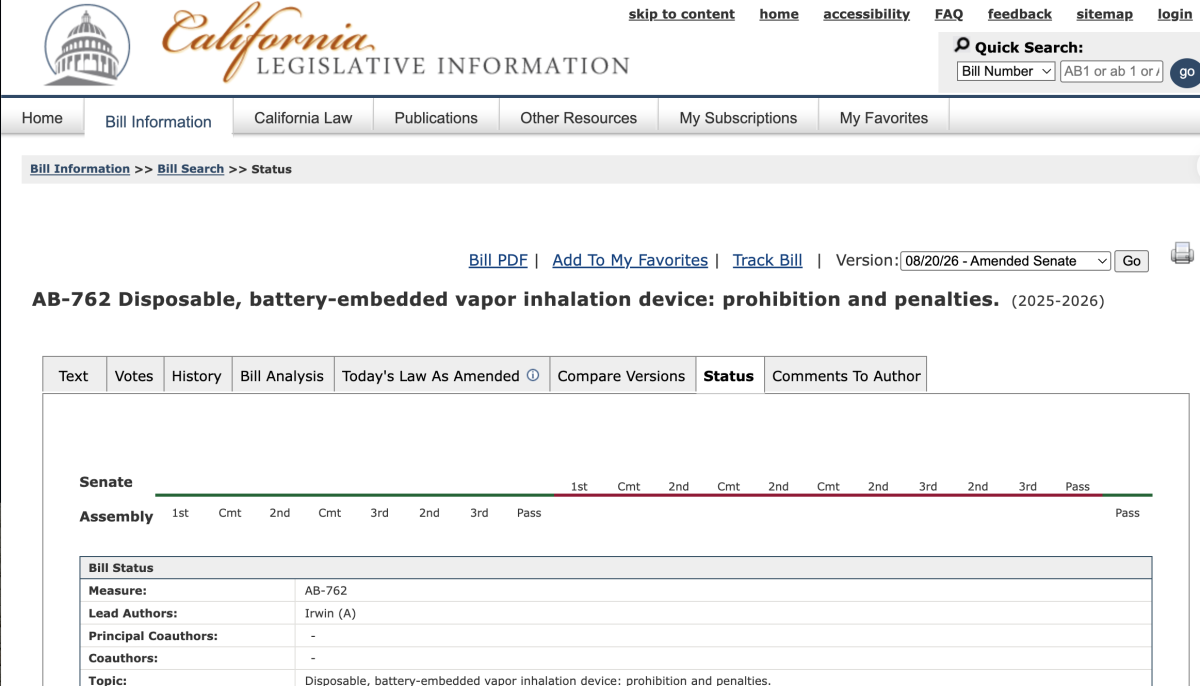
According to CBS Los Angeles on August 27, 2026, California lawmakers have passed Assembly Bill 762, legislation that would phase out disposable, battery-embedded nicotine vapes. If Governor Gavin Newsom signs the measure, California would prohibit manufacturing and importing covered disposable vapes beginning January 1, 2027, followed by a statewide sales ban beginning January 1, 2028.
AB 762 was introduced by Assemblymember Jacqui Irwin. Unlike earlier California vape restrictions centered primarily on flavors and youth use, the legislation is largely framed around electronic waste, lithium-ion battery fires and environmental pollution.
Ban Would Roll Out in Two Stages
The legislation provides a transition period rather than immediately removing disposable vapes from stores.
Beginning January 1, 2027, manufacturing and importation of covered disposable vaping devices would be prohibited in California.
The restrictions would expand to retail sales on January 1, 2028.
Violators could face a $500 fine.
The bill targets single-use, battery-embedded electronic cigarettes containing tobacco or nicotine products. Cannabis vaping devices are exempt.
Under the proposed framework, a vaping device would generally need to use a rechargeable battery and either be refillable or use replaceable pods to remain eligible for legal sale.
If enacted, the measure would therefore remove the disposable format from California’s legal nicotine vape market while leaving reusable open-system and pod-based products as remaining device categories.
An Estimated 500,000 Disposable Vapes Are Discarded Daily
Electronic waste is one of the central arguments behind AB 762.
Supporters cited a 2024 CDC Foundation study estimating that Americans discard about 500,000 disposable vapes every day.
Disposable devices contain lithium-ion batteries, copper and residual nicotine. Supporters argue that when these products are placed in household trash or recycling streams, batteries can be crushed or punctured in collection trucks and waste facilities, creating fire risks.
Groups supporting the measure, including CALPIRG, have also argued that materials such as lithium and copper are consumed in products designed for relatively short lifespans, adding to waste-management costs.
Irwin said she hoped the governor would recognize both the environmental risks and the costs communities and ratepayers bear in managing discarded devices.
AB 762 Would Add Device Design to California’s Compliance Requirements
For the vape industry, the implications extend beyond waste regulation.
California already maintains strict restrictions on flavored tobacco products and operates an Unflavored Tobacco List covering regulated tobacco, nicotine and electronic delivery products.
AB 762 would add another layer by restricting products according to their device architecture.
That means a product could satisfy California’s flavor-related requirements but still become ineligible for sale if it uses a non-reusable, battery-embedded disposable design.
For manufacturers, the change could affect:
● hardware architecture;
● rechargeable battery design;
● refillable or replaceable-pod systems;
● California-specific SKU planning;
● distributor and retailer inventory transitions.
Retailers would also need to manage remaining disposable inventory ahead of the January 2028 sales deadline and shift their assortments toward compliant reusable products.
Retail Industry Questions Impact on Illicit Disposable Market
The proposal has also drawn opposition from retail industry representatives.
During a California Senate committee hearing, the California Fuels and Convenience Alliance said disposable vape waste and battery fires were legitimate concerns but argued that much of California’s disposable vape market was already illegal under existing rules.
The group said only a limited number of disposable products were eligible for lawful sale, raising concerns that AB 762 could eliminate compliant, regulated and taxed products without necessarily removing illicit disposables from the market.
Irwin responded that consumers are addicted to nicotine rather than the specific device delivering it, arguing that removing disposable hardware could substantially reduce the number of lithium batteries entering the waste stream. She also acknowledged that the legislation would not solve the entire problem.
Newsom’s Signature Is the Next Key Step
AB 762 has passed both chambers of the California Legislature, but the measure still requires Governor Gavin Newsom’s signature.
The development therefore should not yet be described as an implemented California disposable vape ban.
If signed, manufacturers and importers would face the first compliance deadline on January 1, 2027, while retailers would have an additional year before the sales prohibition begins on January 1, 2028.
For vape manufacturers, the potential phaseout of disposable devices in one of the largest U.S. markets could increase the strategic importance of rechargeable, reusable and pod-based products in California’s compliant vape segment.
Follow 2Firsts for timely updates on global tobacco and nicotine regulations, product compliance and market restructuring.
Cover Image : California Legislative
Disclaimer
This article is provided solely for professional research, industry discussion, and informational purposes. Any references to brands, companies, products, technologies, or policies are made for factual reporting and analytical purposes only, and do not constitute endorsement, recommendation, promotion, or advertising by 2Firsts.
Nicotine-containing products, including but not limited to cigarettes, e-cigarettes, heated tobacco products, and nicotine pouches, carry significant health risks. Readers are responsible for complying with all applicable laws and regulations in their respective jurisdictions, including age restrictions and access limitations.
The information contained in this article should not be regarded as investment, legal, medical, regulatory, or commercial advice. While 2Firsts strives to ensure the accuracy and reliability of its content, it does not assume liability for any direct or indirect loss arising from errors, omissions, inaccuracies, or reliance on the information contained herein.
This article is not intended for individuals below the legal age for accessing tobacco or nicotine-related information in their jurisdiction.
Copyright Notice
This article is either original content produced by 2Firsts or content reproduced, translated, summarized, or adapted from third-party sources with attribution where applicable. The intellectual property rights of the original content remain with 2Firsts or the respective original rights holders.
No individual or organization may copy, reproduce, distribute, republish, modify, translate, or otherwise use this content without prior authorization. Any unauthorized use may result in legal action.
For copyright-related inquiries, corrections, or removal requests, please contact: info@2firsts.com.
AI-Assisted Translation and Editing Notice
Portions of this article may have been translated, edited, or reviewed with the assistance of artificial intelligence tools to improve efficiency and readability. Due to the limitations of AI-assisted translation and editing, discrepancies, omissions, or inaccuracies may exist when compared with the original source.
Where applicable, readers are advised to refer to the original source for the most complete and accurate information. If you identify any errors or believe that any content infringes upon your rights, please contact us at info@2firsts.com, and we will review and address the matter promptly.