Canadian Conservative MP’s Promotion of Zyn Draws Opposition From Local Nicotine Pouch Brand

Mar.18
Canadian Conservative MP’s Promotion of Zyn Draws Opposition From Local Nicotine Pouch Brand
Conservative MP Jamil Jivani’s public support for nicotine pouch brand Zyn has drawn attention on Canadian university campuses, but Imperial Tobacco, which makes the only similar Canadian product, Zonnic, said it does not support the promotion of an unauthorized competitor.

Key Takeaways


  • Conservative MP Jamil Jivani has publicly supported nicotine pouch product Zyn.
  • Imperial Tobacco said Zyn is not authorized for sale in Canada and that promoting it gives visibility to an “illegal” competitor.
  • Imperial Tobacco said Zonnic is currently the only nicotine pouch widely available for sale in pharmacies in Canada.
  • Adult Canadians are allowed to import nicotine pouches containing no more than four milligrams of nicotine for personal use.
  • Zonnic was approved by Health Canada in July 2023 as a nicotine replacement therapy smoking-cessation aid.


 2Firsts, March 18, 2026


According to National Post, Conservative MP Jamil Jivani’s public support for nicotine product Zyn has gained attention on university campuses, but the maker of Canada’s only similar domestic product, Zonnic, said it does not support the promotion of the grey-market competitor.


Jamil Jivani and other Conservative politicians are frequently photographed holding imported canisters of Zyn, which are not authorized for sale in Canada. Imperial Tobacco said that giving visibility to Zyn promotes an “illegal” and unauthorized competitor.


Imperial Tobacco vice-president Eric Gagnon wrote in an email to National Post that the increasing visibility of illegal nicotine pouches in Canada highlights how widespread and normalized the illicit market has become.


He said Zonnic is currently the only nicotine pouch widely available for sale in pharmacies in Canada and that these products are subject to strict controls on nicotine strength, flavour and point of sale, including pharmacy oversight.


However, adult Canadian consumers are not prohibited from importing low-dosage nicotine pouches from other countries for personal use. Products containing no more than four milligrams of nicotine are regulated as a natural health product. Many Zyn products fall under that threshold and are therefore legal for use in Canada.


Zonnic, which is made and distributed exclusively in Canada, was approved by Health Canada in July 2023 for sale as a nicotine replacement therapy smoking-cessation aid. After initially being widely available in multiple flavours, an August 2024 ministerial order restricted Zonnic sales to behind the counter at pharmacies. Health Canada also required that only mint flavours of Zonnic be allowed and capped nicotine dosage at four milligrams.


Zyn, a Swedish nicotine pouch brand marketed by Philip Morris International, is not licensed for sale in Canada, despite holding roughly 40% of global market share and about three-quarters of U.S. sales.


Conservatives had made it a campaign promise last year to remove the pharmacy-only restriction on nicotine pouch sales. The 38-year-old Jamil Jivani has since become a party voice on the issue, frequently referencing Zyn in social media posts and saying Canadians should have the freedom to buy the pouches to quit smoking. His slogan is “Free the Zyn.”


Zyn has appeared during Jivani’s ongoing “Restore the North” university campus tour across Canada. During a recent stop at the University of British Columbia’s Vancouver campus, he posed for photos with university-aged young men holding Zyn canisters and signed some of the canisters brought by attendees.


Eric Gagnon said promoting Zyn threatens public health by blurring the distinction between Zonnic and imported alternatives. He said it is important that there be a clear distinction between regulated cessation products and illegal products currently on the market, and that conflating the two risks undermining public health objectives and creating confusion among the public, particularly when such products are easily accessible to young people without age verification.


David Clement, North American Affairs Manager with the Consumer Choice Center, said that from a public health standpoint, the optimal policy would be to make a wide variety of nicotine pouches available to Canadian consumers. He said that the more legal products there are on the market, the more options smokers have available to quit.


Image source: National Post.


We welcome news tips, article submissions, interview requests, or comments on this piece.

Please contact us at info@2firsts.com, or reach out to Alan Zhao, CEO of 2Firsts, on LinkedIn


Notice

1.  This article is intended solely for professional research purposes related to industry, technology, and policy. Any references to brands or products are made purely for objective description and do not constitute any form of endorsement, recommendation, or promotion by 2Firsts.

2.  The use of nicotine-containing products — including, but not limited to, cigarettes, e-cigarettes, nicotine pouchand heated tobacco products — carries significant health risks. Users are responsible for complying with all applicable laws and regulations in their respective jurisdictions.

3.  This article is not intended to serve as the basis for any investment decisions or financial advice. 2Firsts assumes no direct or indirect liability for any inaccuracies or errors in the content.

4.  Access to this article is strictly prohibited for individuals below the legal age in their jurisdiction.


Copyright


This article is either an original work created by 2Firsts or a reproduction from third-party sources with proper attribution. All copyrights and usage rights belong to 2Firsts or the original content provider. Unauthorized reproduction, distribution, or any other form of unauthorized use by any individual or organization is strictly prohibited. Violators will be held legally accountable.

For copyright-related inquiries, please contact: info@2firsts.com


AI Assistance Disclaimer


This article may have been enhanced using AI tools to improve translation and editorial efficiency. However, due to technical limitations, inaccuracies may occur. Readers are encouraged to refer to the cited sources for the most accurate information.

We welcome any corrections or feedback. Please contact us at: info@2firsts.com

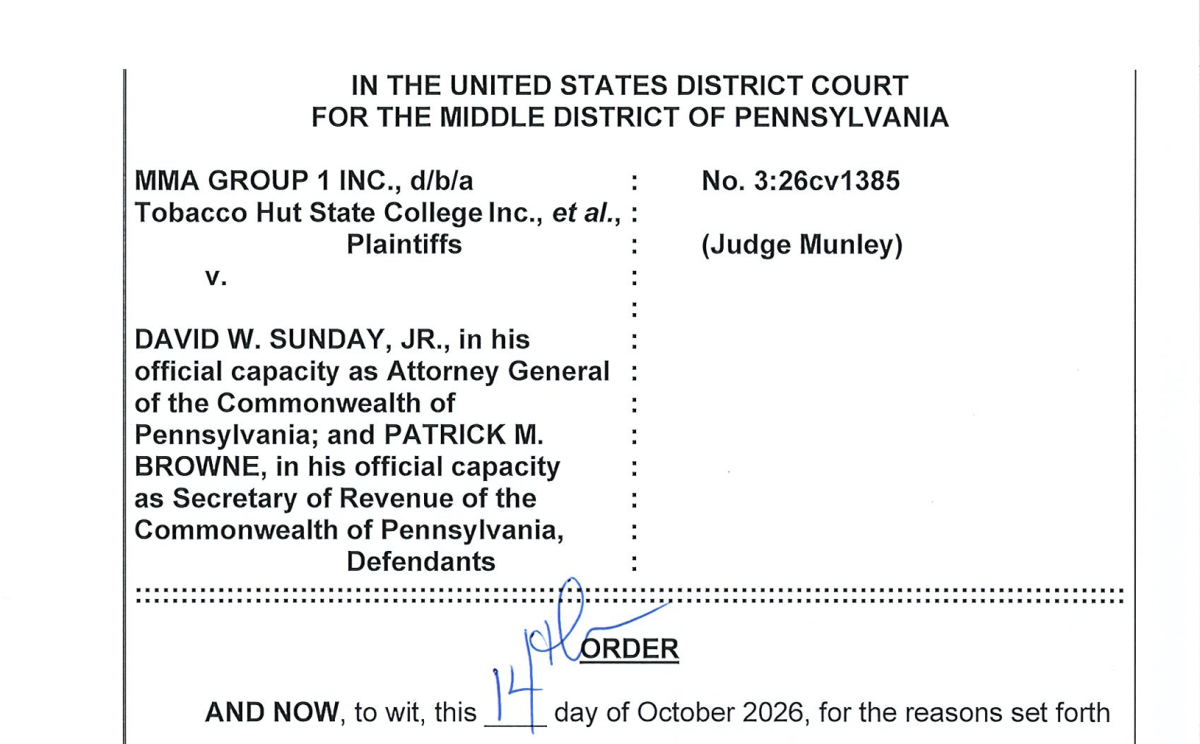
Pennsylvania Vape Directory Law Survives Court Challenge From Nova Distro and Others Amid Similar Rulings Across States
A U.S. federal court upheld Pennsylvania's vape directory law on October 14, rejecting a challenge brought by Nova Distro, 101 Distributors and companies operating Tobacco Hut retail stores. Court records show that vaping accounts for about 60% of Tobacco Hut's profits and that the chain held approximately $2 million in inventory potentially subject to seizure under the law as of June 2. Pennsylvania began enforcement on October 19. The ruling follows similar appellate decisions in other states, even as new research shows that unlisted vaping products continue to account for substantial sales in states with established directories.
Regulations
Oct.22
UK Vape Duty Starts in October as Hayati, DOJO and Others Launch Lower-Capacity Products With Lower Per-Unit Tax
The UK's Vaping Products Duty will take effect on October 1, 2026, at a flat rate of £2.20 per 10ml of vaping liquid. Ahead of implementation, DOJO, PIXL and Hayati have introduced or been reported to be adding lower-capacity tiers alongside larger products. DOJO has added a 6ml BLAST7K Fresh below its 10ml BLAST10K Fresh, PIXL offers both a 12ml 8000 and a 6ml 5K, while retailer Ninja Vapes says Hayati is preparing a 7ml 4K alongside its existing 12ml 6K. The pattern points to a growing lower-capacity tier in the UK market, although the brands have not all explicitly linked the changes to the new duty.
Sep.23
US ITC Judge Finds Glas Infringed Two JUUL Vape Patents, Recommends Restrictions on Related Imports——Glas Received FDA Marketing Authorization for Four Vape Pods in May 2026; Proposed Restrictions Remain Under Commission Review
A U.S. International Trade Commission (USITC) administrative law judge issued an initial determination on October 20, 2026, finding that certain Glas vaping devices, cartridges and components infringed 12 claims across two patents asserted by JUUL, constituting a violation of Section 337 of the Tariff Act of 1930. The judge recommended a limited exclusion order and a cease and desist order against the Glas respondents. Five months earlier, the FDA authorized four Glas e-cigarette pods, including mango, blueberry and two menthol variants. The patent investigation concerns device and cartridge structures and is separate from FDA premarket review. The proposed import restrictions have not become final, and their product-level scope remains unresolved.
company
Nov.05
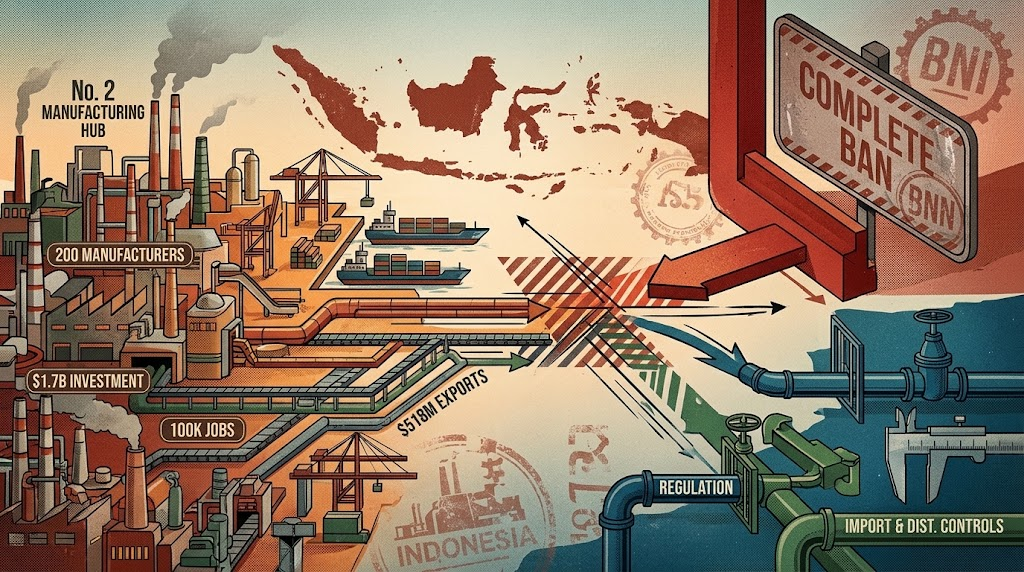
Special report|Indonesia's Vape Industry Has 200 Manufacturers and $1.7 Billion in Investment. Could a Regulatory Divide Derail Its Rise as the World's No. 2 Manufacturing Hub After Shenzhen?
Indonesia's Ministry of Industry said at a November 3, 2026, policy forum that the country has about 200 electronic cigarette companies, Rp31 trillion (approximately $1.71 billion) in cumulative industry investment and around 100,000 jobs across the supply chain. The National Narcotics Agency is seeking a comprehensive ban on vape use and circulation, while the industry ministry favors tighter import, product-standard and distribution controls. Indonesia exported approximately $518 million in vaping products in 2025, and Chinese manufacturers including Smoore, GEEKVAPE and Jinjia Group have established local operations. An international logistics specialist interviewed by 2Firsts said more Chinese vape companies began production in Indonesia from the second half of 2025, accompanied by increased shipments of manufacturing equipment and investment in logistics facilities. The regulatory debate comes as Indonesia expands its role in international vaping manufacturing.
Special Report
Nov.05
Special Report | Russia Places Four JTI Businesses Under Temporary Management, a First for Tobacco Majors
Russia has placed shares in four Japan Tobacco International businesses under temporary management, the first such move involving a major global tobacco manufacturer, according to Interfax. JTI held 35.8% of Russia's tobacco market by volume in the first nine months of 2026. While British American Tobacco and Imperial Brands have exited Russia, Philip Morris International continues operating there. As the market changes and diplomatic efforts continue, could international tobacco companies that left Russia eventually return?
Nov.06
Texas Extends Tobacco Tax Interpretation to a 6-Methylnicotine Product, Citing VELO Ruling
The Texas Comptroller of Public Accounts ruled in September 2026 that a combustible product made with non-tobacco plant material and 6-methylnicotine (6-MN), a synthetic nicotine analog, qualifies as a taxable tobacco product. The applicant said the product contained neither tobacco leaf nor measurable conventional nicotine. The determination applies reasoning from a May Texas Supreme Court decision involving VELO nicotine pouches, finding that the plant material and 6-MN together perform the functions of tobacco in a conventional smoking product. The ruling carries applicable tax, licensing and reporting obligations but is limited to the facts submitted by the taxpayer. It does not establish a blanket tax classification for all 6-MN products or extend the same conclusion to e-cigarettes.
Regulations
Nov.06