China Tobacco Hong Kong (06055.HK) 2024 Mid-Year Report: Total Revenue Up 12% to 8.7B HKD, NGPs Soar by 28%

Business by 2FIRSTS.ai
Aug.28.2024
China Tobacco Hong Kong (06055.HK) 2024 Mid-Year Report: Total Revenue Up 12% to 8.7B HKD, NGPs Soar by 28%
China Tobacco Hong Kong (06055.HK) revealed its mid-term financial report for 2024 on August 27. Company's total revenue rose 12%.

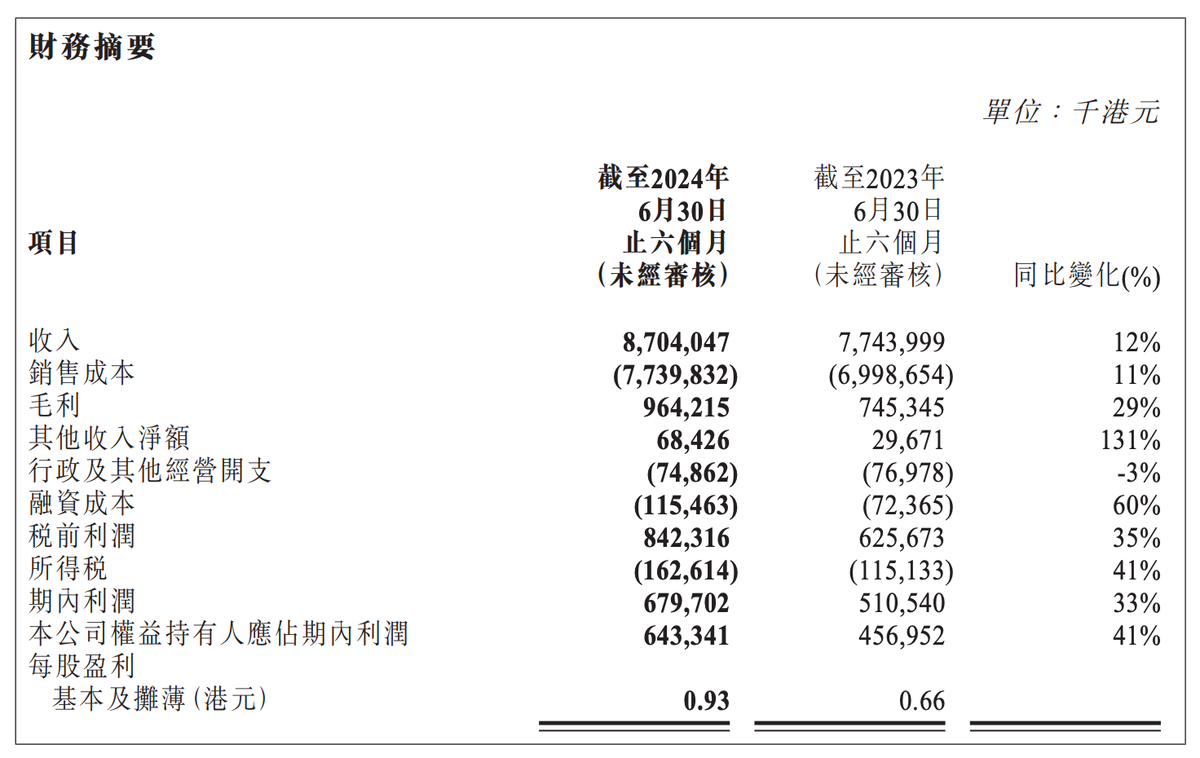
On August 27th, China Tobacco Hong Kong (06055.HK) released its interim performance report for 2024. During the period, the company's revenue reached 8.704 billion Hong Kong dollars, a 12% increase compared to the previous year; the company's attributable profit to equity holders reached 643 million Hong Kong dollars, a 41% increase year-on-year; and gross profit reached 964 million Hong Kong dollars, a 29% increase year-on-year.
China Tobacco Hong Kong (06055.HK) 2024 Mid-Year Report: Total Revenue Up 12% to 8.7B HKD, NGPs Soar by 28%
Image source: China Tobacco Hong Kong


  • The export business of new tobacco products has seen an increase in operating income, reaching 43.5 million Hong Kong dollars, a 28% year-on-year growth, with gross profit increasing by 57%. 
  • Cigarette export business has grown rapidly, with operating income reaching 547.3 million Hong Kong dollars, a 128% year-on-year growth, and gross profit increasing by 223%. 
  • The import and export of tobacco leaf products have seen stable growth, with import business income increasing by 5% year-on-year, and export business operating income increasing by 23% year-on-year. 
  • Operating income from business operations in Brazil has increased by 43% year-on-year, with gross profit decreasing by 8%.


The report reveals:


The company's growth in the new tobacco product sector is mainly attributed to tapping into key market channels, increasing customer marketing efforts, resulting in increased demand for orders in key markets; as well as continuously expanding their product portfolio, optimizing product pricing strategies, and increasing the proportion of self-operated business.


The company stated that the significant growth in cigarette export business was due to the continuous optimization of product portfolio, increased investment in new products, expansion of self-operated business, leading to a substantial increase in revenue and gross profit from cigarette export business. Additionally, foot traffic in duty-free markets has been steadily recovering, leading to improved product turnover compared to the same period last year.


Due to seasonal fluctuations in tobacco leaf production and an increase in the selling price of tobacco products, Chinese tobacco company CNTC's tobacco import business in Hong Kong saw a slight growth. The growth in tobacco export business is beneficial for increasing demand in the international market and optimizing pricing strategies.


Despite a significant increase in operating income in Brazil, gross profit has actually decreased compared to the same period last year. The company stated that this is due to a significant increase in the proportion of finished cigarette sales with high selling prices but low gross margins, while the proportion of product sales with high gross margins but lower selling prices has decreased.


In addition, China Tobacco Hong Kong stated that in the second half of this year, they will continue to enhance the international visibility of new tobacco products, deepen cooperation between production and sales, and comprehensively promote innovation in new tobacco technology and product upgrades.


We welcome news tips, article submissions, interview requests, or comments on this piece.

Please contact us at info@2firsts.com, or reach out to Alan Zhao, CEO of 2Firsts, on LinkedIn


Notice

1.  This article is intended solely for professional research purposes related to industry, technology, and policy. Any references to brands or products are made purely for objective description and do not constitute any form of endorsement, recommendation, or promotion by 2Firsts.

2.  The use of nicotine-containing products — including, but not limited to, cigarettes, e-cigarettes, nicotine pouchand heated tobacco products — carries significant health risks. Users are responsible for complying with all applicable laws and regulations in their respective jurisdictions.

3.  This article is not intended to serve as the basis for any investment decisions or financial advice. 2Firsts assumes no direct or indirect liability for any inaccuracies or errors in the content.

4.  Access to this article is strictly prohibited for individuals below the legal age in their jurisdiction.


Copyright


This article is either an original work created by 2Firsts or a reproduction from third-party sources with proper attribution. All copyrights and usage rights belong to 2Firsts or the original content provider. Unauthorized reproduction, distribution, or any other form of unauthorized use by any individual or organization is strictly prohibited. Violators will be held legally accountable.

For copyright-related inquiries, please contact: info@2firsts.com


AI Assistance Disclaimer


This article may have been enhanced using AI tools to improve translation and editorial efficiency. However, due to technical limitations, inaccuracies may occur. Readers are encouraged to refer to the cited sources for the most accurate information.

We welcome any corrections or feedback. Please contact us at: info@2firsts.com

South Korea Constitutional Court Upholds Volume-Based E-Liquid Tax, With Challenged Rates at KRW 370 and KRW 628 per Milliliter
South Korea's Constitutional Court has upheld fixed taxes on nicotine-containing e-cigarette liquids based on solution volume, ruling that challenged provisions imposing KRW 370 per milliliter in individual consumption tax and KRW 628 per milliliter in tobacco consumption tax do not violate the Constitution. The cases stemmed from historical disputes involving importers that reported nicotine as being extracted from tobacco stems rather than leaves. South Korea has since broadened its tobacco definition to include synthetic nicotine, while current tax laws provide reduced rates for certain products not derived from tobacco.
Sep.18
On-Site Report | CTP Details PMTA Backlog, 180-Day Review Goal and sPMTA Process
FDA’s Center for Tobacco Products detailed new PMTA review data and process changes at the 2026 FDLI conference. Pending PMTAs fell from about 450,000 at the start of 2025 to 135,000 by September 2026. CTP also discussed its 180-day review goal, current sPMTA pilot, alternate-supplier planning, more than 50,300 pending SE reports, and lessons from the nicotine pouch pilot already being applied to ENDS review.
Regulations
Oct.07
Ukraine Raises Excise Stamp Fees for Tobacco, Heated Tobacco and Vape Liquids by 30.5% as Parliament Backs E-Excise Delay to 2027
Ukraine's Cabinet of Ministers adopted Resolution No. 1259 on October 15, 2026, increasing excise stamp production fees for tobacco products and e-cigarette liquids by approximately 30.5%, from UAH 0.1643 to UAH 0.2144 per stamp. Fees for alcoholic beverages rose by about 30.2%. Separately, Ukraine's parliament passed Bill No. 15532 on October 13, proposing to postpone the full implementation of electronic excise stamps and traceability for alcohol, tobacco and e-cigarette liquids from November 1, 2026, to July 1, 2027. Parliament cited additional testing, configuration and integration requirements. The bill was sent to the president for signature on October 19.
Regulations
Oct.21
UK Extends Age-18 Rules to Zero-Nicotine Vapes and Nicotine Pouches From Oct. 29, Bans Vending Machines and Promotional Giveaways
Key provisions of the UK's Tobacco and Vapes Act 2026 will take effect on Oct. 29, extending an age-18 sales restriction to all vaping and non-medicinal nicotine products. In England, Wales and Northern Ireland, the change brings zero-nicotine vapes within statutory age-of-sale rules and also covers products including nicotine pouches, strips and pearls. The law will also prohibit proxy purchasing for under-18s, consumer-facing vending machines, promotional giveaways and substantial discounts intended to promote vaping and nicotine products.
Regulations
Oct.10
Russia Expands Temporary Administration of JTI Assets in Second Round: From Four to All Seven Russian Entities, With Approximately $9.5 Billion in Related Assets
Japan Tobacco Inc. (JT) confirmed on November 9, 2026, that all seven of its Russian entities had been placed under temporary administration after a second presidential decree added three companies to the four designated a day earlier. The additional entities are associated with importing, management, holdings and the former supply of Ploom heated-tobacco devices. JT disclosed approximately ¥1.5 trillion in Russian business-related assets as of September 30, including ¥360 billion in cash and deposits, and approximately ¥200 billion in liabilities. Under its revised FY2026 forecast, Russia accounts for about 25% of adjusted operating profit. JT said operations in Russia were continuing, while the financial impact remained under assessment.
company
Nov.09
FDA Revises Import Alert 98-07 Rules, Bringing May Enforcement Priorities Into Unauthorized ENDS Detentions
The U.S. Food and Drug Administration has revised the rules under Import Alert 98-07 to incorporate its May 2026 enforcement-priority policy for certain electronic nicotine delivery systems marketed without premarket authorization. The alert continues to allow detention without physical examination, or DWPE, for ENDS lacking required marketing authorization, while directing field divisions to apply the May risk-based framework. When necessary, detention or refusal decisions must also undergo review by the FDA's Center for Tobacco Products. Products including PACHA and Vuse Pro have already emerged as industry examples of the May policy, although enforcement discretion does not constitute FDA marketing authorization.
News
Sep.28 by 2Firsts Perspectives