Key Points
- China Tobacco Yunnan filed a patent for a nicotine pouch scaffold designed to eliminate microcrystalline cellulose and cellulose derivatives.
- The claimed scaffold contains 35%-70% bioceramic material, 15%-25% polydextrose and 10%-25% sugar alcohols.
- A preferred formulation uses 58%-62% dicalcium phosphate, 18%-22% polydextrose and 12%-16% erythritol.
- Patent examples reported 30% nicotine release at 10 minutes and more than 75% at 20 minutes for a standard formulation, while a faster-release version reached 50% and more than 90%, respectively.
- The filing explicitly cites intellectual-property constraints around cellulose-based nicotine pouch formulations as one reason for pursuing an alternative scaffold.
2Firsts
September 2, 2026
According to public records from China’s National Intellectual Property Administration (CNIPA), China Tobacco Yunnan Industrial Co., Ltd. has filed a patent application for a cellulose-free composite scaffold for nicotine pouches, exploring the use of bioceramic materials, polydextrose and sugar alcohols as alternatives to microcrystalline cellulose and other cellulose derivatives.
The application, titled “Composite Scaffold Material for Nicotine Pouches, Nicotine Pouch and Preparation Method Thereof,” was filed on May 26, 2026, and published as CN122556709A on August 14, 2026.
Replacing the conventional cellulose scaffold
Microcrystalline cellulose, or MCC, is widely used as a scaffold, filler and carrier in nicotine pouch formulations. The patent identifies powdery or gritty mouthfeel, oral residue and limited flexibility in nicotine release as potential drawbacks of cellulose-based systems.
Patent information:
Item | Details |
Applicant | China Tobacco Yunnan Industrial Co., Ltd. |
Patent title | Composite Scaffold Material for Nicotine Pouches, Nicotine Pouch and Preparation Method Thereof |
Application No. | CN202610733403.X |
Publication No. | CN122556709A |
Filing date | May 26, 2026 |
Publication date | August 14, 2026 |
Technology area | Cellulose-free nicotine pouch scaffold, material substitution, nicotine release control |
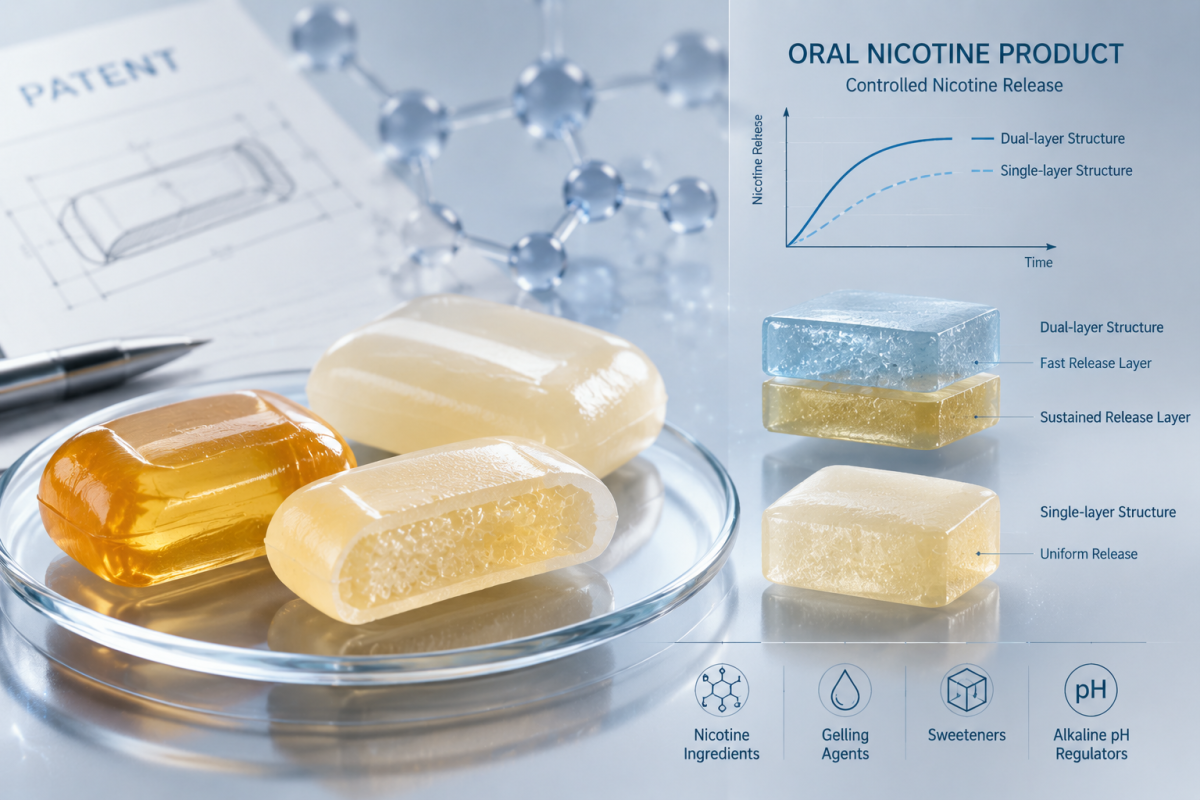
The claims specify a scaffold containing 35%-70% bioceramic material, 15%-25% polydextrose and 10%-25% sugar alcohols, with nicotine ingredients, pH regulators, sweeteners and flavorings making up the remainder.
A preferred formulation uses dicalcium phosphate as the bioceramic component and erythritol as the sugar alcohol, with target ranges of 58%-62% dicalcium phosphate, 18%-22% polydextrose and 12%-16% erythritol.
The patent describes the three components as serving different roles: structural support and pH buffering, binding and lubrication, and dispersion and mouthfeel improvement.
Formulation changes alter nicotine release
The filing provides several nicotine pouch examples using different scaffold compositions.
A standard formulation containing 60% dicalcium phosphate, 20% polydextrose, 15% erythritol and 2.5% nicotine tartrate released 30% of its nicotine within 10 minutes and more than 75% within 20 minutes.
A faster-release formulation reduced the dicalcium phosphate level to 35% while increasing the proportion of sugar alcohols. It released 50% of its nicotine within 10 minutes and more than 90% within 20 minutes. The patent attributes the faster profile partly to the lower proportion of dicalcium phosphate.
A control formulation based on 65% microcrystalline cellulose released 10% within 10 minutes and more than 50% within 20 minutes. The filing also describes the control as producing more powdery mouthfeel and oral residue.
The results suggest the proposed scaffold is intended not only as a material substitute but also as a way to tune nicotine release through changes in composition. The patent, however, does not provide human pharmacokinetic data, and sensory claims remain those of the applicant within the patent testing framework.
Cellulose-free design also targets intellectual-property constraints
An unusual feature of the filing is its explicit discussion of patent constraints around existing nicotine pouch materials.
The patent argues that microcrystalline cellulose and related cellulose derivatives are covered by dense existing patent portfolios, potentially limiting formulation freedom and increasing infringement or litigation risk. It presents a non-cellulose scaffold as a way to create additional room for product development.
From an industry perspective, the filing therefore goes beyond replacing one filler with another. It attempts to establish an alternative base material system that could affect mouthfeel, release characteristics, processing and intellectual-property strategy.
The patent’s references to reducing patent risk should not, however, be interpreted as evidence that the proposed formulation has undergone an independent freedom-to-operate assessment or is free of other intellectual-property claims.
Filing contains a notable inconsistency on cellulose use
One point in the patent requires caution.
The abstract and claims emphasize a scaffold that contains no cellulose components, including microcrystalline cellulose or cellulose derivatives.
However, the preparation description for Example 1 lists sodium carboxymethyl cellulose among the materials subjected to granulation and screening, even though it is not included in the formulation percentages listed immediately before that step.
For that reason, the more precise interpretation is that the patent’s core claims and stated technical direction seek a scaffold free of microcrystalline cellulose and cellulose derivatives, rather than asserting that every disclosed example is unambiguously cellulose-free.
The filing remains a patent proposal and does not indicate that a commercial cellulose-free nicotine pouch based on the technology has been launched.
Follow 2Firsts for continuous coverage of global NGPs policies, technology developments, market trends and industry updates.
Cover Image generated by AI
Disclaimer
This article is provided solely for professional research, industry discussion, and informational purposes. Any references to brands, companies, products, technologies, or policies are made for factual reporting and analytical purposes only, and do not constitute endorsement, recommendation, promotion, or advertising by 2Firsts.
Nicotine-containing products, including but not limited to cigarettes, e-cigarettes, heated tobacco products, and nicotine pouches, carry significant health risks. Readers are responsible for complying with all applicable laws and regulations in their respective jurisdictions, including age restrictions and access limitations.
The information contained in this article should not be regarded as investment, legal, medical, regulatory, or commercial advice. While 2Firsts strives to ensure the accuracy and reliability of its content, it does not assume liability for any direct or indirect loss arising from errors, omissions, inaccuracies, or reliance on the information contained herein.
This article is not intended for individuals below the legal age for accessing tobacco or nicotine-related information in their jurisdiction.
Copyright Notice
This article is either original content produced by 2Firsts or content reproduced, translated, summarized, or adapted from third-party sources with attribution where applicable. The intellectual property rights of the original content remain with 2Firsts or the respective original rights holders.
No individual or organization may copy, reproduce, distribute, republish, modify, translate, or otherwise use this content without prior authorization. Any unauthorized use may result in legal action.
For copyright-related inquiries, corrections, or removal requests, please contact: info@2firsts.com.
AI-Assisted Translation and Editing Notice
Portions of this article may have been translated, edited, or reviewed with the assistance of artificial intelligence tools to improve efficiency and readability. Due to the limitations of AI-assisted translation and editing, discrepancies, omissions, or inaccuracies may exist when compared with the original source.
Where applicable, readers are advised to refer to the original source for the most complete and accurate information. If you identify any errors or believe that any content infringes upon your rights, please contact us at info@2firsts.com, and we will review and address the matter promptly.