Key Points
- Patent applicant: China Tobacco Yunnan Industrial Co., Ltd. filed a patent application titled “Preparation Method and Application of Cigar Flavor Granules,” published as CN 122004509 A.
- Core technology: The method uses LX-8 macroporous resin chromatography and 90% ethanol elution to obtain a characteristic cigar aroma core material.
- Product form: The aroma core is mixed with maltodextrin and sucrose fatty acid ester, then homogenized and spray-dried into cigar flavor granules.
- Key parameters: The patent describes a wall-to-core mass ratio of 2:1 to 4:1, emulsifier addition of 8.0% to 20.0%, and an encapsulation rate of 77.5% under preferred conditions.
- Industry relevance: The design suggests that flavoring for reconstituted tobacco is moving from direct flavor addition toward aroma purification, encapsulation protection and controlled release.
2Firsts
June 9, 2026
According to public records from China’s National Intellectual Property Administration, a patent application filed by China Tobacco Yunnan Industrial Co., Ltd. was published on May 12, 2026, under the title “Preparation Method and Application of Cigar Flavor Granules.” The filing proposes a method for preparing cigar flavor granules, aiming to address aroma impurity, insufficient sensory coordination and the loss of volatile aroma components during the application of cigar flavoring in reconstituted tobacco.
The public filing does not show that the technology has entered commercial application or disclose any productization progress. The technology remains at the patent disclosure stage, with its application path still subject to further process validation, product development and industrial adaptation.
China Tobacco Yunnan Publishes Patent for Cigar Flavor Granules
According to the patent document, the application number is 202610364370.6, and the publication number is CN 122004509 A. The applicant is China Tobacco Yunnan Industrial Co., Ltd., and the patent is titled “Preparation Method and Application of Cigar Flavor Granules.”
The patent falls under the field of tobacco processing. Its core proposal is to purify an ethanol extract of cigar tobacco leaves with a specific resin process and then prepare the purified aroma material into flavor granules for use in reconstituted tobacco. The filing states that cigar tobacco leaves are first extracted with ethanol and concentrated into an extract, which is then passed through an LX-8 macroporous resin column. The 90% ethanol elution fraction is collected and concentrated to obtain a characteristic cigar aroma core material.
After the aroma core material is obtained, it is mixed with maltodextrin as the wall material and sucrose fatty acid ester as the emulsifier. Water is added to form an emulsion, which is then homogenized and spray-dried to obtain cigar flavor granules. The granules are proposed for use in reconstituted tobacco to improve smoking comfort, reduce dryness and enhance aroma release stability.
Technical Mechanism: Purifying the Aroma Core Before Encapsulation
From a technical perspective, the patent does not simply add cigar flavoring to reconstituted tobacco. Instead, it combines aroma purification with encapsulation protection.
The background section of the patent states that reconstituted tobacco is produced from byproducts such as tobacco dust, stems and fragments through fiber separation, recombination, slurry preparation, sheet formation and drying. While reconstituted tobacco can improve resource utilization, reduce production costs and stabilize cigarette quality, its processing may reduce the natural aroma complexity of tobacco leaves. During combustion, it may present dryness and woody notes, affecting smoking comfort.
Adding cigar flavoring with rich and full-bodied aroma characteristics has been used as a technical direction to improve sensory quality. However, the patent notes that existing cigar flavoring products may show mixed aroma profiles, unwanted off-notes and insufficient compatibility with the reconstituted tobacco system. In addition, the porous structure of reconstituted tobacco and subsequent high-temperature drying may cause volatile aroma components to dissipate or degrade, resulting in unstable aroma release.
The patent seeks to obtain a clearer and more coordinated cigar aroma core material through front-end purification, and then improve aroma retention during processing and storage through encapsulated granulation.
Product Form: Turning a Cigar Aroma Core Into Flavor Granules
According to the claims, the preparation method consists of two major steps.
The first step is preparation of the aroma core material. The patent proposes extracting cigar tobacco leaves with 90% to 95% ethanol at 50°C to 60°C, followed by vacuum concentration at 50°C to 60°C to obtain an extract. The extract is then processed through an LX-8 macroporous resin column at a chromatography flow rate of 0.2 to 1.5 BV/h. The patent also states that water, 30% ethanol and 60% ethanol can be used sequentially to remove impurities, while the 90% ethanol elution fraction is collected to obtain the characteristic cigar aroma core material.
The second step is encapsulated granulation. The core material is mixed with maltodextrin and sucrose fatty acid ester, water is added to form an emulsion, and the mixture is homogenized and spray-dried into cigar flavor granules. The wall-to-core mass ratio is 2:1 to 4:1, the emulsifier accounts for 8.0% to 20.0% of the total mass of the wall material and core material, and the homogenization speed is 600 to 1,000 r/min. The preferred parameters disclosed in the patent are a wall-to-core ratio of 3:1, emulsifier addition of 15% to 18%, and homogenization at 800 r/min.
In terms of product form, the technology converts cigar aroma components from a liquid or paste-like flavoring into a granular carrier. This form may be more suitable for incorporation into reconstituted tobacco processing and may improve aroma stability during high-temperature drying and subsequent storage.
Preparation Process: Extraction, Purification, Emulsification and Spray Drying
The preparation route can be summarized as extraction, purification, emulsification and spray drying.
During extraction, cigar tobacco leaves are extracted with ethanol and concentrated under reduced pressure to obtain an aroma-containing extract. During purification, the extract is passed through an LX-8 macroporous resin column, with gradient elution used to separate different components. The patent states that water, 30% ethanol and 60% ethanol may remove impurities, while the 90% ethanol fraction enriches the target characteristic aroma components.
During encapsulation, the characteristic cigar aroma core material is combined with maltodextrin, sucrose fatty acid ester and water to form an emulsion, which is then homogenized to improve dispersion stability. The emulsion is subsequently spray-dried into flavor granules at an inlet air temperature of 160°C to 200°C.
The key to the process lies in matching purification conditions with encapsulation parameters. If the core material is insufficiently purified, encapsulation may only preserve a mixed aroma system. If the encapsulation parameters are not suitable, even a higher-quality core material may still experience aroma loss or unstable release during reconstituted tobacco processing.
Relationship With Conventional Flavoring of Reconstituted Tobacco
The patent differs from conventional reconstituted tobacco flavoring methods in its application route.
Conventional flavoring typically focuses on directly adding flavoring agents or aromas to improve aroma and smoking experience. This patent adds two steps before flavor incorporation: purification and encapsulation. The former is used to isolate and enrich characteristic cigar aroma components, while the latter is intended to improve aroma retention during processing and storage.
For this reason, the technology appears to represent a more systematic modification of reconstituted tobacco flavoring rather than a simple change in flavor type. Its core objective is to address both aroma quality and aroma stability.
The direction also shows that quality improvement in reconstituted tobacco is extending from flavor selection at the formulation stage to the treatment of aroma components, carrier design and release control.
Test Data: Preferred Process Achieves 77.5% Encapsulation Rate
The patent discloses comparative tests of encapsulation rates under different process parameters.
In Example 2, the applicant used 3.0 g of the characteristic cigar aroma core material and added 9.0 g of maltodextrin at a wall-to-core mass ratio of 3:1. Sucrose fatty acid ester was added at 16% of the total mass of the wall and core materials. The mixture was homogenized at 800 r/min and spray-dried at an inlet air temperature of 180°C to obtain cigar flavor granules labeled P1.
Test results showed that P1 reached an average encapsulation rate of 77.5%. By comparison, sample P2, with a wall-to-core ratio of 5:1, had an encapsulation rate of 68.2%; sample P3, with emulsifier addition reduced to 8%, reached 59.8%; sample P4, with homogenization speed reduced to 400 r/min, reached 63.7%; and sample P5, prepared under conventional empirical parameters, reached 65.5%.
The patent also discloses that samples P6, P7 and P8 prepared with different parameter combinations achieved encapsulation rates of 78.1%, 77.6% and 77.9%, respectively. These data suggest that wall-to-core ratio, emulsifier addition and homogenization speed jointly affect the encapsulation performance of the granules.
Sensory Evaluation: Patent Claims Reduced Dryness and More Stable Aroma
The patent also discloses sensory evaluations of the purified core material and the flavor granules when applied to reconstituted tobacco.
In the core material evaluation, core material A, prepared using LX-8 macroporous resin and 90% ethanol elution, was described as having prominent sweet aroma, good moistness and low off-notes. In comparison, the 30% ethanol fraction, 60% ethanol fraction and a 90% ethanol fraction prepared using AB-8 resin showed weaker evaluations in aroma coordination and off-note control.
In the reconstituted tobacco application test, the patent compared the granule sample P1, the granule sample P5 prepared with conventional encapsulation parameters, the unencapsulated core material A and a blank sample. Each sample was incorporated into blank reconstituted tobacco slurry at the same effective core material addition level, then processed through sheet formation and high-temperature drying at 160°C to simulate aroma loss during reconstituted tobacco processing.
The evaluation results state that P1 showed stable and full cigar aroma release after simulated processing, with noticeable smoke moistness and reduced dryness and woody notes. P5 performed better than the unencapsulated core material but showed weaker persistence and general coordination. The unencapsulated core material A showed a clear decline in characteristic aroma intensity after high-temperature processing.
Because these sensory evaluations are disclosed in the patent document, the claimed effects would still require further confirmation through larger-scale production validation and actual product application.
Industry Significance: Reconstituted Tobacco Flavoring Moves Toward Stable Release
The significance of this patent lies in moving reconstituted tobacco flavoring from adding aroma to managing aroma.
For reconstituted tobacco, aroma improvement depends not only on what flavoring is added, but also on whether that flavoring can remain stable during processing, storage and smoking. The patent uses resin purification to control the quality of the aroma core, and then uses wall-material encapsulation to form a granular carrier, aiming to improve aroma retention and release stability.
From a product development perspective, this type of technology may help improve the suitability of reconstituted tobacco for higher-end cigarettes or cigar-style products. If cigar flavor granules can maintain higher aroma stability during processing, they may provide clearer aroma positioning and more controllable sensory performance for reconstituted tobacco.
The technology also reflects continued exploration of functionalized reconstituted tobacco in tobacco processing. Reconstituted tobacco is no longer only a tool for raw material utilization and cost control, but is also becoming a functional carrier for flavor design, release control and product style expression.
Regulatory and Application Considerations: Flavor Enhancement and Product Positioning
This patent mainly concerns tobacco processing and flavoring technology for reconstituted tobacco. Compared with nicotine delivery patents, its regulatory focus is more likely to center on application scenarios, aroma modulation and the attributes of the final tobacco product.
First, the flavor granules are proposed for use in reconstituted tobacco, and their final application may still depend on formula management, product standards and production licensing systems for relevant tobacco products.
Second, cigar flavor enhancement may affect product style positioning. If the technology is applied to cigarettes or cigar-style products, companies would need to balance aroma expression, smoking comfort and compliance requirements.
Third, the patent emphasizes improving smoking comfort, reducing dryness and enhancing aroma stability. Such descriptions relate to sensory quality optimization in tobacco processing, and their market value would still depend on subsequent product development, consumer testing and industrial application results.
If the technology enters commercial application, addition level, processing stability, flavor consistency and the impact on final smoke indicators may become key areas of R&D and quality control.
Conclusion
Overall, China Tobacco Yunnan’s cigar flavor granule patent shows that reconstituted tobacco technology is extending from raw material recombination and cost optimization toward flavor stabilization and sensory quality improvement. Compared with directly adding cigar flavoring, the approach emphasizes obtaining a coordinated aroma core through purification and improving retention during processing through encapsulated granules.
The technology remains at the patent disclosure stage. Whether it can be industrialized and whether it can consistently improve aroma performance and smoking comfort in reconstituted tobacco products will depend on further process scale-up, product validation and quality control.
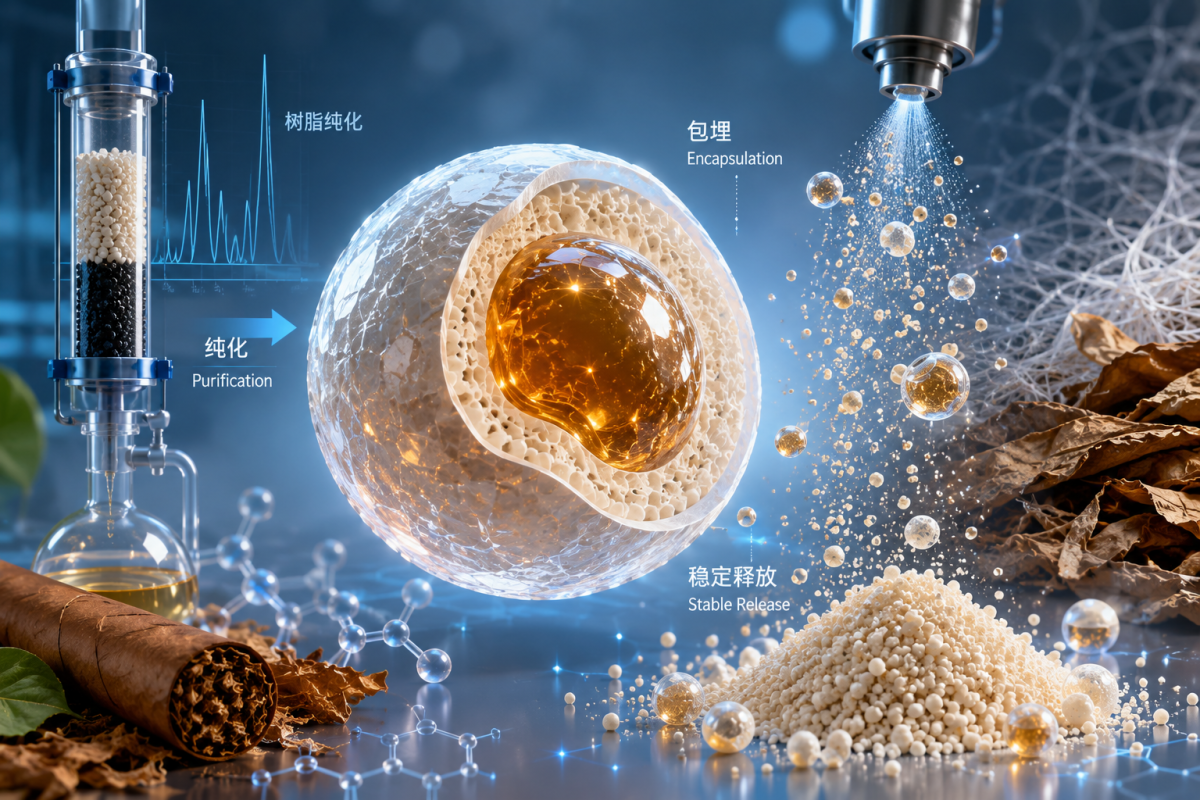
Cover image:generated by AI
Disclaimer
This article is provided solely for professional research, industry discussion, and informational purposes. Any references to brands, companies, products, technologies, or policies are made for factual reporting and analytical purposes only, and do not constitute endorsement, recommendation, promotion, or advertising by 2Firsts.
Nicotine-containing products, including but not limited to cigarettes, e-cigarettes, heated tobacco products, and nicotine pouches, carry significant health risks. Readers are responsible for complying with all applicable laws and regulations in their respective jurisdictions, including age restrictions and access limitations.
The information contained in this article should not be regarded as investment, legal, medical, regulatory, or commercial advice. While 2Firsts strives to ensure the accuracy and reliability of its content, it does not assume liability for any direct or indirect loss arising from errors, omissions, inaccuracies, or reliance on the information contained herein.
This article is not intended for individuals below the legal age for accessing tobacco or nicotine-related information in their jurisdiction.
Copyright Notice
This article is either original content produced by 2Firsts or content reproduced, translated, summarized, or adapted from third-party sources with attribution where applicable. The intellectual property rights of the original content remain with 2Firsts or the respective original rights holders.
No individual or organization may copy, reproduce, distribute, republish, modify, translate, or otherwise use this content without prior authorization. Any unauthorized use may result in legal action.
For copyright-related inquiries, corrections, or removal requests, please contact: info@2firsts.com.
AI-Assisted Translation and Editing Notice
Portions of this article may have been translated, edited, or reviewed with the assistance of artificial intelligence tools to improve efficiency and readability. Due to the limitations of AI-assisted translation and editing, discrepancies, omissions, or inaccuracies may exist when compared with the original source.
Where applicable, readers are advised to refer to the original source for the most complete and accurate information. If you identify any errors or believe that any content infringes upon your rights, please contact us at info@2firsts.com, and we will review and address the matter promptly.