Key Points
- China Tobacco Zhejiang filed a patent for an oral nicotine product whose release can be actively adjusted by applying pressure in the mouth.
- The design uses shallow, thin-walled and deeper, thicker-walled nicotine reservoirs that respond to different levels of force.
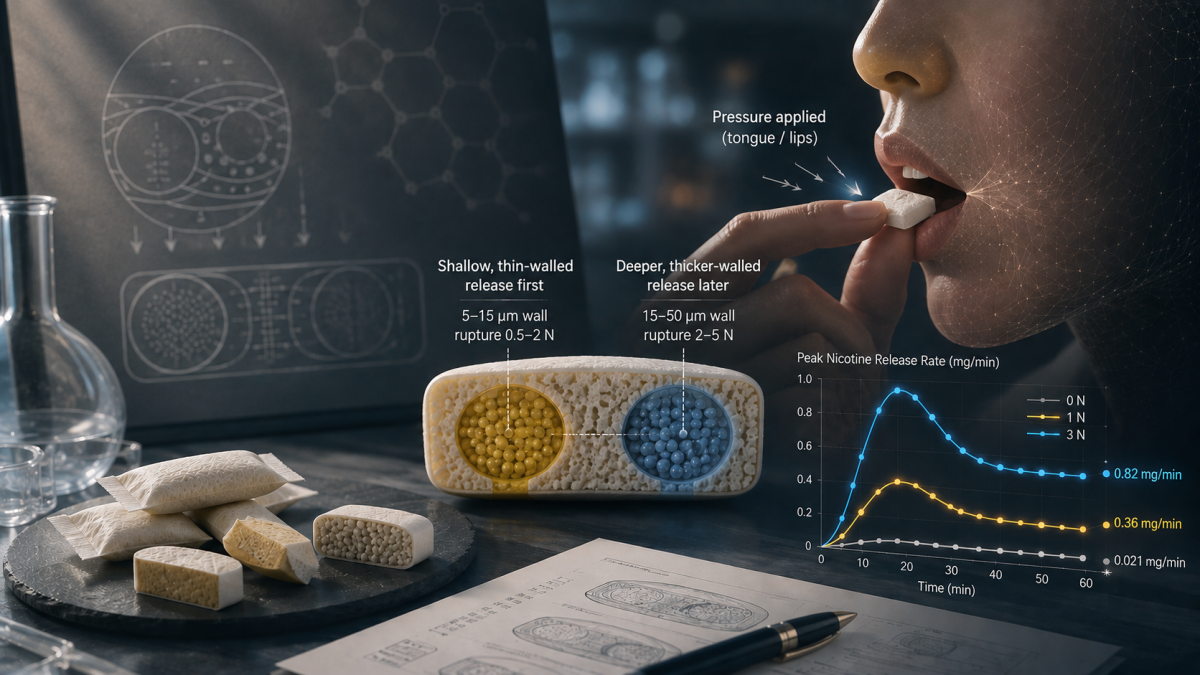
- The first reservoirs have wall thicknesses of 5-15 μm and rupture under 0.5-2 N, while the second use 15-50 μm walls and rupture under 2-5 N.
- In one example, peak nicotine release increased from 0.021 mg/min without applied force to 0.36 mg/min at 1 N and 0.82 mg/min at 3 N.
- The results come from simulated compression and in-vitro release testing; the patent does not provide human pharmacokinetic data.
2Firsts
September 1, 2026
According to public records from China’s National Intellectual Property Administration (CNIPA), China Tobacco Zhejiang Industrial Co., Ltd. has filed a patent application for an oral nicotine delivery product that allows users to actively alter the rate of nicotine release by applying pressure with the tongue or lips.
The design embeds nicotine reservoirs with different rupture thresholds inside a deformable matrix, allowing different levels of oral pressure to trigger additional nicotine release during use.
The application, titled “An Oral Nicotine Delivery Product and Preparation Method Thereof,” was filed on June 30, 2026, and published as CN122604104A on August 21, 2026.
Two nicotine reservoirs respond to different pressure levels
At the core of the patent are two types of nicotine reservoirs that differ in wall thickness and position within the deformable carrier matrix.
Patent information:
Item | Details |
Applicant | China Tobacco Zhejiang Industrial Co., Ltd. |
Patent title | An Oral Nicotine Delivery Product and Preparation Method Thereof |
Application No. | CN202610963117.2 |
Publication No. | CN122604104A |
Filing date | June 30, 2026 |
Publication date | August 21, 2026 |
Technology area | Oral nicotine delivery, active release control, nicotine reservoirs |
The first reservoirs are positioned primarily within 0-1 mm of the product surface. Their walls are 5-15 μm thick and are designed to rupture under forces of 0.5-2 N.
The second reservoirs are placed deeper than 1 mm from the surface. Their walls are thicker, at 15-50 μm, and require forces of 2-5 N to rupture.
The intended mechanism is for lighter pressure to activate shallow, thin-walled reservoirs first, while stronger pressure can rupture the deeper reservoirs and trigger a larger release response.
Tongue or lip pressure triggers additional nicotine release
According to the patent, when a user compresses the product with the tongue or lips, the deformable carrier transfers the force to the embedded reservoirs. Their walls then rupture under sufficient pressure, releasing nicotine into saliva.
Unlike technologies in which release rates are predetermined primarily through formulation, moisture content, particle size or coating structures, the filing focuses on active control during use.
The deformable matrix may contain materials including gelatin, agar, carrageenan or xanthan gum. The reservoirs may contain nicotine free base, nicotine salts or nicotine-resin complexes, while reservoir walls may use materials such as gelatin, gum arabic, calcium alginate or chitosan.
The patent also proposes controlling the amount released by adjusting reservoir numbers, wall thickness and distribution. Reservoir rupture is described as irreversible, limiting repeated release from the same reservoir.
Simulated tests show release rates rising with pressure
The patent tested five examples and two controls using a simulated oral compression system. Tests were conducted at 37°C with artificial saliva flowing at 1 mL/min, under constant applied forces of 0 N, 1 N and 3 N.
In Example 1, which used a layered arrangement of shallow thin-walled and deeper thick-walled reservoirs, the peak nicotine release rate was 0.021 mg/min without applied force. It increased to 0.36 mg/min at 1 N and to 0.82 mg/min under 3 N.
Example 2 recorded peak rates of 0.024, 0.42 and 0.89 mg/min, respectively, while Example 3 recorded 0.018, 0.29 and 0.75 mg/min.
Sample | 0 N | 1 N | 3 N |
Example 1 | 0.021 mg/min | 0.36 mg/min | 0.82 mg/min |
Example 2 | 0.024 mg/min | 0.42 mg/min | 0.89 mg/min |
Example 3 | 0.018 mg/min | 0.29 mg/min | 0.75 mg/min |
The controls further illustrate the different pressure thresholds. A product containing only the thinner first reservoir reached 0.34 mg/min at 1 N but only 0.36 mg/min at 3 N. A product containing only the thicker second reservoir recorded just 0.08 mg/min at 1 N but rose to 0.72 mg/min at 3 N.
The results support the pressure-responsive mechanism proposed in the filing. They were, however, generated using a simulated compression device and artificial saliva and do not establish equivalent changes in nicotine uptake in human users.
From preset release to on-demand nicotine delivery
Nicotine release from existing oral products is generally determined during product design through formulation, material selection and structural parameters, leaving users with limited ability to change the release rate once use begins.
China Tobacco Zhejiang’s patent explores a different approach by making user interaction part of the delivery mechanism: the product can provide a baseline release while allowing additional reservoirs to be activated through oral compression.
From a technology perspective, the concept moves oral nicotine delivery beyond a fixed release curve toward an interactive, user-triggered model. The filing also explicitly links the squeezing action to the type of behavioral interaction users may associate with controlling intake during smoking.
The application remains a patent proposal. Claims of “on-demand” or rapid satisfaction reflect the applicant’s technical description and in-vitro release testing; the filing does not provide human pharmacokinetic evidence or indicate that the technology has been commercialized.
Follow 2Firsts for continuous coverage of global NGPs policies, technology developments, market trends and industry updates.
Cover Image generated by AI
Disclaimer
This article is provided solely for professional research, industry discussion, and informational purposes. Any references to brands, companies, products, technologies, or policies are made for factual reporting and analytical purposes only, and do not constitute endorsement, recommendation, promotion, or advertising by 2Firsts.
Nicotine-containing products, including but not limited to cigarettes, e-cigarettes, heated tobacco products, and nicotine pouches, carry significant health risks. Readers are responsible for complying with all applicable laws and regulations in their respective jurisdictions, including age restrictions and access limitations.
The information contained in this article should not be regarded as investment, legal, medical, regulatory, or commercial advice. While 2Firsts strives to ensure the accuracy and reliability of its content, it does not assume liability for any direct or indirect loss arising from errors, omissions, inaccuracies, or reliance on the information contained herein.
This article is not intended for individuals below the legal age for accessing tobacco or nicotine-related information in their jurisdiction.
Copyright Notice
This article is either original content produced by 2Firsts or content reproduced, translated, summarized, or adapted from third-party sources with attribution where applicable. The intellectual property rights of the original content remain with 2Firsts or the respective original rights holders.
No individual or organization may copy, reproduce, distribute, republish, modify, translate, or otherwise use this content without prior authorization. Any unauthorized use may result in legal action.
For copyright-related inquiries, corrections, or removal requests, please contact: info@2firsts.com.
AI-Assisted Translation and Editing Notice
Portions of this article may have been translated, edited, or reviewed with the assistance of artificial intelligence tools to improve efficiency and readability. Due to the limitations of AI-assisted translation and editing, discrepancies, omissions, or inaccuracies may exist when compared with the original source.
Where applicable, readers are advised to refer to the original source for the most complete and accurate information. If you identify any errors or believe that any content infringes upon your rights, please contact us at info@2firsts.com, and we will review and address the matter promptly.