Colorado Allocates $17.4 Million from Juul Labs Lawsuit

Regulations by 2FIRSTS.ai
Jul.10.2024
Colorado Allocates $17.4 Million from Juul Labs Lawsuit
Colorado receives $17.4 million from Juul Labs lawsuit to combat youth e-cigarette crisis, announced Attorney General Phil Weiser.

According to a report by The Denver Post on July 9th, Colorado Attorney General Phil Weiser announced on Tuesday (the 9th) that 42 schools, government agencies, and non-profit organizations will receive $17.4 million from a nationwide lawsuit against e-cigarette manufacturer Juul Labs. The funds will be used to address the youth vaping crisis.


Weiss said, "This funding will enable the community to educate young people about risks, take preventive measures, and provide necessary treatment for those affected.


Juul Labs' payment of $31.7 million to Colorado is part of a $462 million settlement the e-cigarette company is paying to six states and the District of Columbia to resolve allegations of illegally marketing e-cigarettes to young people and misrepresenting the health risks of e-cigarette use.


According to the 2021 Colorado Children's Health Survey conducted by the state's Department of Public Health and Environment, an estimated 30% of high school students in Colorado have tried vaping e-cigarettes, a slightly higher percentage than the 20.8% of students who have ever smoked cigarettes.


The Office of the US Attorney General announced that a series of projects funded by a $17.4 million settlement agreement will focus on education, prevention, and treatment for youth vaping e-cigarettes, including mental and behavioral health services.


The Colorado state legal department is planning to allocate $11.4 million to school districts, charter schools, and education service agencies over the next three years.


Colorado Education Commissioner Susana Córdova stated, "We are pleased to award this funding to address the youth e-cigarette crisis by providing education, prevention, and treatment resources for Colorado schools. Our goal is to equip local educators with the tools they need to address the impact of e-cigarette use on youth health.


We welcome news tips, article submissions, interview requests, or comments on this piece.

Please contact us at info@2firsts.com, or reach out to Alan Zhao, CEO of 2Firsts, on LinkedIn


Notice

1.  This article is intended solely for professional research purposes related to industry, technology, and policy. Any references to brands or products are made purely for objective description and do not constitute any form of endorsement, recommendation, or promotion by 2Firsts.

2.  The use of nicotine-containing products — including, but not limited to, cigarettes, e-cigarettes, nicotine pouchand heated tobacco products — carries significant health risks. Users are responsible for complying with all applicable laws and regulations in their respective jurisdictions.

3.  This article is not intended to serve as the basis for any investment decisions or financial advice. 2Firsts assumes no direct or indirect liability for any inaccuracies or errors in the content.

4.  Access to this article is strictly prohibited for individuals below the legal age in their jurisdiction.


Copyright


This article is either an original work created by 2Firsts or a reproduction from third-party sources with proper attribution. All copyrights and usage rights belong to 2Firsts or the original content provider. Unauthorized reproduction, distribution, or any other form of unauthorized use by any individual or organization is strictly prohibited. Violators will be held legally accountable.

For copyright-related inquiries, please contact: info@2firsts.com


AI Assistance Disclaimer


This article may have been enhanced using AI tools to improve translation and editorial efficiency. However, due to technical limitations, inaccuracies may occur. Readers are encouraged to refer to the cited sources for the most accurate information.

We welcome any corrections or feedback. Please contact us at: info@2firsts.com

As Regulators Focus on Nicotine Pouch Child Safety, Safeguard Pursues an External Packaging Route
As regulators pay closer attention to child safety in nicotine pouches, manufacturers face a practical challenge: how to strengthen child-resistant packaging without unnecessarily reworking products, production lines and regulatory submissions already in place. In a written interview with 2Firsts, Chemular detailed Safeguard’s external packaging approach, its customer-specific testing requirements and possible PMTA pathways. The model remains early-stage, but it offers a new way to think about an increasingly important regulatory and manufacturing issue.
Industry Insight
Sep.19
Sweden Threatens EU Tobacco Tax Deal as Nicotine Pouch Duty Dispute Looms Over November 9 Meeting
Sweden is expected to oppose a European Union proposal to raise minimum tobacco excise duties, Law360 reported on October 26, 2026, citing an EU official. A provisional Council agenda dated October 23 confirms that the tobacco taxation package is scheduled for discussion at the November 9 finance ministers' meeting, where member states will seek a general approach. The proposed reforms would raise minimum taxes on conventional tobacco products and establish EU-wide excise rules for vaping liquids, heated tobacco and nicotine pouches. Sweden supports harmonising tobacco taxation rules but objects to requiring nicotine pouches to bear the same minimum tax burden as certain smoking tobacco products. As EU indirect tax legislation requires unanimous Council approval, Swedish opposition could block the proposal in its current form.
Regulations
Oct.29
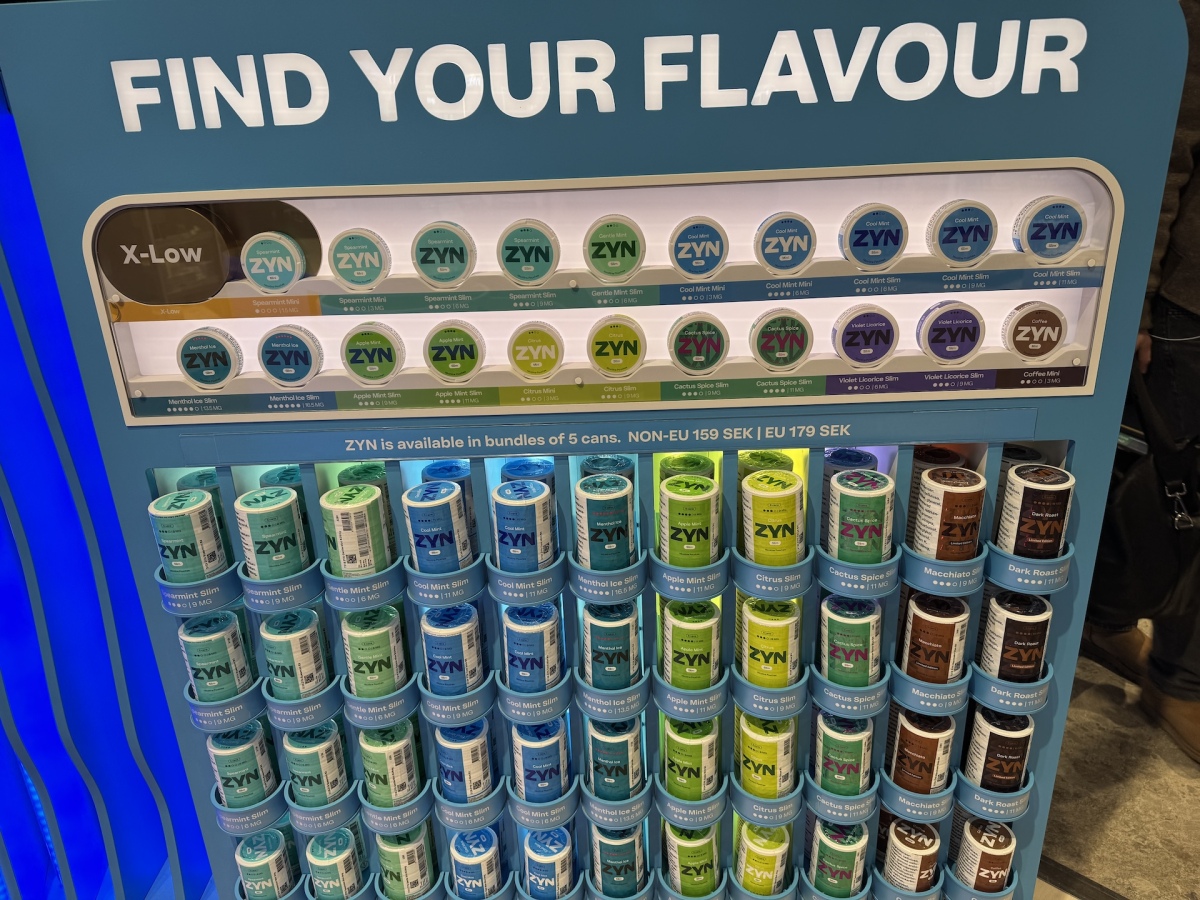
Sweden Finds ZYN Ingredient Labels Noncompliant Over Generic Flavoring Disclosure, Swedish Match Faces SEK 2 Million Monthly Penalty
Sweden's Public Health Agency has found ingredient labels on ZYN nicotine pouches sold by Philip Morris International subsidiary Swedish Match to be noncompliant, according to Dagens industri. The products' packaging listed 10 to 13 ingredients, compared with 11 to 42 in regulatory submissions, with multiple flavoring ingredients grouped under the generic term "aromer." The agency ordered corrective action, warning of a conditional penalty of SEK 2 million per month for noncompliance. The order applies only to products manufactured after the decision becomes legally effective and does not require recalls. Swedish Match disputes the agency's interpretation and plans to appeal.
PMI
Oct.22
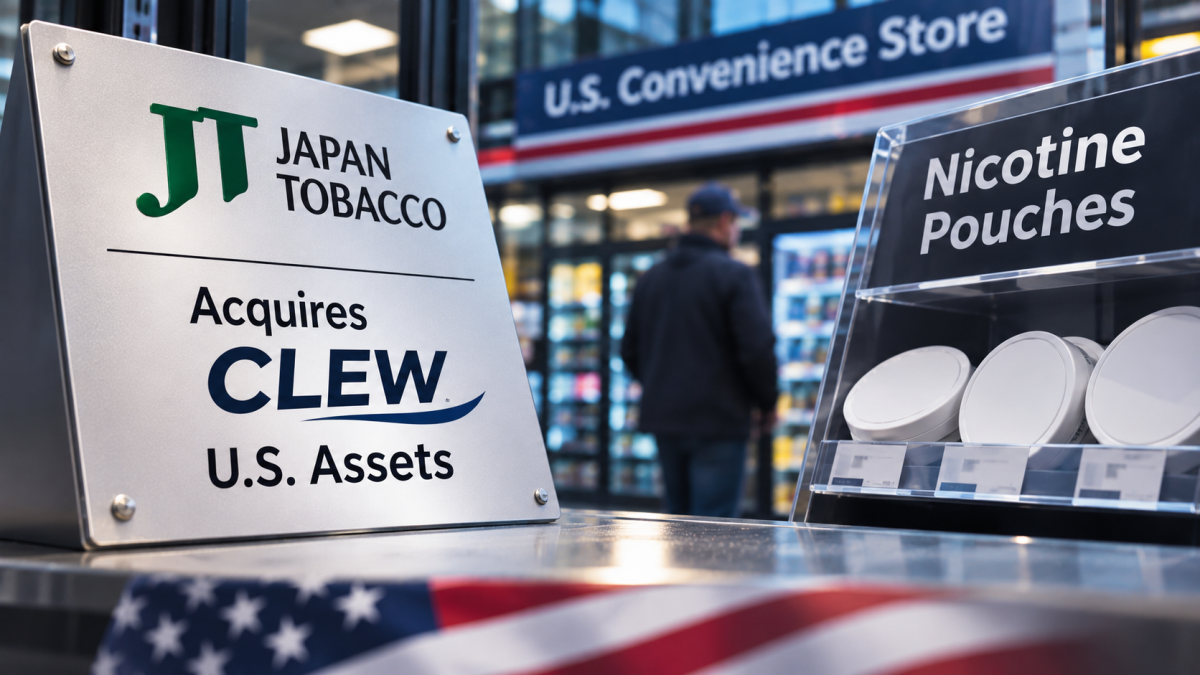
Special Report|Japan Tobacco Buys CLEW: Can Its 160,000-Store Cigarette Network Help It Vie for U.S. Nicotine Pouch Share Against PMI and BAT?
Japan Tobacco Inc. (JT) announced on November 12, 2026, that it had acquired the U.S. assets of nicotine pouch brand CLEW from Nevcore Innovations Inc., including trademarks, intellectual property, product formulations and a Premarket Tobacco Product Application (PMTA). CLEW, currently distributed through selected outlets in 13 U.S. states, will immediately join the JTI LIGGETT portfolio. The transaction follows JT's approximately $2.4 billion acquisition of U.S. cigarette maker Vector Group in 2024. JTI LIGGETT says its existing cigarette brands reach more than 160,000 U.S. retail stores. During the 2026 NACS Show in October, JTI LIGGETT booth staff told 2Firsts that the company had not yet launched nicotine pouches in the United States. Although Nevcore previously announced FDA acceptance of CLEW's PMTA, the brand is absent from the agency's current list of authorized nicotine pouch products. JT has not disclosed a retail expansion plan for CLEW.
Business
Nov.12
FDA Unifies Tobacco Registration and Product Listing Form Across Product Categories
The U.S. FDA has consolidated two tobacco establishment registration and product listing forms into a redesigned Form FDA 3741 covering all regulated product categories, including e-cigarettes, heated tobacco products and nicotine pouches. The current requirements remain limited to domestic establishments. Separately, the FDA has proposed extending registration and product listing requirements to foreign manufacturers, signaling greater regulatory attention to manufacturing entities and product-level information across the tobacco and nicotine supply chain.
FDA
Sep.30
Latest UK ONS Data: Vaping Rate Edges Down to 9.9% in 2025, a Year After Overtaking Cigarette Smoking
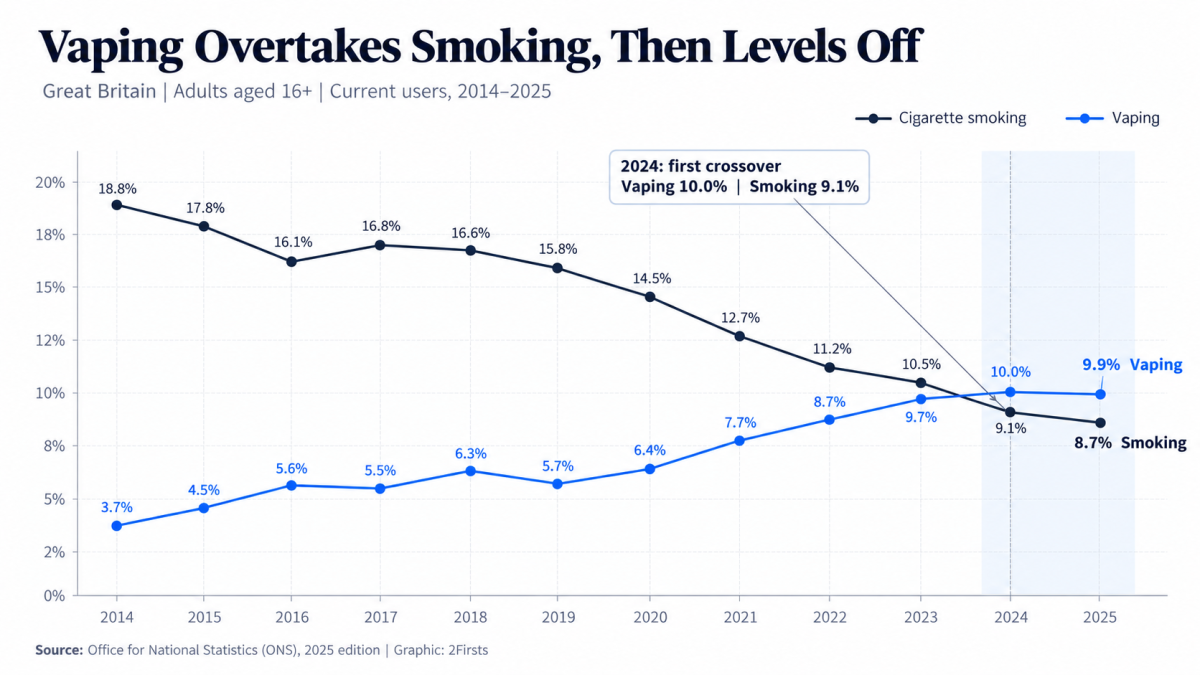
Vaping prevalence in Great Britain edged down to 9.9% in 2025 from 10.0% in 2024, with the number of adult users holding at approximately 5.4 million for a second consecutive year, according to the Office for National Statistics (ONS). E-cigarette use had risen from 6.4% in 2020 to 10.0% in 2024, when it exceeded cigarette smoking prevalence for the first time. Cigarette smoking continued to decline to 8.7% in 2025, widening the gap to 1.2 percentage points. Daily vaping declined slightly, while usage among adults aged 25–34 increased despite falling rates in other age groups.
DATA
Oct.14