Key points:
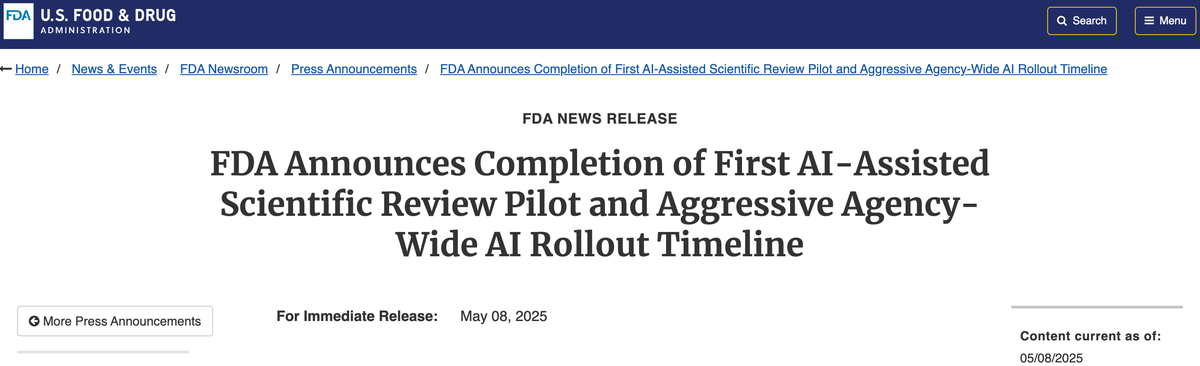
1.The United States Food and Drug Administration (FDA) has officially completed its first AI-assisted scientific review pilot.
2.The entire AI system across all departments will be fully deployed by June 30, 2025, covering all centers.
3.The goal of AI applications is to reduce the repetitive work of reviewers and improve the efficiency of evaluating new therapies.
4.The system is being jointly promoted by the FDA's newly appointed Chief AI Officer Jeremy Walsh and Senior Information Officer Sridhar Mantha.
5.Further optimizations will continue to be made to ensure information security and meet the business requirements of each center.
The U.S. Food and Drug Administration (FDA) announced on May 8 that it has successfully completed its first pilot program using generative artificial intelligence (AI) for scientific evaluation, and will fully deploy a unified AI system across all its centers by June 30. The initiative, led by FDA Commissioner Martin A. Makary, aims to systematically improve internal scientific review efficiency and reduce the workload of professionals on repetitive tasks.
"We need to highly value the time of scientists and reduce redundant processes. The widespread application of AI technology can significantly accelerate the speed of reviewing new therapies."
At the same time, he emphasized that the deployment operation this round will be based on the basic principles of "fast, unified, and safe," and will comprehensively establish interfaces between the evaluation data platform and AI tools.
The pilot project uses generative AI technology specifically designed for FDA scientists and experts, with a focus on reducing inefficient, repetitive labor. Jinzhong (Jin) Liu, Deputy Director of the Office of New Drug Review at the FDA Center for Drug Evaluation and Research (CDER), said the tool can complete a task that originally took three days in just a matter of minutes, calling it a "transformative technology.
According to deployment arrangements, all FDA centers have received instructions to immediately initiate internal deployment. June 30th is the timeline for the first round of full system launch, at which time each center will carry out AI-assisted work based on a unified platform deeply integrated with FDA internal data structures. After deployment, FDA will continue to optimize functions, expand specific application scenarios, and ensure that each center can customize their usage paths based on their own business characteristics.
The program is led by Jeremy Walsh, the newly appointed Chief AI Officer at the FDA. Walsh has previously overseen major technology deployments at various federal health and intelligence agencies. He is partnered with Sridhar Mantha, who formerly served as the head of the CDER Business Informatics Office. Together, they will collaborate on advancing overall AI deployment, user training, system security, and ongoing performance assessments throughout the agency.
The FDA announced that more details will be released in June and progress updates will be made public. The agency also promised to continuously iterate AI tools through user feedback mechanisms to ensure they are closely aligned with regulatory tasks and assist in the mission of promoting public health.
We welcome news tips, article submissions, interview requests, or comments on this piece.
Please contact us at info@2firsts.com, or reach out to Alan Zhao, CEO of 2Firsts, on LinkedIn
Notice
1. This article is intended solely for professional research purposes related to industry, technology, and policy. Any references to brands or products are made purely for objective description and do not constitute any form of endorsement, recommendation, or promotion by 2Firsts.
2. The use of nicotine-containing products — including, but not limited to, cigarettes, e-cigarettes, nicotine pouchand heated tobacco products — carries significant health risks. Users are responsible for complying with all applicable laws and regulations in their respective jurisdictions.
3. This article is not intended to serve as the basis for any investment decisions or financial advice. 2Firsts assumes no direct or indirect liability for any inaccuracies or errors in the content.
4. Access to this article is strictly prohibited for individuals below the legal age in their jurisdiction.
Copyright
This article is either an original work created by 2Firsts or a reproduction from third-party sources with proper attribution. All copyrights and usage rights belong to 2Firsts or the original content provider. Unauthorized reproduction, distribution, or any other form of unauthorized use by any individual or organization is strictly prohibited. Violators will be held legally accountable.
For copyright-related inquiries, please contact: info@2firsts.com
AI Assistance Disclaimer
This article may have been enhanced using AI tools to improve translation and editorial efficiency. However, due to technical limitations, inaccuracies may occur. Readers are encouraged to refer to the cited sources for the most accurate information.
We welcome any corrections or feedback. Please contact us at: info@2firsts.com