Key Points
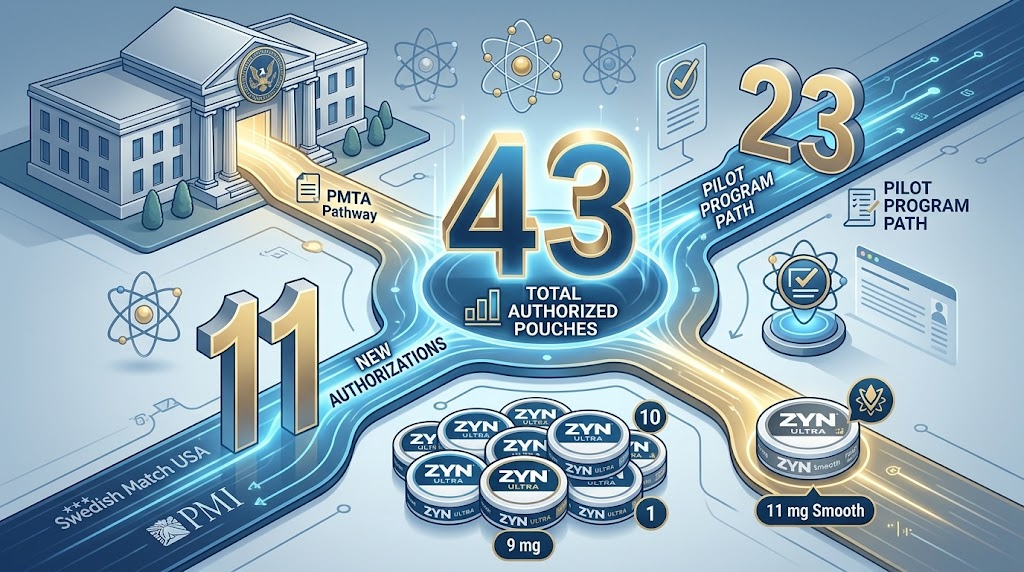
- FDA authorized 11 ZYN ULTRA nicotine pouch products through the PMTA pathway, with Swedish Match USA as the applicant.
- The authorizations cover ten 9 mg products and one 11 mg product, ZYN ULTRA Smooth.
- FDA said labeled nicotine content is not the only factor in assessing nicotine exposure; product design, formulation, materials and nicotine delivery characteristics are also considered.
- FDA has now authorized 43 nicotine pouch products, including 23 through its nicotine pouch PMTA pilot program.
- Philip Morris International (PMI) said additional ZYN ULTRA 11 mg products remain under FDA scientific review.
2Firsts
August 24, 2026
The U.S. Food and Drug Administration (FDA) on August 21, 2026, authorized the marketing of 11 ZYN ULTRA nicotine pouch products made by Swedish Match USA through the premarket tobacco product application (PMTA) pathway, including ten products with labeled nicotine content of 9 mg and one 11 mg product.
The reviews were conducted as part of FDA’s nicotine pouch PMTA pilot program. FDA said the pilot has streamlined review processes, accelerated issue resolution, shortened applicant response times to deficiency letters and improved the efficiency of scientific reviews. Following the latest decisions, FDA has authorized 43 nicotine pouch products, including 23 through the pilot.
Ten 9 mg Products and One 11 mg Product Authorized
The ten authorized 9 mg products are ZYN ULTRA Chill, ZYN ULTRA Citrus, ZYN ULTRA Cool Mint, ZYN ULTRA Deep Freeze, ZYN ULTRA Menthol, ZYN ULTRA Peppermint, ZYN ULTRA Smooth, ZYN ULTRA Spearmint, ZYN ULTRA Wintergreen Chill and ZYN ULTRA Wintergreen.
FDA also authorized ZYN ULTRA Smooth 11 mg.
Swedish Match USA is a U.S. affiliate of Philip Morris International (PMI). Following FDA’s decision, PMI said additional ZYN ULTRA 11 mg products remain under scientific review at the agency.
The latest authorizations expand the range of nicotine strengths for ZYN products authorized for marketing in the U.S. FDA had previously authorized multiple ZYN nicotine pouch products in 3 mg and 6 mg strengths.
FDA Says Labeled Nicotine Content Is Not the Only Factor in Exposure Assessment
In announcing the authorizations, FDA provided additional detail on how it assesses nicotine exposure when reviewing nicotine pouch PMTAs.
FDA said the nicotine exposure associated with each product is considered as part of its overall assessment of population-level public health risks and benefits. However, actual nicotine exposure is determined by more than the nicotine content stated on the product label.
The agency also considers product design, formulation, materials and other characteristics that may affect the amount and rate of nicotine delivery, evaluating each product based on its individual characteristics.
FDA said the newly authorized products, including the 11 mg product, contained lower levels of most harmful and potentially harmful constituents (HPHCs) than other oral and smokeless tobacco products, with many constituents at levels too low to quantify.
The agency also said the applicant submitted product-specific data indicating that the products appealed to existing adult cigarette smokers and smokeless tobacco users who would be most likely to benefit from switching completely.
According to FDA, the products may also deliver sufficient nicotine to reduce cravings and withdrawal symptoms to a degree that could support product substitution among adults currently using more harmful tobacco products.
FDA Emphasizes Complete Switching
FDA said adults aged 21 and older who currently smoke cigarettes or use smokeless tobacco may reduce their exposure to many harmful chemicals by switching completely to FDA-authorized nicotine pouches.
Under the PMTA standard, FDA assesses the risks and benefits of a new tobacco product to the U.S. population as a whole. This includes potential benefits for existing adult tobacco users who switch products, as well as potential risks to youth and people who do not currently use tobacco products.
The marketing authorizations therefore do not mean FDA has determined that the products are safe or risk-free. Rather, FDA determined that the applications met the statutory standard for marketing authorization as appropriate for the protection of the public health.
Pilot Program Accounts for 23 Authorized Nicotine Pouches
FDA also provided an update on its nicotine pouch PMTA pilot program.
The agency said the pilot has streamlined review processes, resulting in faster resolution of issues, shorter applicant response times to deficiency letters and more efficient scientific reviews.
FDA said it has also begun applying some of the efficiencies and lessons developed through the pilot to other PMTA reviews.
As of August 21, 2026, FDA had authorized 43 nicotine pouch products, including 23 reviewed through the nicotine pouch pilot program.
Separately, on June 30, 2026, FDA issued Modified Risk Tobacco Product (MRTP) orders for 20 previously authorized ZYN nicotine pouch products, marking the first such orders for nicotine pouches. Those MRTP orders are distinct from the PMTA marketing authorizations issued for the 11 ZYN ULTRA products on August 21.
Follow 2Firsts for the latest developments in global tobacco and nicotine regulation, product authorizations and market trends.
Cover Image generated by AI
Disclaimer
This article is provided solely for professional research, industry discussion, and informational purposes. Any references to brands, companies, products, technologies, or policies are made for factual reporting and analytical purposes only, and do not constitute endorsement, recommendation, promotion, or advertising by 2Firsts.
Nicotine-containing products, including but not limited to cigarettes, e-cigarettes, heated tobacco products, and nicotine pouches, carry significant health risks. Readers are responsible for complying with all applicable laws and regulations in their respective jurisdictions, including age restrictions and access limitations.
The information contained in this article should not be regarded as investment, legal, medical, regulatory, or commercial advice. While 2Firsts strives to ensure the accuracy and reliability of its content, it does not assume liability for any direct or indirect loss arising from errors, omissions, inaccuracies, or reliance on the information contained herein.
This article is not intended for individuals below the legal age for accessing tobacco or nicotine-related information in their jurisdiction.
Copyright Notice
This article is either original content produced by 2Firsts or content reproduced, translated, summarized, or adapted from third-party sources with attribution where applicable. The intellectual property rights of the original content remain with 2Firsts or the respective original rights holders.
No individual or organization may copy, reproduce, distribute, republish, modify, translate, or otherwise use this content without prior authorization. Any unauthorized use may result in legal action.
For copyright-related inquiries, corrections, or removal requests, please contact: info@2firsts.com.
AI-Assisted Translation and Editing Notice
Portions of this article may have been translated, edited, or reviewed with the assistance of artificial intelligence tools to improve efficiency and readability. Due to the limitations of AI-assisted translation and editing, discrepancies, omissions, or inaccuracies may exist when compared with the original source.
Where applicable, readers are advised to refer to the original source for the most complete and accurate information. If you identify any errors or believe that any content infringes upon your rights, please contact us at info@2firsts.com, and we will review and address the matter promptly.