Key Points
- Foreign registration: FDA’s proposed rule would require foreign tobacco establishments serving the U.S. market to register and list products, though the rule is not final.
- Medical-device logic: Accorto told 2Firsts the proposal reflects FDA’s use of compliance structures familiar from drug and medical device regulation.
- TPMP linkage: Establishment registration identifies relevant parties, while TPMP could define how those parties are expected to operate.
- Full-chain compliance: U.S. compliance expectations are extending beyond product authorization to supply chains, manufacturing, importation, distribution, retail and marketing.
- China supply pressure: Chinese e-cigarette companies need to assess registration obligations, U.S. representation, inspection readiness and quality-system capacity before the rule is finalized.
2Firsts
July 9, 2026
The U.S. Food and Drug Administration’s proposed rule requiring foreign tobacco establishments to register and list products remains at the rulemaking stage, and the final requirements may change.
But for Chinese and other overseas e-cigarette manufacturers, the direction of travel is becoming clear. U.S. market access is increasingly tied not only to whether a product has a marketing authorization pathway, but also to whether the supply chain behind that product can be identified, documented, represented, inspected and brought into a quality-system framework.
In an interview with 2Firsts, Kristina Haysmer, Vice President of Quality and Compliance Consulting at Accorto Regulatory Solutions, said the proposal should be read against FDA’s broader experience with other regulated product categories.
Accorto is a U.S.-based regulatory consulting firm whose work spans medical devices, pharmaceuticals, tobacco products and next-generation nicotine products.
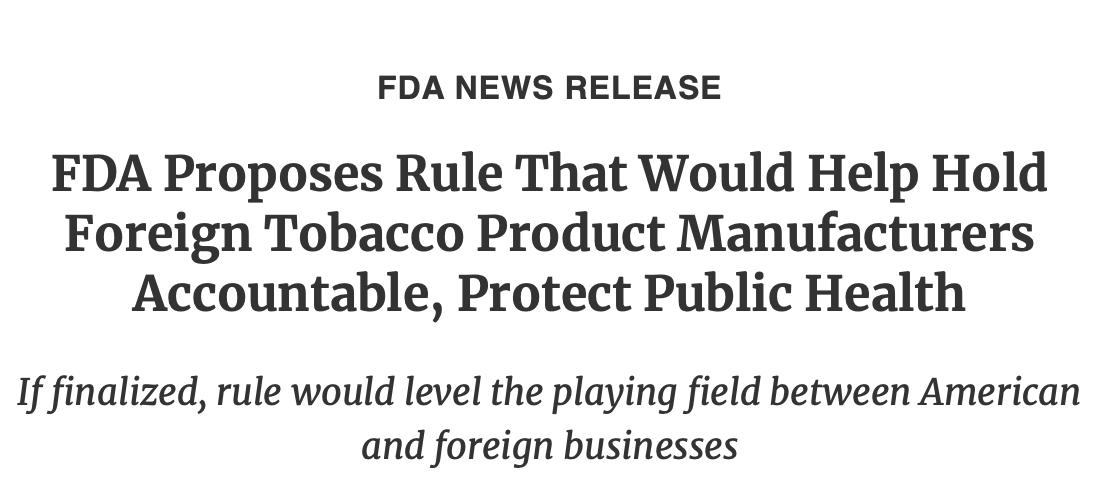
The proposed rule, titled “Establishment Registration and Product Listing for Tobacco Products,” would require foreign establishments that manufacture, prepare, compound or process tobacco products for import or offer for import into the United States to register with FDA and list their products.
FDA has said the proposal would help the agency identify illegal foreign tobacco products more efficiently, including unauthorized e-cigarettes, and support inspections of manufacturing facilities outside the United States.
FDA seeks direct visibility into foreign suppliers
Haysmer said the legal background is direct. Section 905 of the Federal Food, Drug, and Cosmetic Act has required domestic tobacco establishments to register and list products since the Tobacco Control Act was passed in 2009. Section 905(h) gave FDA authority to extend the same requirement to foreign establishments, but only after issuing implementing regulations.
For more than 15 years, FDA did not issue those rules. As a result, Haysmer said, FDA lacked a direct registration and listing mechanism for foreign tobacco establishments comparable to the one applied to U.S. domestic manufacturers.
The point is not that foreign manufacturers were unregulated in their home markets. For Chinese e-cigarette manufacturers, domestic production and export activities are already subject to China’s licensing and export-management framework. The gap identified in the FDA proposal concerns FDA’s own direct visibility into foreign establishments and products intended for the U.S. market.
Without registration and product listing data, FDA lacks systematic information on which foreign facilities are producing which products, in what volumes and under what conditions, Haysmer said.
The gap also affects inspections. FDA can currently inspect a foreign tobacco establishment mainly in the narrower context of a pending premarket tobacco product application, or PMTA, she said. Once registered, a facility would become subject to broader inspection authority under Sections 905(g) and 905(h), expanding FDA’s reach beyond individual product applications.
In a previous interview with 2Firsts, Keller and Heckman partner Azim Chowdhury said the proposal should be understood not merely as a paperwork rule, but as part of FDA’s import enforcement, inspection and market surveillance strategy.
Accorto sees medical-device-style compliance logic
Tobacco is a comparatively newer regulatory category for FDA. The Center for Tobacco Products was established in 2009, decades after FDA had developed mature systems for drugs and medical devices.
Haysmer said FDA is drawing on systems it already understands rather than building an entirely new tobacco framework from scratch. The proposed rule refers to parts of FDA’s existing drug registration and listing framework under 21 CFR Part 207, including parent and affiliate registration provisions, timing standards for foreign establishments and electronic filing waiver structures. She said those mechanisms reflect decades of FDA experience in monitoring domestic and foreign manufacturing establishments.
The point, she said, is not that tobacco products would be regulated as drugs or medical devices. Tobacco products remain subject to their own statutory standards, including the “appropriate for the protection of the public health” standard for new tobacco products. But the proposal shows how FDA may apply administrative and compliance practices familiar from medical device and pharmaceutical regulation to tobacco products.
For companies with experience in FDA drug or medical device regulation, many of the proposed tobacco requirements may feel familiar, including registration cycles, establishment identifiers and foreign establishment provisions.
For many tobacco supply-chain companies without that background, particularly smaller overseas manufacturers, the shift could be more significant.
“This won’t simply be a matter of completing a new form,” Haysmer said. Rather, she said, it could mark the beginning of a more structured approach to compliance than many companies have previously maintained.
Representation is one example. The proposed tobacco rule permits an owner or operator to authorize a third-party agent to handle registration. In practice, Haysmer said, FDA expects a U.S.-based point of contact who understands the regulatory system, not merely someone able to submit paperwork.
Chinese e-cigarette manufacturers should anticipate similar regulatory scrutiny, she said. A logistics partner or distributor would not be enough for serious FDA engagement.
Timing is another lesson from medical devices. Companies that bring in experienced U.S. regulatory support before their first FDA interaction, rather than after receiving a deficiency letter or regulatory challenge, generally fare better on timelines, costs and the overall agency relationship, Haysmer said.
TPMP could add the quality-system layer
The clearest sign that FDA may be developing a broader tobacco compliance architecture is the relationship between the new registration proposal and FDA’s proposed Tobacco Product Manufacturing Practice, or TPMP, regulations.
FDA proposed the TPMP rule in 2023. It has not been finalized. But Haysmer said the new registration and listing proposal directly cites the earlier TPMP proposal when defining who counts as a manufacturer, including specification developers, third-party manufacturers and bulk producers.
That cross-reference suggests FDA is developing these frameworks in parallel and designing them to work together, she said.
“Establishment registration identifies who the relevant parties are. TPMP governs how those parties are expected to operate,” Haysmer said.
Together, the two frameworks begin to resemble the registration-plus-quality-system structure already in place for medical devices, she said.
For tobacco and nicotine product manufacturers, this could be a more important signal than registration alone. A company may be able to collect establishment information and submit product listings. But a quality-system framework raises a different question: whether the company’s operations, documentation, controls, supplier relationships and manufacturing records are ready for FDA scrutiny.
A Full-Chain Compliance and Regulatory System Takes Shape
The proposed rule itself focuses on establishment registration, product listing and related records for tobacco product manufacturers. But when read alongside PMTA requirements, customs enforcement, import alerts, distributor responsibilities and U.S. federal and state-level oversight, it points to a broader compliance system gradually taking shape across the e-cigarette value chain.
Full-chain compliance spans supply chain management, manufacturing, logistics, importation, distribution, retail and marketing. It covers production qualification, product compliance and marketing compliance, as well as market authorization, import enforcement, labeling, advertising, age-gating and federal-to-state regulatory obligations.
The shift goes beyond traceability. As compliance obligations expand across the chain, the commercial interests and regulatory risks of manufacturers, specification developers, brand owners, importers, distributors and retailers become more closely linked. A failure at one point in the chain could create regulatory, commercial or reputational exposure for others.
That may push companies to scrutinize not only their own compliance systems, but also the reliability of suppliers, customers and commercial partners.
Adverse event reporting is one possible future area to watch, Haysmer said, though it remains outside the current proposal. FDA has not proposed a formal tobacco adverse event reporting system in this rule. Such a system does not currently exist for tobacco products in the same formal, ongoing way it does for drugs and medical devices.
But if FDA builds a more complete establishment registry and later finalizes a TPMP-based quality framework, Haysmer said adverse event reporting could become a possible future mechanism for giving the agency feedback on real-world product performance.
Chinese suppliers face uneven pressure
For Chinese e-cigarette supply-chain companies, including OEM and ODM manufacturers, specification developers, brand owners and some component suppliers, Accorto’s immediate advice is not to wait.
“Waiting for a final rule before taking action is a mistake,” Haysmer said.
Immediate priorities include determining whether a facility or entity would be required to register. The proposed rule’s expanded manufacturer definition goes beyond physical production sites to cover specification developers and brand owners that use contract manufacturers. Some companies may find that their U.S.-market activities trigger registration obligations even if they do not view themselves as conventional manufacturers.
Companies also need to identify a qualified U.S. regulatory representative. Haysmer said this is not a role for a distributor or freight forwarder; it requires someone who understands FDA communication expectations and can respond effectively on the company’s behalf during audits or inspections.
Inspection readiness is another priority. Haysmer said companies should recognize that readiness extends beyond the documents required under the registration and listing proposal. A full facility inspection looks at operations as a whole, meaning companies need to prepare the facility, not just records tied to registration and listing.
The impact will not be uniform. Larger manufacturers with existing U.S. regulatory teams and quality systems may need to reassess contractual roles, specification control, supplier qualification, documentation responsibilities and inspection readiness. Smaller factories or trading-led exporters may face a more basic capability test: whether they can build the documentation, regulatory representation and quality-system infrastructure needed for FDA engagement.
Although TPMP has not been finalized, Haysmer said the proposal already gives companies a framework they can begin building against now. Early preparation could give facilities more time to prepare for standards FDA may later apply during inspections.
Registration and product listing would not by themselves make an unauthorized e-cigarette product legal in the U.S. market. Products subject to PMTA requirements still need an appropriate marketing authorization pathway.
But for global e-cigarette manufacturers, including Chinese companies, the signal from the U.S. market is clear. Compliance is no longer only about whether a product has a marketing authorization pathway. It is about whether the broader chain around that product can meet expectations for qualification, documentation, regulatory communication, import control, marketing discipline and inspection readiness.
For the e-cigarette supply chain, the task is therefore not only to watch FDA’s next move. It is to begin upgrading compliance systems now.
2Firsts will continue to follow U.S. market regulation and its implications for global tobacco and nicotine supply chains.

Cover image generated by AI.
Disclaimer
This article is provided solely for professional research, industry discussion, and informational purposes. Any references to brands, companies, products, technologies, or policies are made for factual reporting and analytical purposes only, and do not constitute endorsement, recommendation, promotion, or advertising by 2Firsts.
Nicotine-containing products, including but not limited to cigarettes, e-cigarettes, heated tobacco products, and nicotine pouches, carry significant health risks. Readers are responsible for complying with all applicable laws and regulations in their respective jurisdictions, including age restrictions and access limitations.
The information contained in this article should not be regarded as investment, legal, medical, regulatory, or commercial advice. While 2Firsts strives to ensure the accuracy and reliability of its content, it does not assume liability for any direct or indirect loss arising from errors, omissions, inaccuracies, or reliance on the information contained herein.
This article is not intended for individuals below the legal age for accessing tobacco or nicotine-related information in their jurisdiction.
Copyright Notice
This article is either original content produced by 2Firsts or content reproduced, translated, summarized, or adapted from third-party sources with attribution where applicable. The intellectual property rights of the original content remain with 2Firsts or the respective original rights holders.
No individual or organization may copy, reproduce, distribute, republish, modify, translate, or otherwise use this content without prior authorization. Any unauthorized use may result in legal action.
For copyright-related inquiries, corrections, or removal requests, please contact: info@2firsts.com.
AI-Assisted Translation and Editing Notice
Portions of this article may have been translated, edited, or reviewed with the assistance of artificial intelligence tools to improve efficiency and readability. Due to the limitations of AI-assisted translation and editing, discrepancies, omissions, or inaccuracies may exist when compared with the original source.
Where applicable, readers are advised to refer to the original source for the most complete and accurate information. If you identify any errors or believe that any content infringes upon your rights, please contact us at info@2firsts.com, and we will review and address the matter promptly.