Legal Definition Challenges in Managing Tobacco in Vietnam

Apr.10.2025
Legal Definition Challenges in Managing Tobacco in Vietnam
Vietnam's tobacco management faces legal challenges due to unclear definitions, prompting calls for clarification on e-cigarettes and heated tobacco.

Key Points:

The tobacco management in Vietnam faces challenges due to unclear legal definitions.

The Department of Justice suggests enhancing legislation to clearly define e-cigarettes and heated tobacco products.


According to the Vietnamese newspaper "Frontier," at the seminar "Preventing Tobacco Smuggling: Facing Many Challenges," Deputy Director of the Department of Civil Law and Economic Law of the Vietnamese Ministry of Justice, Lê Đại Hải, detailed the legal difficulties that various government departments are facing in the implementation of the new Resolution No. 173/2024/QH15 on tobacco. He also proposed some recommendations.


Currently, the Tobacco Hazards Prevention Law and related regulations mainly focus on traditional cigarettes, with the definition of new tobacco products still unclear. Despite the ban on the production, operation, import, agency, transportation, and use of new tobacco products set to take effect on January 1, 2025, law enforcement agencies will face significant challenges if they solely rely on the aforementioned resolution.


In order to implement this resolution, it is necessary to introduce corresponding guidance documents that clarify the definitions and differences between e-cigarettes and heated tobacco products. Heated tobacco products are not e-cigarettes; they are tobacco products that are heated using electronic devices instead of being lit, and the cigarette remains intact after use. On the other hand, e-cigarettes rely on electronic devices to vaporize e-liquid, creating an aerosol for inhalation. There are currently various forms of e-cigarette products on the market. The Social Committee and the Committee on Culture and Education of the Vietnamese National Assembly have found that in some schools, vendors are selling e-cigarettes that resemble juice boxes to students, making it difficult to identify these products.


The Justice Department believes that these definitions should be revised and expanded in legal texts to cover new tobacco products on the market, ensuring complete and comprehensive regulation of the law. According to the established procedures for drafting laws and regulations, the drafting body needs to evaluate the impact of policies on different parties. For example, in Resolution 173, if the production and sale of new tobacco products are prohibited, the drafters must explain how this policy will directly and indirectly affect stakeholders.


Previously, investment regulations in Vietnam had categorized tobacco production as a conditionally restricted industry, but had not yet fully banned it.


The Ministry of Justice has recommended that definitions for e-cigarettes and heated tobacco be added to the Tobacco Hazards Prevention Law and Law No. 67 of 2013 to ensure legal consistency and comprehensive management. Drafting agencies are required to report their differing opinions and anticipated consequences to the government for analysis before issuing penalty provisions.


We welcome news tips, article submissions, interview requests, or comments on this piece.

Please contact us at info@2firsts.com, or reach out to Alan Zhao, CEO of 2Firsts, on LinkedIn


Notice

1.  This article is intended solely for professional research purposes related to industry, technology, and policy. Any references to brands or products are made purely for objective description and do not constitute any form of endorsement, recommendation, or promotion by 2Firsts.

2.  The use of nicotine-containing products — including, but not limited to, cigarettes, e-cigarettes, nicotine pouchand heated tobacco products — carries significant health risks. Users are responsible for complying with all applicable laws and regulations in their respective jurisdictions.

3.  This article is not intended to serve as the basis for any investment decisions or financial advice. 2Firsts assumes no direct or indirect liability for any inaccuracies or errors in the content.

4.  Access to this article is strictly prohibited for individuals below the legal age in their jurisdiction.


Copyright


This article is either an original work created by 2Firsts or a reproduction from third-party sources with proper attribution. All copyrights and usage rights belong to 2Firsts or the original content provider. Unauthorized reproduction, distribution, or any other form of unauthorized use by any individual or organization is strictly prohibited. Violators will be held legally accountable.

For copyright-related inquiries, please contact: info@2firsts.com


AI Assistance Disclaimer


This article may have been enhanced using AI tools to improve translation and editorial efficiency. However, due to technical limitations, inaccuracies may occur. Readers are encouraged to refer to the cited sources for the most accurate information.

We welcome any corrections or feedback. Please contact us at: info@2firsts.com

Product | DOJO Launches 0+6ml BLAST7K Fresh in UK in September, Retaining 2+8ml Pod Compatibility Ahead of October Per-Milliliter Vaping Duty
DOJO officially launched the BLAST7K Fresh on September 17, 2026, introducing a UK-market prefilled pod product with 6ml of e-liquid and a manufacturer-rated capacity of up to 7,000 puffs. The device features a 1000mAh rechargeable battery, the INSTA-JUICED structure and COREX BLAST dual-mesh technology, while retaining compatibility with existing BLAST pods. The launch comes less than two weeks before the UK's Vaping Products Duty takes effect on October 1. At the new duty rate, 6ml of vaping liquid would correspond to £1.32 in VPD. DOJO has not stated that the product's 6ml format was designed in response to the new duty.
Sep.20
How Investors Are Repricing the Global Tobacco Industry as Nicotine Markets Shift
How are investors reassessing the global tobacco industry as nicotine markets evolve? In an interview with 2Firsts, Charlie Chen, Head of Research at CCB International Securities, forecasts annual growth of 30–50% for nicotine pouches, outpacing vaping and heated tobacco. He examines how regulatory enforcement, shifting market shares and new business models are influencing company valuations. The report also explores differences between multinational tobacco groups and Chinese companies, drawing on insights from the New Approaches Summit on profitability, investment strategies and industry consolidation.
Nov.11
UK Vape Duty Starts in October as Hayati, DOJO and Others Launch Lower-Capacity Products With Lower Per-Unit Tax
The UK's Vaping Products Duty will take effect on October 1, 2026, at a flat rate of £2.20 per 10ml of vaping liquid. Ahead of implementation, DOJO, PIXL and Hayati have introduced or been reported to be adding lower-capacity tiers alongside larger products. DOJO has added a 6ml BLAST7K Fresh below its 10ml BLAST10K Fresh, PIXL offers both a 12ml 8000 and a 6ml 5K, while retailer Ninja Vapes says Hayati is preparing a 7ml 4K alongside its existing 12ml 6K. The pattern points to a growing lower-capacity tier in the UK market, although the brands have not all explicitly linked the changes to the new duty.
Sep.23
FRE and ALP Push Modern Oral to 48% of Q2 Sales as Turning Point Brands Changes CEO and Lowers Profit-Guidance Ceiling
Turning Point Brands said Executive Chairman David E. Glazek will become CEO on October 1, replacing Graham Purdy, who is stepping down for personal reasons. The company narrowed its 2026 adjusted EBITDA outlook to $70 million-$80 million from $70 million-$90 million while maintaining Modern Oral gross sales guidance of $330 million-$350 million and net sales guidance of $260 million-$270 million. In the second quarter, Modern Oral net sales rose 128% to $68.4 million and accounted for 48% of company-wide net sales. Adjusted EBITDA fell 50% year over year. TPB shares closed about 10% lower on September 21.
Market
Sep.22 by 2Firsts Perspectives
2Firsts Data|China’s Vape-Related Exports Rose 3.3% in August 2026 as UK Shipments Jumped 51.4% and U.S. Exports Fell 12.4%
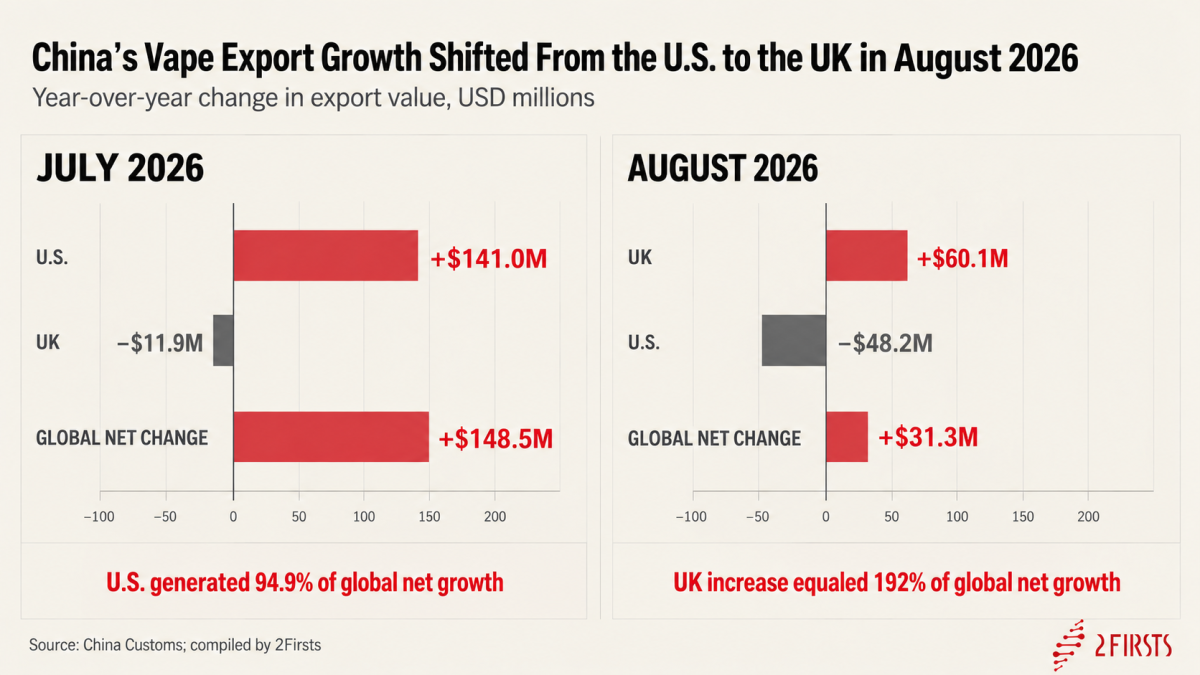
China exported $979 million of vape-related products in August 2026, up 3.3% from a year earlier but down 6.4% from July. The UK replaced the U.S. as the main source of growth: UK-bound shipments jumped 51.4% to a 2026 high of $177 million, while exports to the U.S. fell 12.4% to $339 million. Shipments to markets outside the U.S. increased 14.2%, broadening growth beyond the market that had driven July’s rebound.
News
Sep.23 by 2Firsts Perspectives
New York City Opens Lottery for 55 Vape Retail License Slots Across 23 Community Districts, Including 28 in Brooklyn
New York City's Department of Consumer and Worker Protection (DCWP) opened applications on November 2, 2026, for a lottery covering tobacco and electronic cigarette retail dealer licenses, with a deadline of 5 p.m. New York local time on November 30. According to the city's October 1 notice, 55 electronic cigarette retail license slots are available across 23 community districts, including 28 in Brooklyn, alongside 322 tobacco retail license slots across 41 districts. Businesses must enter the lottery and, if invited, complete licensing requirements within 65 days. New York City continues to restrict e-cigarette retail sales to tobacco-flavored or unflavored products, while city retail licenses do not replace FDA product marketing authorization.
Market
Nov.04