New Zealand Implements Stricter Regulations on E-cigarette Devices

Sep.25.2024
New Zealand Implements Stricter Regulations on E-cigarette Devices
New Zealand health ministry mandates e-cigarettes must have removable batteries and child safety mechanisms by October 1, 2024.

On September 24th, the New Zealand Ministry of Health announced that all e-cigarette devices must be equipped with removable batteries and child safety mechanisms by October 1, 2024. Any devices that do not meet these requirements will not be able to be sold thereafter.


This change is part of the New Zealand government's efforts to crack down on teenage e-cigarette use, as reaffirmed in March of this year. The new regulations also include banning the use of cartoon or toy designs on packaging, as well as restricting flavor names to generic descriptions.


These regulations were initially implemented on October 21, 2023, and only apply to disposable e-cigarette devices. Starting on October 1, 2024, all e-cigarette devices (including reusable devices) must contain removable batteries and child safety mechanisms.


After the new regulations take effect, retailers, importers, and manufacturers will not be able to sell or stock products that do not meet the requirements. Retailers who continue to sell non-compliant products may face fines of up to 50,000 New Zealand dollars (approximately 31,000 US dollars), while larger companies could face fines of up to 400,000 New Zealand dollars (approximately 250,000 US dollars).


We welcome news tips, article submissions, interview requests, or comments on this piece.

Please contact us at info@2firsts.com, or reach out to Alan Zhao, CEO of 2Firsts, on LinkedIn


Notice

1.  This article is intended solely for professional research purposes related to industry, technology, and policy. Any references to brands or products are made purely for objective description and do not constitute any form of endorsement, recommendation, or promotion by 2Firsts.

2.  The use of nicotine-containing products — including, but not limited to, cigarettes, e-cigarettes, nicotine pouchand heated tobacco products — carries significant health risks. Users are responsible for complying with all applicable laws and regulations in their respective jurisdictions.

3.  This article is not intended to serve as the basis for any investment decisions or financial advice. 2Firsts assumes no direct or indirect liability for any inaccuracies or errors in the content.

4.  Access to this article is strictly prohibited for individuals below the legal age in their jurisdiction.


Copyright


This article is either an original work created by 2Firsts or a reproduction from third-party sources with proper attribution. All copyrights and usage rights belong to 2Firsts or the original content provider. Unauthorized reproduction, distribution, or any other form of unauthorized use by any individual or organization is strictly prohibited. Violators will be held legally accountable.

For copyright-related inquiries, please contact: info@2firsts.com


AI Assistance Disclaimer


This article may have been enhanced using AI tools to improve translation and editorial efficiency. However, due to technical limitations, inaccuracies may occur. Readers are encouraged to refer to the cited sources for the most accurate information.

We welcome any corrections or feedback. Please contact us at: info@2firsts.com

UK-Listed Consumer Goods Group Supreme Sees Vape Duty as Potential Consolidation Opportunity, Holds FY27 Outlook
UK-listed consumer goods group Supreme plc says it continues to expect FY27 trading to meet market expectations as the Vaping Products Duty takes effect on October 1, while maintaining a comparatively positive view of the new tax and compliance regime. Supreme has said the framework could increase compliance complexity for smaller operators and contribute to market consolidation, while its manufacturing, compliance and distribution scale may allow it to gain share. Its 88Vape brand will retain its value positioning.
Sep.18
India Steps Up Nicotine Pouch Enforcement as ZYN, White Fox Circulate and Drug Panel Urges Halt to New Nicotine Formulations
India's Ministry of Health and Family Welfare has directed states to step up enforcement against nicotine pouch sales, citing increased availability through online and offline channels and concern about nicotine exposure among children. Reuters reported that international brands including ZYN and White Fox are being sold in India. A study led by ICMR-NICPR found pouches in seven of 10 surveyed locations and identified 68 brands and 445 flavors online. Separately, India's Drugs Technical Advisory Board recommended in August that no new nicotine formulation be approved.
Regulations
Sep.28 by 2Firsts Perspectives
Product | KIWI Launches Spark 2 and Spark 2 Pro in Germany, Two Hardware Tiers Share Backward-Compatible 2ml Pods
KIWI has launched the Spark 2 and Spark 2 Pro refillable pod systems in Germany at official prices of €18 and €29, respectively. Spark 2 uses an 800mAh removable lithium-ion battery in a pen-style body, while Spark 2 Pro features a 1,400mAh removable battery, a box-shaped design and vibration feedback every 20 puffs. Both devices use the same 2ml Spark V2 pods in 0.8Ω and 1.2Ω versions, with AirSync airflow adjustment and a choice between Cotton Tips and conventional Drip Tips. The new pods also remain compatible with the original KIWI Spark.
News
Sep.29 by 2Firsts Perspectives
Pennsylvania Vape Directory Law Survives Court Challenge From Nova Distro and Others Amid Similar Rulings Across States
A U.S. federal court upheld Pennsylvania's vape directory law on October 14, rejecting a challenge brought by Nova Distro, 101 Distributors and companies operating Tobacco Hut retail stores. Court records show that vaping accounts for about 60% of Tobacco Hut's profits and that the chain held approximately $2 million in inventory potentially subject to seizure under the law as of June 2. Pennsylvania began enforcement on October 19. The ruling follows similar appellate decisions in other states, even as new research shows that unlisted vaping products continue to account for substantial sales in states with established directories.
Regulations
Oct.22
2Firsts Interview | Cigarette Sales Fall as Smokeless Alternatives Gain in U.S. Convenience Stores, NACS Says
Ahead of the 2026 NACS Show, 2Firsts interviewed Chris Rapanick, NACS managing director of research, on changes reshaping the U.S. convenience-store tobacco and nicotine market. NACS data show cigarette sales declining while smokeless alternatives, including nicotine pouches, continue to grow. The interview also examines higher OTP margins, shifting backbar space, weaker store traffic, regulatory uncertainty and NACS’ outlook for 2027, offering a retailer-side view of one of the world’s largest nicotine markets.
Interview
Oct.03
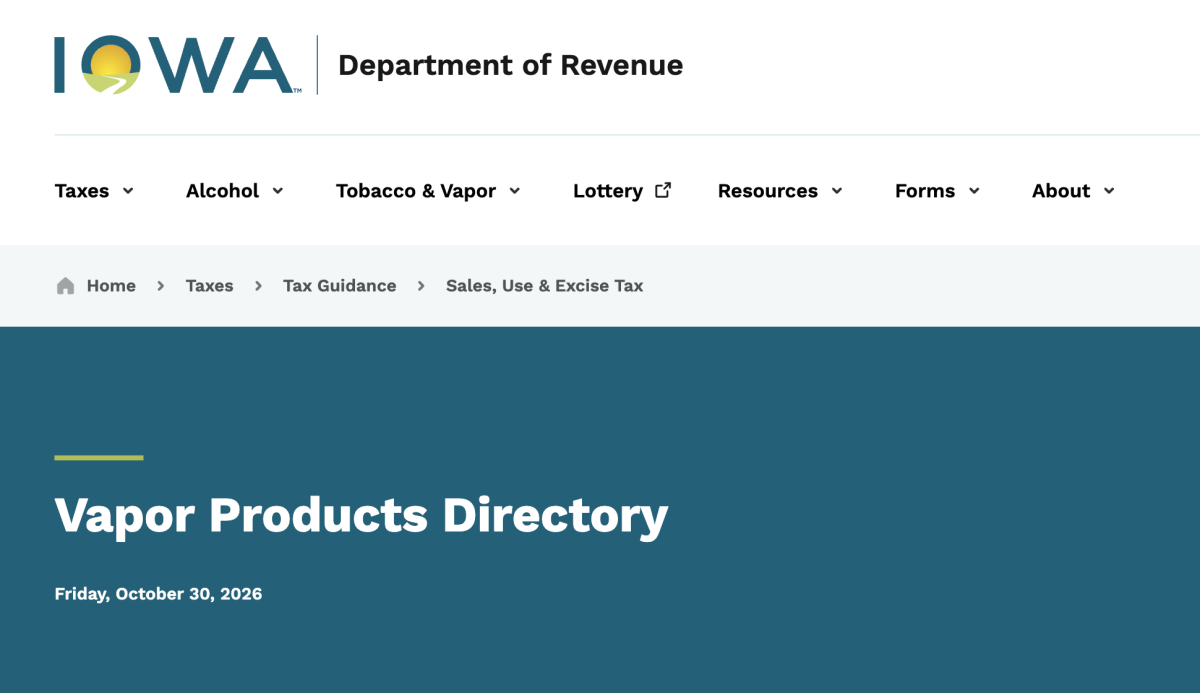
Iowa Sets November 16 Vape Directory Launch: Unlisted Products Face Sales Ban, Manufacturers $1,000 Daily Fines per Product
Iowa plans to publish its first vapor products directory on November 16, 2026, after which products not listed will be prohibited from sale or offer for sale in the state. The Department of Revenue expects to begin penalty enforcement on December 17, following an initial 21-business-day period focused on compliance education. Under House File 2677, retailers, distributors and wholesalers selling unlisted products face civil penalties of $300 per product per day, while manufacturers face $1,000 per product per day. Eligibility extends to FDA-authorized products and certain products meeting historical marketing and pending PMTA requirements. The directory program resumed after a federal appeals court vacated a preliminary injunction in July 2026.
Regulations
Nov.05