Potential Ban on Flavored Tobacco Products in Oregon Upheld

Regulations by 2FIRSTS.ai
Dec.18.2023
Potential Ban on Flavored Tobacco Products in Oregon Upheld
Oregon's ban on flavored tobacco products may take effect in January 2024, despite ongoing appeals from the tobacco industry.

A ruling by a circuit judge in Multnomah County, Oregon, this week stated that a ban on the sale of flavored tobacco products may go into effect in January 2024, despite the ongoing appeal by the tobacco industry against a previous decision upholding the ban, which is being heard by the Oregon Court of Appeals.


Judge Ben Souede ruled on December 13 that the Oregon Tobacco and E-Cigarette Retailers Association, No Moke Daddy, and Paul Bates have a very low likelihood of winning their appeal and that their appeal lacks factual or legal support. As a result, the ban passed by the Commissioner of Multnomah County in December 2022 can now go into effect.


The ruling in Suede is a significant victory for anti-tobacco advocates, who welcome the court's decision.


The tobacco industry targets its audience with candy-flavored tobacco products. We commend the judge's decision to protect future generations in Oregon," said Brittany Grant, Regional Director of the Western region for the Smoke-Free Kids movement. "Big tobacco companies know that candy, fruit, and mint-flavored tobacco products can be addictive for children. We appreciate the courageous leadership of policy-makers and community leaders in Sonoma County.


We welcome news tips, article submissions, interview requests, or comments on this piece.

Please contact us at info@2firsts.com, or reach out to Alan Zhao, CEO of 2Firsts, on LinkedIn


Notice

1.  This article is intended solely for professional research purposes related to industry, technology, and policy. Any references to brands or products are made purely for objective description and do not constitute any form of endorsement, recommendation, or promotion by 2Firsts.

2.  The use of nicotine-containing products — including, but not limited to, cigarettes, e-cigarettes, nicotine pouchand heated tobacco products — carries significant health risks. Users are responsible for complying with all applicable laws and regulations in their respective jurisdictions.

3.  This article is not intended to serve as the basis for any investment decisions or financial advice. 2Firsts assumes no direct or indirect liability for any inaccuracies or errors in the content.

4.  Access to this article is strictly prohibited for individuals below the legal age in their jurisdiction.


Copyright


This article is either an original work created by 2Firsts or a reproduction from third-party sources with proper attribution. All copyrights and usage rights belong to 2Firsts or the original content provider. Unauthorized reproduction, distribution, or any other form of unauthorized use by any individual or organization is strictly prohibited. Violators will be held legally accountable.

For copyright-related inquiries, please contact: info@2firsts.com


AI Assistance Disclaimer


This article may have been enhanced using AI tools to improve translation and editorial efficiency. However, due to technical limitations, inaccuracies may occur. Readers are encouraged to refer to the cited sources for the most accurate information.

We welcome any corrections or feedback. Please contact us at: info@2firsts.com

Russia’s Vape Device Labeling Regime Enters Force: Registration Starts in September, Mandatory Coding in December
Russia's digital labeling regime for reusable e-cigarettes and similar personal vaping devices entered its first mandatory phase in September 2026. From September 1, manufacturers, importers and other market participants must register with the national Chestny ZNAK tracking system. From December 1, newly manufactured and imported covered devices will be required to carry digital identification codes and be reported as entering circulation. Russia has also issued new operational guidance for imports, marking the transition from a voluntary pilot to phased mandatory implementation.
Sep.15
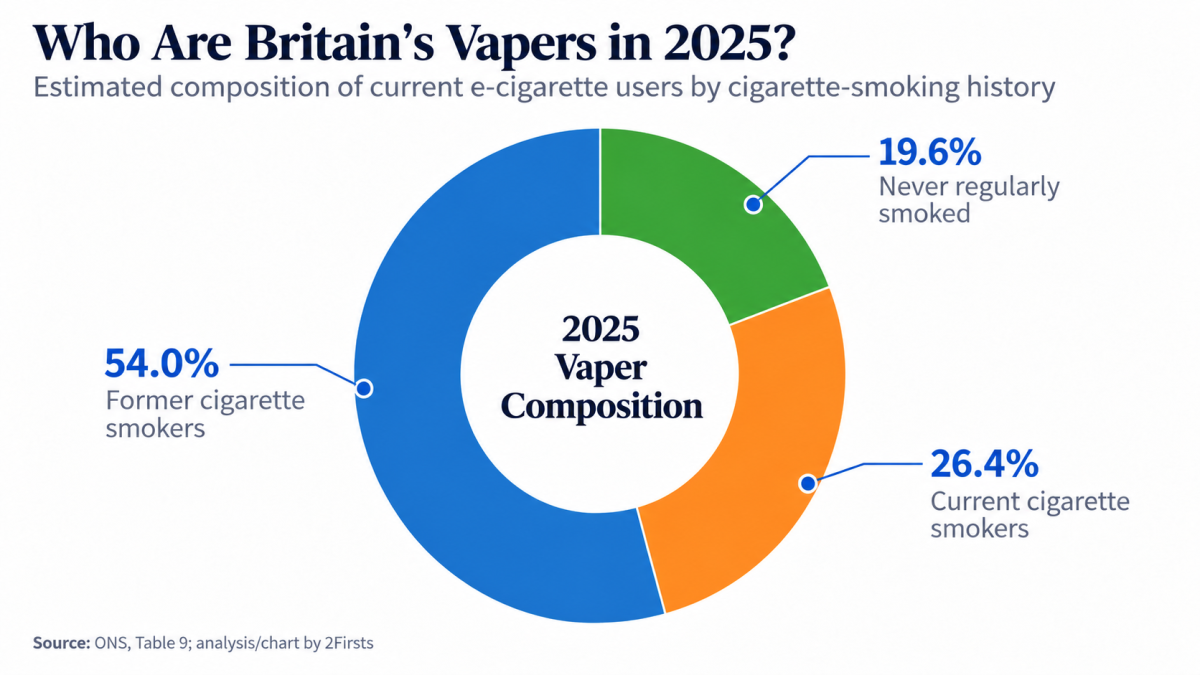
Latest UK ONS Data: 54% of Vapers Are Former Cigarette Smokers, 26% Also Smoke and 20% Never Smoked Regularly
Former cigarette smokers accounted for an estimated 54% of current e-cigarette users in Great Britain in 2025, while 26% also smoked cigarettes and 20% had never regularly smoked, according to a 2Firsts analysis of Office for National Statistics (ONS) data. Among former cigarette smokers who currently vape, approximately 81% used e-cigarettes daily, compared with about 50% of dual users. The ONS found that 33.8% of current cigarette smokers also vaped in 2025, up from 10.6% in 2014. Approximately 1.1 million adults who had never regularly smoked cigarettes used e-cigarettes, representing 2.9% of that population, compared with 0.2% in 2014. The figures highlight differences in the composition, frequency of use and long-term trends across Britain's vaping population.
DATA
Oct.14
Canada Health Minister Says She Is Not Considering Looser Nicotine Pouch Retail Rules as PMI-Linked Group Pushes for Wider Access
Canadian Health Minister Marjorie Michel says she is not considering loosening retail restrictions on nicotine pouches. Canada regulates pouches containing 4 mg or less of nicotine per unit as non-prescription nicotine replacement therapy and requires newer NRT formats such as pouches to be sold from behind pharmacy counters. Meanwhile, Unsmoke Canada, linked to Philip Morris International's Canadian business, is pushing to allow pouches in convenience stores and other general retail outlets. Health Canada also acknowledges continued unauthorized sales, while recent research shows rising pouch use among Canadian youth aged 16 to 19.
Sep.24
Russia's Vape Ban Decisions Reach 17 Regions With 39 More Considering Laws, Putting Over 3,000 St. Petersburg Retail Outlets in Focus
Russia's regional vape retail restrictions are expanding. State Duma Speaker Vyacheslav Volodin said on November 7 that 17 regions had adopted decisions to ban vape sales, while another 39 were preparing or considering similar legislation. On November 12, lawmakers in Leningrad Oblast and the Republic of Karelia adopted bans scheduled to begin on March 1, 2027. A day earlier, St. Petersburg unanimously approved a five-year ban proposal in its first reading. The city has 615 specialist vape shops and more than 2,400 other retail outlets selling vaping products alongside other goods. Under Federal Law No. 186-FZ, enacted in June 2026, Russian regions may prohibit retail sales of electronic nicotine delivery systems and related liquids between March 2027 and March 2032. The legislation also restricts licensed suppliers from delivering covered products to retail premises in regions where bans apply.
Regulations
Nov.13
Former Roche Neuroscience and Rare Diseases Communications Director Ria Kioupritzi Joins PMI as Scientific Affairs Director
Eleftheria (Ria) Kioupritzi, a biopharmaceutical professional with more than 15 years of experience, has joined Philip Morris International as Director Scientific Affairs within Corporate Affairs. She previously served at Roche as Senior Scientific Communications Director for Neuroscience and Rare Diseases and worked extensively in spinal muscular atrophy. Her earlier career also covered competitive intelligence, clinical and regulatory monitoring, pipeline development and launch preparation. During her time working in Roche's SMA field, Evrysdi passed through several U.S. FDA milestones, including its initial approval, an expanded indication for younger infants and approval of a tablet formulation. Public records do not show that Kioupritzi herself led the FDA submissions.
Sep.22
On-Site Report | After FDA Announces Review of PMTA Framework, CTP Director Details Reform Priorities
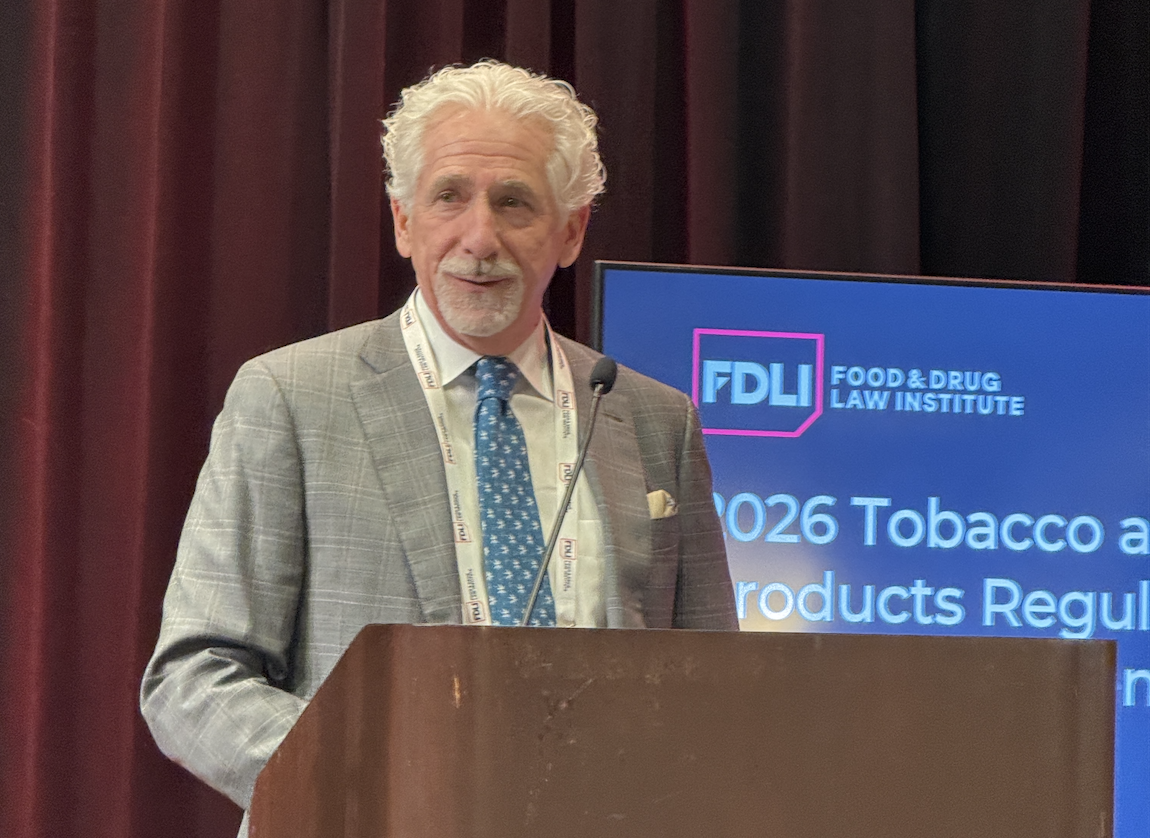
FDA CTP Director Bret Koplow used his FDLI keynote in Washington to outline how the agency is rethinking the PMTA framework. He discussed category-specific review, nicotine pouch and sPMTA pilots, AI-assisted review, a 70% reduction in pending applications, and a major staffing constraint: CTP currently has only nine scientific review teams. He also reaffirmed tobacco harm reduction while stressing youth protection, flavored products, risk communication, and the challenge of unauthorized e-cigarettes.
Regulations
Oct.06