Potential Dangers in Synthetic Cooling Agents in E-cigarettes

Dec.13.2022
Potential Dangers in Synthetic Cooling Agents in E-cigarettes
New study warns of potential health risks from synthetic cooling agents used in e-cigarettes in the US.

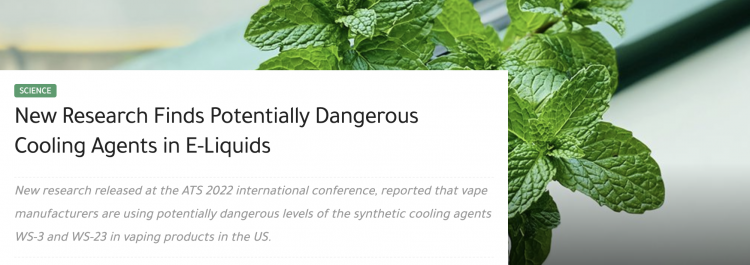
A new research report released at the American Thoracic Society's ATS 2022 International Conference states that electronic cigarette manufacturers in the United States are using synthetic cooling agents WS-3 and WS-23 in their electronic cigarette products, which have the potential to be dangerous.


Due to the popularity of tobacco products with peppermint and menthol flavors, due to their cooling effect, e-cigarette manufacturers have begun to use synthetic versions of these flavors and add them to e-liquids. However, researchers note that to date, there is limited knowledge regarding the ingredients of such cooling agents and their potential health risks.


Dr. Sven Jordt, associate professor of anesthesiology, pharmacology, and cancer biology at Duke University and a researcher on the topic, stated that their findings revealed the addition of a synthetic cooling agent called WS-3 in Juul e-cigarettes sold in Europe, which was the most popular e-cigarette brand at the time. This prompted their investigation of whether e-cigarettes sold in the United States also contained this synthetic cooling agent.


Meanwhile, a recent article in the open-access journal eNeuro published by the Society for Neuroscience discusses a previous American study that found the common green apple-flavored e-liquid chemical, farnesene, stimulates excitatory behavior in the ventral tegmental area of the brain by activating highly-sensitive nAChRs.


In simple terms, the taste of this compound can be addictive. "Whether or not they contain nicotine, flavored electronic cigarettes pose potential risks to the brain and addiction," said lead author Skylar Cooper.


Cooper and her research team have divided their research subjects (mice) into three groups. One group is given nicotine, another is given the green apple flavored compound farnesene, or a combination of both, while the third group is given a saline solution.


Researchers have found that farnesene is a stimulant in and of itself, as mice preferred the farnesene chamber over the saltwater chamber. However, when mixed with nicotine, farnesene was found to further increase stimulation levels.


2FIRSTS will continue to provide coverage on this topic, with updates available on the '2FIRSTS APP.' Scan the QR code below to download the app.


This document has been generated through artificial intelligence translation and is provided solely for the purposes of industry discourse and learning. Please note that the intellectual property rights of the content belong to the original media source or author. Owing to certain limitations in the translation process, there may be discrepancies between the translated text and the original content. We recommend referring to the original source for complete accuracy. In case of any inaccuracies, we invite you to reach out to us with corrections. If you believe any content has infringed upon your rights, please contact us immediately for its removal.


South Korea Moves Against Synthetic Nicotine Regulatory Gap as Three Companies Face Tobacco Business Act Probe
South Korea’s Ministry of Finance and Economy said on May 4 that it requested the Daejeon Metropolitan Police Agency and Gyeonggi Nambu Provincial Police Agency to investigate three sales companies on suspicion of violating the Tobacco Business Act.
May.06 by 2FIRSTS.ai
Kentucky Governor Signs Tobacco, Nicotine, and Vapor Product Licensing Bill Into Law
A Kentucky bill relating to tobacco, nicotine, and vapor product licensing was signed by the governor on April 10, 2026, and enacted as Acts Chapter 70. The measure sets application requirements for tobacco, nicotine, and vapor product licenses, governs batch licensing, renewals, ownership changes, and denial grounds, and requires the Department of Alcoholic Beverage Control to publish application forms and related regulations within 30 days of the law’s effective date.
Apr.14 by 2FIRSTS.ai
Fontem Drops Texas Lawsuit and Plans to Refile in D.C. Over FDA Handling of Zone Application
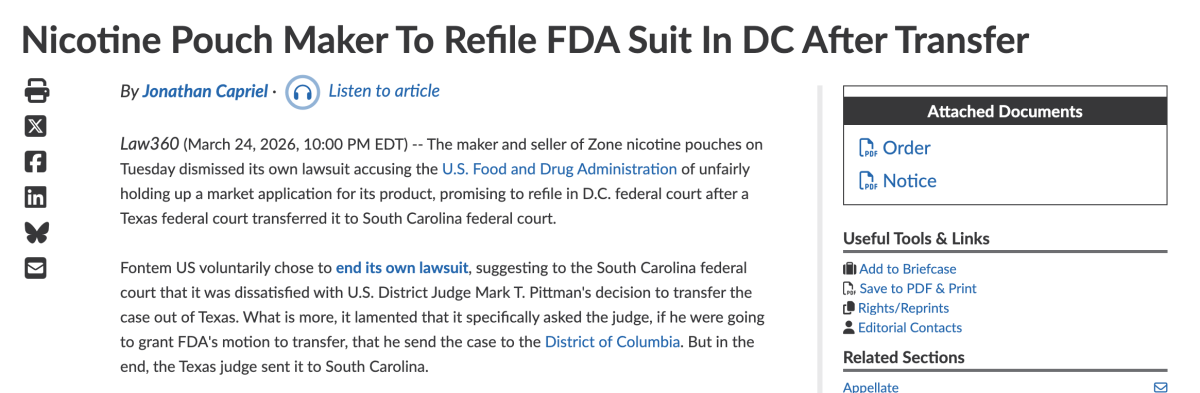
Fontem US, the maker and seller of Zone nicotine pouches, has voluntarily dismissed its lawsuit against the U.S. Food and Drug Administration, which it had accused of unfairly delaying its market application.
Mar.25 by 2FIRSTS.ai
FDA Tobacco Center Pushes Review-Efficiency Statement After Commissioner’s Exit
FDA CTP issued a May 7 statement on accelerating product review and improving PMTA efficiency, but did not push it via official X and newsletter until May 13, one day after FDA Commissioner Marty Makary’s resignation was confirmed. FDA has not explained the delay, and no public evidence links it directly to the leadership change. The timing is notable given CTP’s usual 24-hour distribution practice.
Special Report
May.14
New Zealand Vape Company Alt Becomes Government Partner After Suing Over Nicotine Limits
Health NZ signed a NZD 500,000 contract with New Zealand-owned vape company Alt NZ Limited in December 2025 for its free vape kit programme for smokers, with more than 7,000 kits distributed so far.
Mar.23 by 2FIRSTS.ai
Reuters Exclusive: FDA’s Fast-Track Review of Nicotine Pouches Slows Over Youth and New-User Concerns
Reuters reported on April 1 that several popular nicotine pouch products still have not been cleared for sale in the United States despite a fast-track review pilot run by the U.S. Food and Drug Administration. Three sources said FDA reviewers have taken a cautious approach because of potential risks to youth and other non-tobacco users, including the possibility of driving nicotine addiction among adults who do not already smoke.
Apr.02 by 2FIRSTS.ai