Disclaimer: The content of this article is sourced from the official website and is intended solely for research purposes by industry professionals. Please refer to the official website for all information.
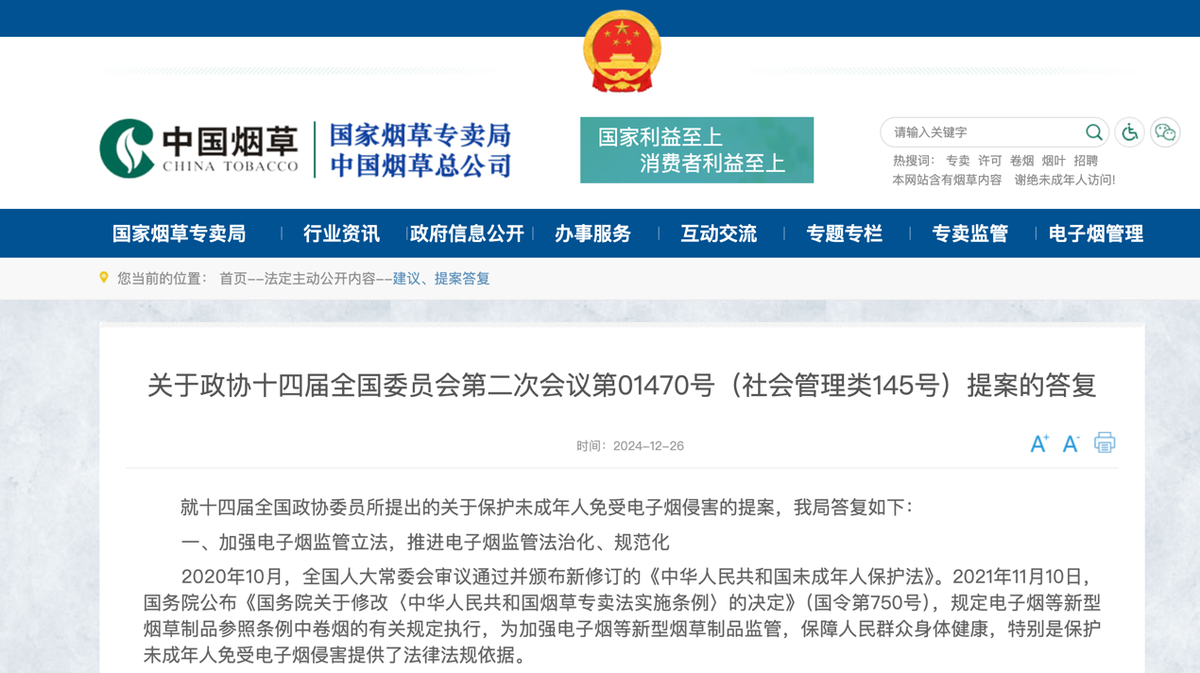
On December 26, 2024, the State Tobacco Monopoly Administration website published its response to Proposal No. 01470 (Social Management Category No. 145) of the Second Session of the 14th National Committee of the Chinese People's Political Consultative Conference. The full text is as follows:
Reply to Proposal No. 01470 (Social Management Category 145) of the Second Session of the Fourteenth National Committee of the Chinese People's Political Consultative Conference (CPPCC)
Regarding the proposal raised by the 14th National Committee of the Chinese People's Political Consultative Conference on protecting minors from the harm of e-cigarettes, our department's response is as follows:
1. Strengthening e-cigarette regulatory legislation to promote the legalization and standardization of e-cigarette regulation
In October 2020, the Standing Committee of the National People's Congress reviewed and issued the newly revised "Law of the People's Republic of China on the Protection of Minors." On November 10, 2021, the State Council issued the "Decision of the State Council on Amending the Regulations on the Implementation of the Tobacco Monopoly Law of the People's Republic of China" (State Council Order No. 750), which stipulates that new tobacco products such as e-cigarettes should be subject to the relevant regulations for cigarettes. This decision aims to strengthen the regulation of new tobacco products such as e-cigarettes, protect the physical health of the people, especially minors, and provide a legal basis for protecting minors from the harm of e-cigarettes.
On March 11, 2022, our department announced the "Regulations on the Management of e-cigarettes", in accordance with the requirements of the "Law of the People's Republic of China on the Protection of Minors" and tobacco monopoly laws and regulations on tobacco regulation. The regulations include provisions on e-cigarette product packaging labeling and warnings, prohibiting the establishment of e-cigarette product sales outlets around primary and secondary schools, special education schools, vocational schools, specialized schools, and kindergartens, as well as prohibiting the sale of tobacco to minors. These regulations provide strong policy support for protecting the legitimate rights and interests of minors and safeguarding their healthy growth. On April 8, 2022, the State Administration for Market Regulation (National Standardization Administration) issued the mandatory national standard for e-cigarettes (GB 41700-2022), which explicitly states that e-cigarette products should not present flavors other than tobacco, in order to prevent the inducement of minors to smoke e-cigarettes by providing scientific and technological standards. Building upon this, China has established a comprehensive "1+2+N" e-cigarette regulatory system, based on the "Implementation Regulations of the Tobacco Monopoly Law", focusing on the "Regulations on the Management of e-cigarettes" and the national standard for e-cigarettes, supported by multiple policy documents. This system provides strong legal guarantees for protecting minors from the harm of e-cigarettes.
2. Strengthen e-cigarette regulatory enforcement to protect the health and growth of minors
In August 2018, our department and the State Administration for Market Regulation jointly issued a notice on banning the sale of e-cigarettes to minors. In November 2019, the two departments once again jointly issued a notice on further protecting minors from the harm of e-cigarettes. Our department, in conjunction with the State Administration for Market Regulation, conducted special inspections of the e-cigarette market from July to September 2020 and from June to September 2021, as well as the "Guarding Growth" special operation to protect minors from the harm of smoking. Starting in February 2022, the Ministry of Public Security, our department, the State Administration for Market Regulation, and the Ministry of Education jointly organized a three-month special crackdown on the illegal sale of e-cigarettes to minors and cracking down on crimes related to e-cigarettes. In November 2022, a special action was launched to crack down on the illegal sale of disguised and modified e-cigarettes such as "milk tea cups" and "cola cans". In 2023 and 2024, continuous efforts were made to conduct special inspections to regulate the e-cigarette market, conducting comprehensive inspections and clean-up at the production source, distribution channels, and retail markets. In May 2024, a special governance action was launched to protect minors from the harm of e-cigarettes, resolutely preventing e-cigarettes from entering primary and secondary school campuses. The joint public security departments successfully cracked down on hundreds of cases of illegal e-cigarettes containing banned substances such as cannabis (commonly known as "heady e-cigarettes"), creating a good environment for protecting minors from the harm of e-cigarettes and promoting the legalization and standardization of the e-cigarette industry.
3. Strengthening public legal education to create a strong public opinion atmosphere for protecting the healthy growth of minors
The organization held a policy briefing session and a press conference to clarify to the public the firm stance and policy orientation of strengthening the supervision of new tobacco products such as e-cigarettes in accordance with the spirit of the State Council's amendment decision. They have proactively voiced their opinions on government websites and relevant media multiple times, strengthening public opinion guidance, providing policy interpretations, and addressing social concerns. They have actively carried out legal education and public awareness campaigns on e-cigarettes in collaboration with the education and health departments through activities such as “entering campuses”, by posting slogans, creating exhibition boards, signing pledges, online video and information dissemination, campus lectures, etc., to enhance minors' self-consciousness in recognizing and resisting e-cigarettes. They have conducted online surveys on e-cigarettes for middle school students in collaboration with the public security departments nationwide. They have produced and released a series of public service short videos titled "Guarding Growth", which have been viewed millions of times online, shared by several mainstream media outlets, and became the main content of the "first lesson of the new school year" in many places. They have also produced a public service advertisement on cracking down on illegal online e-cigarette sales and protecting minors from harm. Central media outlets such as Xinhua News Agency, CCTV, and People's Daily have strengthened publicity and reporting on the supervision of e-cigarettes, creating a sustained public opinion atmosphere for strengthening e-cigarette regulation.
In the next step, our department will continue to enhance the implementation of relevant laws, improve regulatory policies, strengthen joint assessment and cooperation, regulate industry operation, strengthen market supervision, actively promote guidance, comprehensively enhance the comprehensive regulatory efficiency of e-cigarettes in our country, and do everything possible to protect minors from the harm of e-cigarettes.
Reference information:
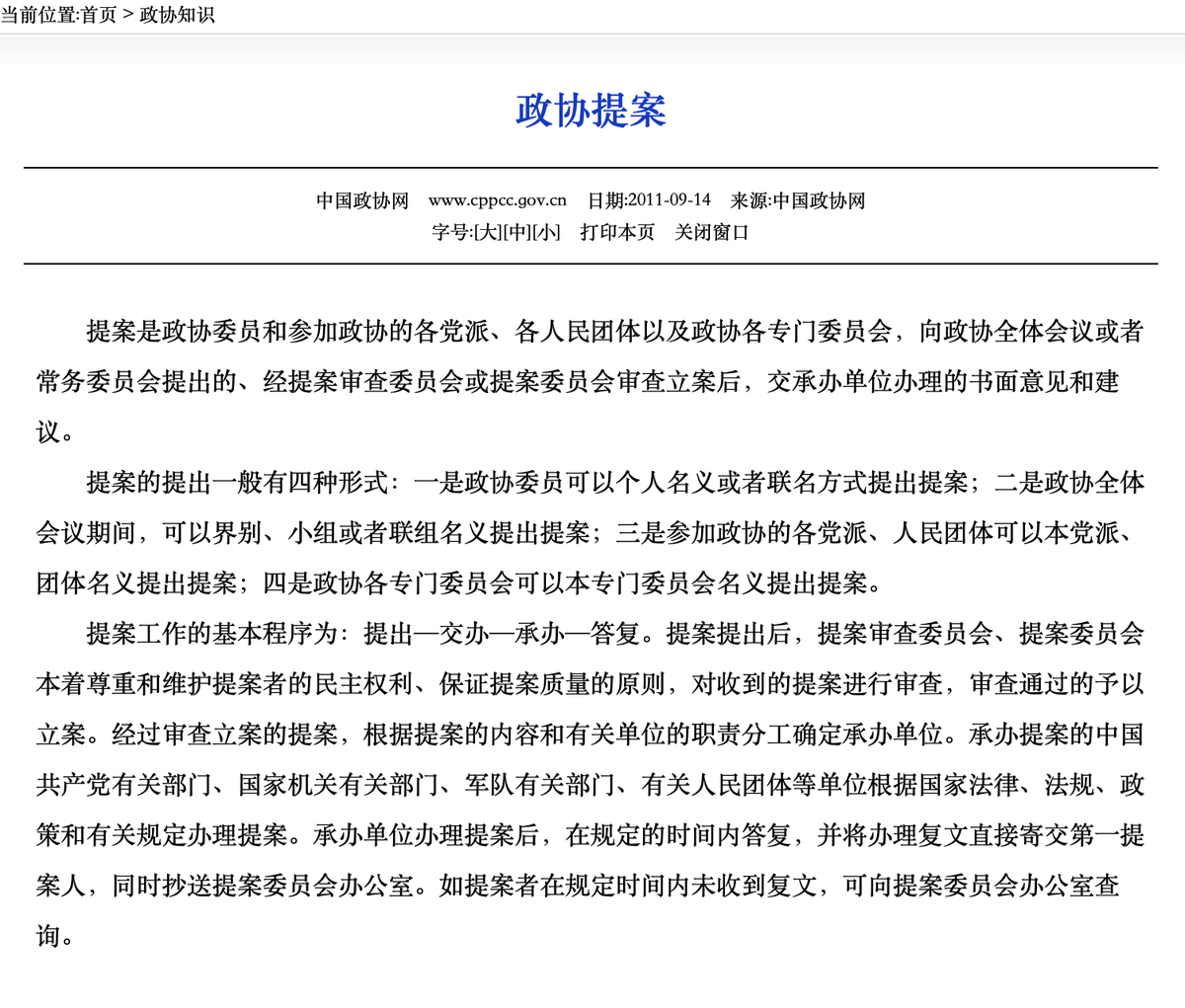
CPPCC Proposal
(Source: CPPCC website www.cppcc.gov.cn Date: 2011-09-14)
The proposal is a written opinion and suggestion submitted by members of the Chinese People's Political Consultative Conference (CPPCC) and representatives of various political parties, people's organizations, and specialized committees of the CPPCC to the plenary session or standing committee of the CPPCC for review and filing by the Proposals Review Committee or Proposal Committee, and then processed by the responsible unit.
Proposals are generally presented in four forms: first, members of the CPPCC can submit proposals in their personal capacity or jointly with others; second, during the full session of the CPPCC, proposals can be submitted in the name of a delegation, a group, or a coalition; third, parties and people's organizations participating in the CPPCC can submit proposals in the name of their party or organization; and fourth, specialized committees of the CPPCC can submit proposals in the name of their committee.
The basic procedure for handling proposals is as follows: proposal submission, assignment, undertaking, and response. After a proposal is submitted, the proposal review committee and proposal committee review the proposals received in accordance with the principles of respecting and safeguarding the democratic rights of the proposers and ensuring the quality of the proposals. Proposals that pass the review are registered. Once a proposal is registered, the unit responsible for handling the proposal is determined based on the content of the proposal and the division of responsibilities among relevant units. The Chinese Communist Party departments, state institutions, military departments, and relevant people's organizations that undertake the proposals handle them in accordance with national laws, regulations, policies, and relevant provisions. After handling a proposal, the responsible unit must respond within the specified time frame and send the response directly to the original proposer, while also providing a copy to the proposal committee office. If the proposer does not receive a response within the specified time frame, they may inquire with the proposal committee office.
We welcome news tips, article submissions, interview requests, or comments on this piece.
Please contact us at info@2firsts.com, or reach out to Alan Zhao, CEO of 2Firsts, on LinkedIn
Notice
1. This article is intended solely for professional research purposes related to industry, technology, and policy. Any references to brands or products are made purely for objective description and do not constitute any form of endorsement, recommendation, or promotion by 2Firsts.
2. The use of nicotine-containing products — including, but not limited to, cigarettes, e-cigarettes, nicotine pouchand heated tobacco products — carries significant health risks. Users are responsible for complying with all applicable laws and regulations in their respective jurisdictions.
3. This article is not intended to serve as the basis for any investment decisions or financial advice. 2Firsts assumes no direct or indirect liability for any inaccuracies or errors in the content.
4. Access to this article is strictly prohibited for individuals below the legal age in their jurisdiction.
Copyright
This article is either an original work created by 2Firsts or a reproduction from third-party sources with proper attribution. All copyrights and usage rights belong to 2Firsts or the original content provider. Unauthorized reproduction, distribution, or any other form of unauthorized use by any individual or organization is strictly prohibited. Violators will be held legally accountable.
For copyright-related inquiries, please contact: info@2firsts.com
AI Assistance Disclaimer
This article may have been enhanced using AI tools to improve translation and editorial efficiency. However, due to technical limitations, inaccuracies may occur. Readers are encouraged to refer to the cited sources for the most accurate information.
We welcome any corrections or feedback. Please contact us at: info@2firsts.com