Reynolds Appeals ITC Defeat in Disposable Vape Section 337 Case to U.S. Federal Circuit

Mar.16
Reynolds Appeals ITC Defeat in Disposable Vape Section 337 Case to U.S. Federal Circuit
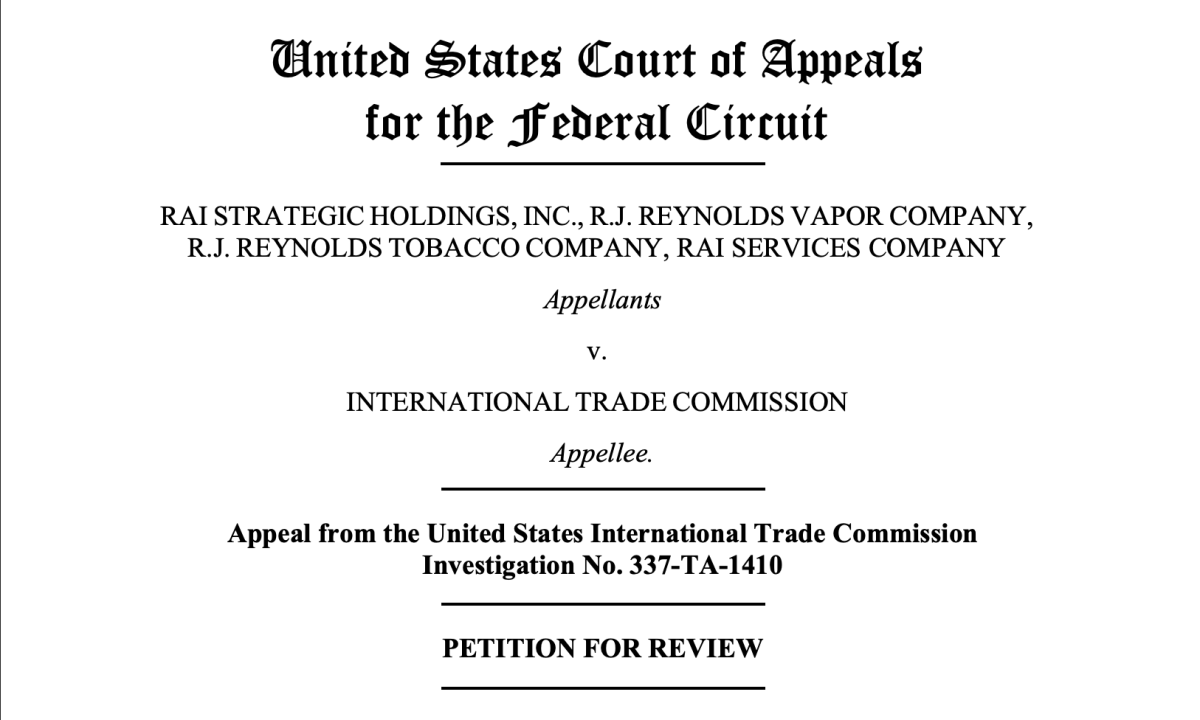
On March 13, 2026, R.J. Reynolds and related companies filed an appeal with the U.S. Court of Appeals for the Federal Circuit, seeking review of the U.S. International Trade Commission’s final ruling in the disposable vape Section 337 investigation.

Key Takeaways


  • Reynolds filed an appeal on March 13, 2026 with the U.S. Court of Appeals for the Federal Circuit seeking review of the ITC’s March 10 final ruling.
  • The ITC invalidated claims 1, 4 and 12 of U.S. Patent No. 11,925,202 and terminated the Section 337 investigation.
  • The investigation began on July 22, 2024 and involved 35 disposable vape companies.
  • In August 2025, the administrative law judge found infringement of claims 4 and 12 and recommended a general exclusion order and a 136% bond.
  • Reynolds paid a USD 600 filing fee when submitting the appeal.


2Firsts, March 16, 2026


R.J. Reynolds and its related companies have filed an appeal with the U.S. Court of Appeals for the Federal Circuit seeking to overturn the U.S. International Trade Commission’s final ruling in the disposable vape Section 337 investigation, Investigation No. 337-TA-1410.


The case began on July 22, 2024, when the ITC instituted a Section 337 investigation based on Reynolds’ complaint against 35 companies accused of infringing U.S. Patent No. 11,925,202. The respondents included Chinese manufacturers and U.S. brands such as Breeze Smoke, Kangvape and IVPS.


On August 29, 2025, the ITC administrative law judge issued a final initial determination finding that the respondents infringed claims 4 and 12 of the “202 patent” and that those claims were valid. The administrative law judge also recommended that the ITC issue a general exclusion order and impose a 136% bond.


The respondents later petitioned for review. On January 9, 2026, the ITC Commission decided to review portions of the administrative law judge’s determination, focusing on patent validity.


On March 10, 2026, the ITC issued its Commission Opinion and final determination, reversing the administrative law judge and holding that claims 1, 4 and 12 of the “202 patent” were invalid. The Commission also found no violation of Section 337 and terminated the investigation.


According to the original report, the ITC concluded that the claimed invention would have been obvious to a person of ordinary skill in the art in view of the Kim reference, U.S. Patent App. Pub. No. 2006/0016453, and the Pienemann reference, WO 00/28843.


With respect to porous wicking, the ITC said that using porous material to store and guide liquid was a basic principle and that a skilled person would naturally consider such a design to improve e-cigarette function.


With respect to airflow and heater structure, the ITC said the prior art had already disclosed central passageways and heating coil structures, and that allowing air to pass through the heater and mix with aerosol was a conventional design choice.


Three days after the ITC issued its final ruling, Reynolds filed a petition for review with the U.S. Court of Appeals for the Federal Circuit on March 13, 2026, and paid a USD 600 filing fee. According to the original report, Reynolds asked the court to review all adverse rulings issued by the ITC on March 10.


The original report also said the case affects Reynolds’ position in the reduced-risk product market and the ability of the respondent Chinese vape manufacturers and U.S. distributors to continue operating in the U.S. market.


Related reading:
 

2FIRSTS | Special Report|Reynolds’ 337 Patent Case Ends, but a Harsher 337 Compliance Battle Now Targets the Entire Vape Supply Chain
The U.S. International Trade Commission (ITC) has terminated Investigation 337-TA-1410 after invalidating key vape patent claims asserted by R.J. Reynolds Vapor Company, removing the immediate risk of import bans for dozens of companies. However, a new case—337-TA-1486—has already opened a more consequential legal front, shifting the focus from patent disputes to regulatory compliance across the vape supply chain, including PACT Act reporting, tax compliance, and FDA marketing authorization.
www.2firsts.com


We welcome news tips, article submissions, interview requests, or comments on this piece.

Please contact us at info@2firsts.com, or reach out to Alan Zhao, CEO of 2Firsts, on LinkedIn


Notice

1.  This article is intended solely for professional research purposes related to industry, technology, and policy. Any references to brands or products are made purely for objective description and do not constitute any form of endorsement, recommendation, or promotion by 2Firsts.

2.  The use of nicotine-containing products — including, but not limited to, cigarettes, e-cigarettes, nicotine pouchand heated tobacco products — carries significant health risks. Users are responsible for complying with all applicable laws and regulations in their respective jurisdictions.

3.  This article is not intended to serve as the basis for any investment decisions or financial advice. 2Firsts assumes no direct or indirect liability for any inaccuracies or errors in the content.

4.  Access to this article is strictly prohibited for individuals below the legal age in their jurisdiction.


Copyright


This article is either an original work created by 2Firsts or a reproduction from third-party sources with proper attribution. All copyrights and usage rights belong to 2Firsts or the original content provider. Unauthorized reproduction, distribution, or any other form of unauthorized use by any individual or organization is strictly prohibited. Violators will be held legally accountable.

For copyright-related inquiries, please contact: info@2firsts.com


AI Assistance Disclaimer


This article may have been enhanced using AI tools to improve translation and editorial efficiency. However, due to technical limitations, inaccuracies may occur. Readers are encouraged to refer to the cited sources for the most accurate information.

We welcome any corrections or feedback. Please contact us at: info@2firsts.com

Thailand’s Bangkok Port Customs Reports E-Cigarette and Nitrous Oxide Seizure Worth More Than THB 27 Million
Bangkok Port Customs on April 28 announced the seizure of 52,000 complete e-cigarettes, 100 gallons of e-liquid and 126,226 canisters of nitrous oxide, with total economic damage exceeding THB 27 million, or about USD 831,178 based on an April 28 USD/THB rate of 32.484. The e-cigarette and e-liquid shipment was valued at THB 5.56 million, or about USD 171,161, while the nitrous oxide shipment was valued at THB 21.27 million, or about USD 654,784.
Apr.29 by 2FIRSTS.ai
 Bangladesh Approves Amended Tobacco Control Law Expanding Ad Bans and Smoke-Free Areas
Bangladesh Approves Amended Tobacco Control Law Expanding Ad Bans and Smoke-Free Areas
Bangladesh’s new government has approved a broad tobacco control amendment that bans tobacco advertising, promotion and display across print, electronic, digital and social media, entertainment platforms and points of sale. The law does not cover newer products such as vapes, heated tobacco products, electronic nicotine delivery systems or nicotine pouches.
Apr.22 by 2FIRSTS.ai
South Korea Expands Tobacco Harmful Components Testing System to Cover Synthetic Nicotine Liquid Vapes
South Korea’s Ministry of Food and Drug Safety said on April 17 that it has additionally designated the International Characterization Research Institute as a tobacco harmful components testing body under the Act on the Management of Tobacco Harmfulness. The institute has research experience in analyzing harmful components in liquid e-cigarettes and has obtained recognition for tobacco-sector ISO 17025 requirements.
Apr.17 by 2FIRSTS.ai
Imperial Brands Pulls myblu Vape Business From U.S., Citing Prolonged FDA Approval Process
Imperial Brands said it will phase out its myblu vaping business in the United States, citing prolonged FDA approval timelines for new vape products. The company said it will instead focus on modern oral nicotine products in the U.S., including the expansion of its Zone brand and new flavors. While overall next-generation product revenue continued to grow, revenue from the category in the Americas declined sharply.
May.12
More Than 500 Stores in Russia’s Nizhny Novgorod Region Voluntarily Stop Selling Vapes
According to the Nizhny Novgorod regional government, 550 stores in the region have voluntarily removed vapes and e-liquids from their product assortments. Regional officials said a public offer encouraging businesses to self-restrict vape sales has been in place since September 2025, and that a large retail chain with more than 40 outlets in Nizhny Novgorod joined the initiative. The regional government also said a federal ban on vape sales is expected in the near future.
Apr.15 by 2FIRSTS.ai
The new regulations on nicotine in Argentina are creating caution, expectations, and doubts about the market, according to a local reference in harm reduction for smoking.
The new Argentine framework for tobacco and nicotine marks a shift from prohibition towards registration, traceability, and health surveillance. Juan Facundo Teme told 2Firsts that adult consumers and some of the commercial sector are cautiously optimistic, although concerns remain about flavors, registration costs, and market access.
May.11