Key Points
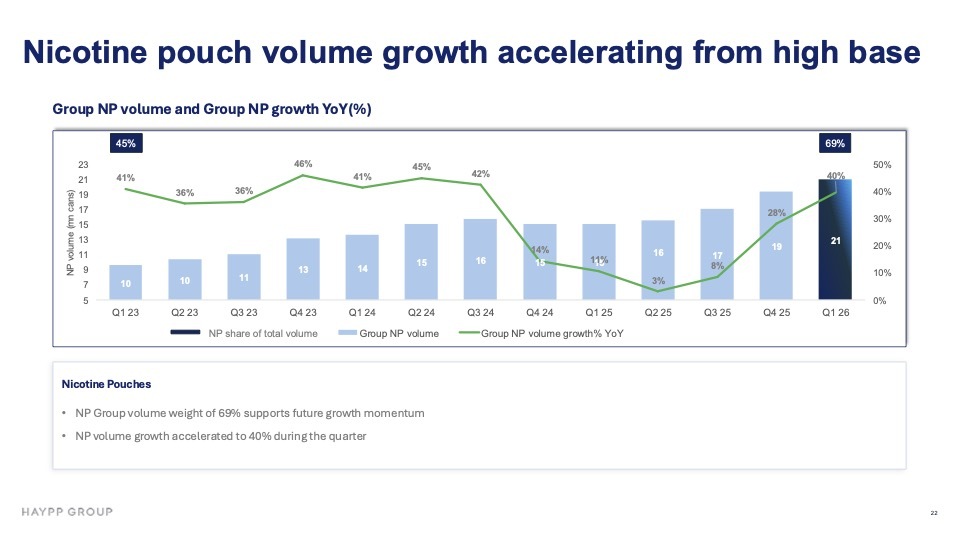
- Haypp’s nicotine pouch volumes rose 40% year-on-year in Q1 2026, accounting for 69% of total group volume.
- The U.S. and U.K. were key growth markets, with pouch volumes up 123% and 102%, respectively.
- Haypp says around 97% of its consumer traffic is organic, pointing to a growing digital shelf advantage.
- Its Media & Insights business extends Haypp beyond online retail into consumer data and trial activation.
- For international tobacco companies, Haypp may be both a growth partner and a future source of channel leverage.
2Firsts
May 22, 2026
Haypp’s first-quarter 2026 results show that nicotine pouches have become the company’s core growth category. The company said total group volume rose 23% year-on-year, while nicotine pouch volume increased 40%. Nicotine pouches accounted for 69% of total group volume. In the Growth segment, nicotine pouch volume rose 83%, with volumes in the U.S. and U.K. increasing 123% and 102%, respectively.
The growth was also reflected in Haypp’s financial performance. The company said net sales rose 19.6% year-on-year, or 24.3% at constant currencies, while gross profit increased 20.1% and gross margin stood at 18.6%. At the same time, Haypp said investments in its U.S. and U.K. organizations, higher marketing spending in the Growth segment and expansion into new geographies weighed on adjusted EBIT.
Over a longer period, Haypp’s growth is not a single-quarter event. The company’s presentation shows a nicotine pouch volume CAGR of around 32% from 2021 to 2025, net sales CAGR of around 14%, and adjusted EBIT CAGR of around 38%. That suggests nicotine pouches are not only driving Haypp’s latest quarterly performance, but have also been central to the company’s business transformation in recent years.
Haypp has also set ambitious 2028 targets. Relative to 2024, the company aims to double revenue and increase adjusted EBIT by three to four times. It targets revenue CAGR of 18% to 25% at constant currencies from 2024 to 2028, and an adjusted EBIT margin of 5.5%, plus or minus 150 basis points. The company says the targets are largely driven by U.S. growth.
The data suggests that Haypp is no longer merely a Nordic online retailer built around snus. It is shifting toward a modern oral platform centered on nicotine pouches. The category is also moving beyond its Nordic smokeless-tobacco roots and becoming a faster-moving, cross-market consumer segment.After ZYN: Competition Moves From Brand Education to Consumer Access
In recent years, global nicotine pouch growth has been driven largely by brand education. ZYN’s expansion in the U.S. helped make modern oral nicotine a major growth focus for international tobacco companies. For large tobacco groups, nicotine pouches are increasingly viewed as an important alternative growth category as cigarette consumption declines.
But Haypp’s growth raises another question: once consumers understand what nicotine pouches are, will the next phase of competition still be only about brands? Or will it move further into channels, data and consumer access?
In 2Firsts’ view, ZYN can be seen as a marker of the brand-education phase of nicotine pouches, while Haypp offers a window into the next phase of channel and data competition. Brands remain important. But if consumers make purchasing decisions through search results, online platforms, on-site recommendations and email communication, platforms that control the digital purchase path may gain influence over how the category develops.
This shift matters especially for international tobacco companies. In the past, brand owners mainly competed for convenience-store shelves, distribution networks and physical retail visibility. As modern oral sales move further online, search ranking, platform recommendations, brand pages and consumer data are becoming new channel assets.
Haypp’s presentation also shows that online penetration varies across markets. Some Nordic markets already have a relatively high online base, while growth markets such as the U.S. and U.K. may still have room for further online migration. For Haypp, this means growth may come not only from the nicotine pouch category itself, but also from channel migration as the category becomes more digital.
The Digital Shelf: Organic Traffic, Platform Recommendations and Product Data
Haypp says around 97% of its consumer traffic is organic, with paid traffic accounting for about 3%. The company says this has two effects: marketing costs remain at only 1% to 2% of revenue, and search dominance creates a barrier to entry.
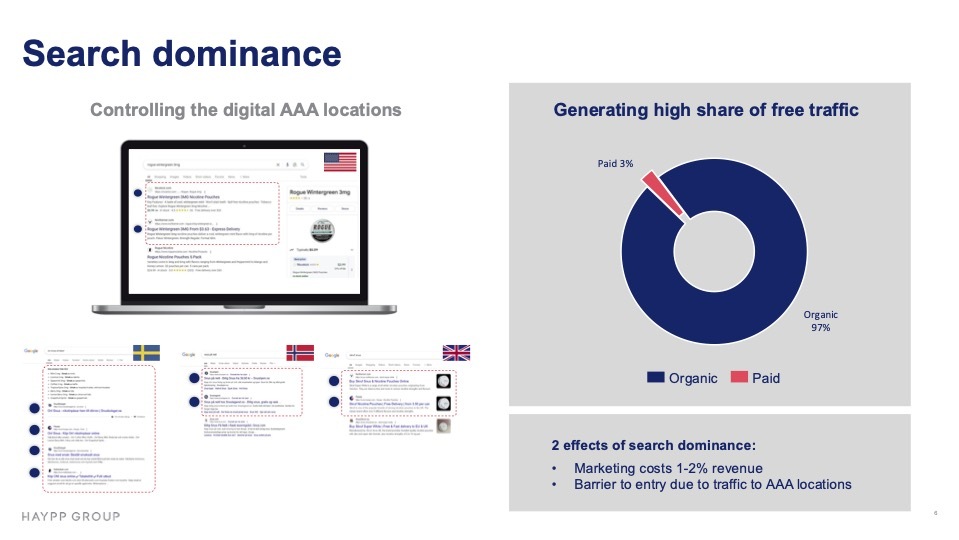
This is the core of the “digital shelf.” In physical retail, convenience-store shelf space determines product visibility. Online, search ranking, on-site recommendations, brand pages and checkout upsell positions play a similar role. For nicotine pouch brands, Haypp is evolving from a sales channel into a manager of the digital shelf.
That platform value is particularly visible in nicotine pouches. Haypp’s presentation says roughly one-third of current nicotine pouch sales come from products that did not exist 12 months earlier. The company also shows a rising number of new launches across Sweden, the U.K. and the U.S.
This suggests that nicotine pouches are not a traditional tobacco category with stable SKUs. They are a fast-iterating consumer category. Flavors, strengths, packaging and brand positioning continue to change, while consumers are willing to try new SKUs. The more products enter the category, and the more complex consumer choice becomes, the more valuable platforms become if they can track trial, repurchase, conversion and price sensitivity.
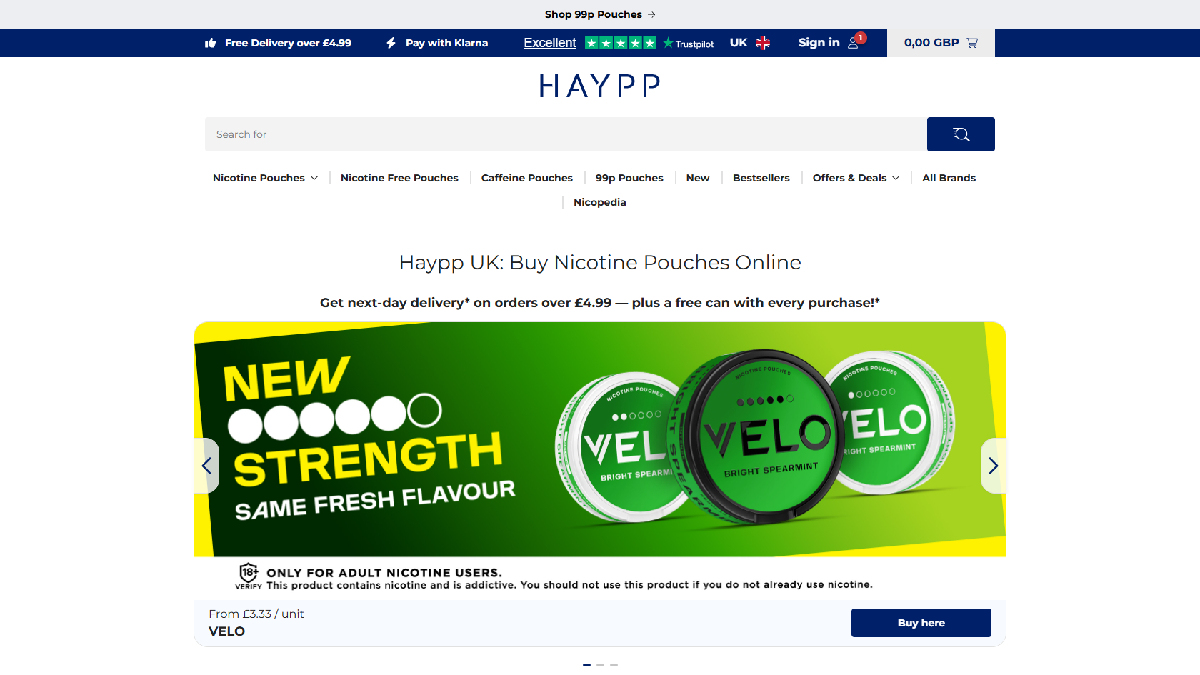
Haypp’s Media & Insights business reinforces this logic. The company says around 90% of revenue comes from product sales and around 10% from Media & Insights. Its media ecosystem includes sponsored listings, search bar visibility, mail communication, on-site communication, brand pages, checkout upsell and consumer insights. Haypp also says Media 2.0 has been rolled out across all markets and can generate two to four times the share of trials.
This means Haypp’s strategic value lies not only in selling nicotine pouches, but in potentially becoming a platform for consumer feedback, product testing and purchase influence. Future nicotine pouch launches may rely not only on brand advertising, but increasingly on platform recommendations, trial conversion and consumer data.
4. Compliance: Moat or Growth Boundary?
For online nicotine retail, compliance is not a background issue. It is part of the business model. Haypp identifies “Legal Age Access Only” as a priority and says it uses providers including Veratad in the U.S. for age-verification systems. The company also notes that U.S. federal, state and local regulations create a complex environment, while complex compliance implementation at low transaction costs can strengthen Haypp’s scale advantage.
This is an important part of Haypp’s investor narrative: regulatory complexity is not only a cost, but may also become a barrier to entry for platform businesses. For smaller online sellers, age verification, product access rules, local requirements, marketing restrictions and tax compliance can raise operating difficulty. For platforms with systems, scale and supplier relationships, compliance requirements may support channel consolidation.
That logic, however, needs to be balanced. If regulation raises standards for age verification, product access and compliant online sales, it may favor scaled platforms. But if regulators move to restrict online sales, reduce available SKUs, increase tax burdens or limit digital marketing, Haypp’s growth potential could also be constrained.
For Haypp, compliance may become both a moat and a boundary. For brand owners, Haypp may offer a more controlled and compliant online channel. At the same time, they need to assess their visibility on the platform, access to consumer data and the risk of channel dependence.
5. U.S. and U.K. Test Markets: Big Tobacco Reassesses Channel Power
The U.S. is not only a source of growth for Haypp, but also a key test of whether its platform model can scale internationally. Haypp says its 2028 targets are largely driven by U.S. growth. The U.S. is one of the most important growth markets for modern oral nicotine, but it also has a complex federal, state and local regulatory environment. Whether Haypp can scale in the U.S. will help determine whether it can evolve from a Nordic online retailer into a global modern oral platform.
The U.K. offers another test case. Haypp says U.K. nicotine pouch regulation is improving as the Tobacco and Vapes Bill advances. If the market moves into a clearer regulatory framework, compliant online platforms may gain more formal room to grow.
For international tobacco companies, Haypp is not only a fast-growing channel. It may play three roles at once. First, it is a partner that can help brands reach online consumers, activate product trials and provide data feedback. Second, it is a channel intermediary that controls search traffic and digital shelf visibility, influencing brand exposure. Third, it may become a future bargaining counterparty by owning part of the consumer gateway through data and traffic.
Haypp’s growth therefore raises several strategic questions for international tobacco companies: Should they deepen cooperation with platforms like Haypp? Do they need to build their own DTC, CRM and consumer data systems? How should they balance platform efficiency with channel control? Should launch budgets shift further toward online testing and trial conversion? And how should compliance responsibilities be allocated among brands, platforms and logistics providers?
Haypp’s investor presentation suggests that the nicotine pouch market is entering a second phase of competition. The first phase was driven by brand-led consumer education. The next phase may be shaped by digital shelves, search traffic, trial conversion, consumer data and compliant distribution. For international tobacco companies, the key question is no longer only how to launch the next successful nicotine pouch brand, but who will control the consumer relationship, the compliance gateway and the digital shelf.
(Cover Image:generated by AI. )

This document has been generated through artificial intelligence translation and is provided solely for the purposes of industry discourse and learning. Please note that the intellectual property rights of the content belong to the original media source or author. Owing to certain limitations in the translation process, there may be discrepancies between the translated text and the original content. We recommend referring to the original source for complete accuracy. In case of any inaccuracies, we invite you to reach out to us with corrections. If you believe any content has infringed upon your rights, please contact us immediately for its removal.