Key Points
- Cross-border inquiry: South Korean lawmaker Chung Jin-uk asked China’s tobacco regulator to clarify rules for producing and exporting e-cigarettes containing synthetic nicotine.
- Diverging export interpretations: Chung said China’s current licensing framework effectively rules out such exports, while South Korea’s Ministry of Finance and Economy said they were not subject to a blanket ban.
- Tax dispute: Chung estimated a potential tax shortfall of 16 trillion to 20 trillion won, though South Korean tax and customs authorities have not confirmed the figure.
- Regulatory gap: South Korea has brought nicotine products under tobacco regulation, but some technical standards remain incomplete.
- Global impact: China’s licensing, traceability and export rules have international significance because the country produces more than 90% of the world’s e-cigarettes.
2Firsts
July 10, 2026
A South Korean lawmaker has asked China’s tobacco regulator to clarify rules governing the production and export of e-cigarettes containing synthetic nicotine, according to Korean media, after he and South Korea’s finance ministry offered different interpretations of the Chinese framework.
The dispute points to a broader problem in aligning destination-market standards with China’s export controls. When a country has brought a product under regulation but has yet to complete its technical standards, exporters and regulators may disagree over which requirements apply and how compliance should be verified.
South Korean lawmaker asks China about synthetic nicotine
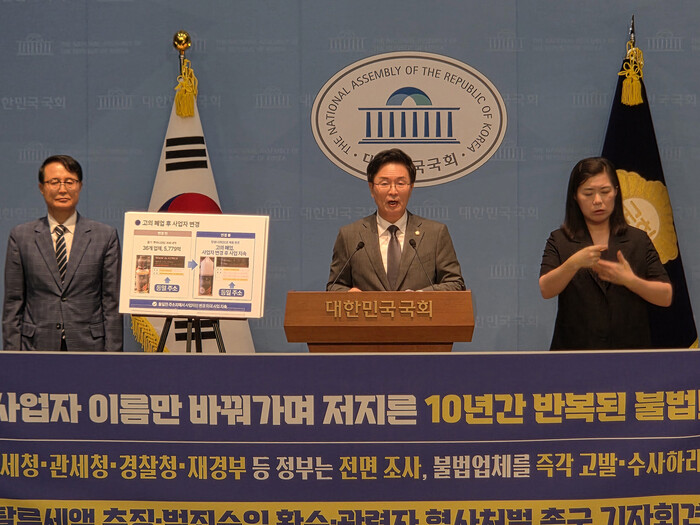
Democratic Party lawmaker Chung Jin-uk(정진욱) submitted questions to China’s State Tobacco Monopoly Administration through the South Korean embassy in Beijing, Weekly Chosun reported on July 5.
The inquiry asked whether Chinese authorities could grant an exception when a foreign company commissions a Chinese manufacturer to produce, solely for export, e-cigarettes using non-tobacco-derived nicotine, or synthetic nicotine.
The report quoted the State Tobacco Monopoly Administration as saying that its licensing rules contained no exception for the use of synthetic nicotine.
The regulator also cited Article 9 of China’s Administrative Measures for E-cigarettes, under which companies engaged in the production or operation of e-cigarette products, aerosol-generating materials or nicotine for e-cigarettes must obtain a tobacco monopoly production enterprise license.
Products made exclusively for export must comply with the laws, regulations and standards of their destination market, the regulator was quoted as saying. Where the destination market has no relevant requirements, Chinese laws, regulations and standards apply.
Jeong interpreted the response as meaning that China’s licensing system provides no special production or export route for e-cigarettes containing synthetic nicotine.
South Korea’s Ministry of Finance and Economy took a different view. It said the production of synthetic nicotine solution was tightly regulated in China, but that exports were not subject to a blanket ban and that there were no special rules governing shipments to South Korea.
The inquiry followed questions over whether nicotine products entering South Korea had been declared consistently with their actual composition and production status in China.
At a June 23 news conference at the National Assembly, Jeong alleged that some companies may have imported e-cigarettes containing tobacco-derived nicotine from China while declaring them as synthetic-nicotine products to avoid tobacco-related taxes.
Jeong estimated that products declared as synthetic nicotine since 2016 were equivalent to about 300 million 30-ml bottles. Applying an average tax burden to that volume, he put the potential tax shortfall at between 16 trillion won and 20 trillion won, or about $10.7 billion to $13.3 billion.
The estimate has not been confirmed as an actual tax loss by South Korean tax or customs authorities, and publicly available information does not establish that all the products covered by the calculation were incorrectly declared.
South Korea’s revised Tobacco Business Act, which took effect in April, expanded the definition of tobacco to cover products made with nicotine. Weekly Chosun said detailed standards covering matters such as the concentration and volume of the liquids remained incomplete, leaving room for different interpretations of how Chinese export rules interact with South Korean requirements.
2Firsts has not reviewed the full inquiry submitted by the South Korean side or the complete response from the State Tobacco Monopoly Administration. References to the exchange in this report are based on the text published by Korean media.
China’s role in global e-cigarette oversight grows
China produces more than 90% of the world’s e-cigarettes, according to industry estimates. Over the past two decades, Shenzhen and surrounding areas have developed a supply chain spanning research and development, components, e-liquids, contract manufacturing and export services.
The resulting industry structure is largely one of Chinese manufacturing for global consumption. Products pass through brand owners, trading companies and distributors before entering markets governed by separate rules in the country of production, transit jurisdictions and the final destination.
Import and retail records in the destination market may not be enough to establish a product’s manufacturer, nicotine source or production license. Information held by Chinese regulators on licensing, corporate qualifications, traceability and export management can therefore become important to overseas authorities examining legality and supply-chain origins.
The South Korean inquiry is not an isolated example.
2Firsts previously reported that Australian Border Force Deputy Commissioner Tim Fitzgerald met State Tobacco Monopoly Administration Deputy Director Liu Sanjiang in Beijing on March 9, 2026. Officials from the regulator’s General Office, Monopoly Supervision Department and E-cigarette Regulatory Department attended the meeting.
Australian officials had held earlier talks with the Chinese regulator. Australia’s Illicit Tobacco and E-Cigarette Commissioner Erin Dale met State Tobacco Monopoly Administration Deputy Director Wang Gongcheng in July 2024. Fitzgerald also met Zhang Jianmin, then director of the administration, in Beijing in May that year.
The contacts involving South Korea and Australia show that the State Tobacco Monopoly Administration is increasingly becoming a point of contact for overseas regulators and enforcement agencies seeking information about Chinese production and e-cigarette rules.
The manufacture, export, transit, import and sale of e-cigarettes often take place in different jurisdictions. Enforcement against illicit trade therefore depends in part on information-sharing and cooperation among manufacturing countries, transit points and consumer markets.
China updates its e-cigarette regulatory framework
The State Tobacco Monopoly Administration issued Announcement No. 2 of 2026 on July 3, revising seven regulatory policy documents covering the e-cigarette industry.
The regulator said the revisions were intended to implement policies aimed at balancing supply and demand in the sector and to maintain consistency across the regulatory framework.
The documents cover fixed-asset investment, technical product review, product traceability, import and export trade, foreign economic and technical cooperation, the establishment and restructuring of manufacturers, and electronic versions of production licenses.
The revisions were also linked to a State Tobacco Monopoly Administration notice on implementing e-cigarette industrial policy and promoting a dynamic balance between supply and demand. The updated framework extends across capacity, investment, technical review, traceability and international trade.
Destination-market rules pose an enforcement challenge
China’s Administrative Measures for E-cigarettes require export-only products to comply with the laws, regulations and standards of the destination country or region. Chinese requirements apply where the destination market has no relevant rules.
The South Korean case illustrates the boundary problems that can arise under that approach. A market may have passed legislation bringing a product under tobacco or nicotine regulation while its implementing rules and technical standards remain under development. Product definitions, technical requirements, import declarations and tax classifications may also fall under different government agencies.
Companies bear primary responsibility for complying with destination-market rules. They must monitor local requirements and demonstrate that their products meet them.
If a company submits incomplete information or fails to reflect recent regulatory changes, the same product may receive different treatment at the Chinese export stage and from customs, tax or market regulators in the importing country.
Regulators, for their part, must assess whether the evidence submitted by companies is authentic and valid, and determine which requirements apply when legislation has taken effect but technical standards remain incomplete. Jeong’s inquiry sought to establish whether the rules governing production in China were consistent with the declarations made when the products entered South Korea.
China’s e-cigarette regulation has clear global effects. Because most of the world’s e-cigarettes are manufactured in China, changes to Chinese rules on production licensing, traceability, technical review and exports affect not only domestic companies but also the compliance assessments made by overseas brands, importers and regulators.
Building a clearer connection between domestic regulatory goals, export trade and destination-market requirements will remain an important task for China’s e-cigarette regulatory system.
For continuing coverage of China’s e-cigarette regulation, industry and market developments, follow 2Firsts.
Cover image generated by AI.
Disclaimer
This article is provided solely for professional research, industry discussion, and informational purposes. Any references to brands, companies, products, technologies, or policies are made for factual reporting and analytical purposes only, and do not constitute endorsement, recommendation, promotion, or advertising by 2Firsts.
Nicotine-containing products, including but not limited to cigarettes, e-cigarettes, heated tobacco products, and nicotine pouches, carry significant health risks. Readers are responsible for complying with all applicable laws and regulations in their respective jurisdictions, including age restrictions and access limitations.
The information contained in this article should not be regarded as investment, legal, medical, regulatory, or commercial advice. While 2Firsts strives to ensure the accuracy and reliability of its content, it does not assume liability for any direct or indirect loss arising from errors, omissions, inaccuracies, or reliance on the information contained herein.
This article is not intended for individuals below the legal age for accessing tobacco or nicotine-related information in their jurisdiction.
Copyright Notice
This article is either original content produced by 2Firsts or content reproduced, translated, summarized, or adapted from third-party sources with attribution where applicable. The intellectual property rights of the original content remain with 2Firsts or the respective original rights holders.
No individual or organization may copy, reproduce, distribute, republish, modify, translate, or otherwise use this content without prior authorization. Any unauthorized use may result in legal action.
For copyright-related inquiries, corrections, or removal requests, please contact: info@2firsts.com.
AI-Assisted Translation and Editing Notice
Portions of this article may have been translated, edited, or reviewed with the assistance of artificial intelligence tools to improve efficiency and readability. Due to the limitations of AI-assisted translation and editing, discrepancies, omissions, or inaccuracies may exist when compared with the original source.
Where applicable, readers are advised to refer to the original source for the most complete and accurate information. If you identify any errors or believe that any content infringes upon your rights, please contact us at info@2firsts.com, and we will review and address the matter promptly.