Main Points:
·Prohibited Source Countries: Prohibited sale of all e-liquid products or disposable e-cigarette products containing e-liquid made in China or countries listed as "foreign hostile forces".
·Penalties Increased: Illegal activities related to e-cigarettes have been elevated from a B-level misdemeanor to an A-level misdemeanor, with the possibility of higher fines and longer imprisonment.
·Scope of Regulation Expanded: E-liquids without nicotine are now included in the regulatory category of "e-cigarette products.
·Additives Ban: Explicitly prohibits e-cigarette products containing or mixed with substances such as cannabis, alcohol, kratom, kava, magic mushrooms, and synthetic cathinones.
·Marketing Restrictions for Teenagers: The continued ban on using cartoon packaging, attractive food appearance, celebrity endorsements, etc. to attract minors in the design of e-cigarettes.
Recently, the Texas State Legislature made significant revisions to Senate Bill No. 2024 (S.B. No. 2024), which covers regulations on the marketing, advertising, sale, and distribution of e-cigarette products within the state (Background Reading).
Compared to existing regulations, the new legislation not only expands the range of e-cigarette products prohibited for sale, but also significantly increases the level of criminal penalties for violations. It also for the first time explicitly includes e-cigarette products manufactured or marketed by "Made in China" and "foreign hostile force countries" on the list of banned items. The law is expected to take effect on September 1, 2025.
Main Differences and New Contents Between the Old and New Legislation
1.Significant increase in penalties:
·The old legislation typically treated related offenses as Class B misdemeanors.
·The new legislation raises the criminal penalty level for offenses to Class A misdemeanors, meaning higher fines and longer potential imprisonment periods.
2.Expansion of the definition of "e-cigarette products":
·The old legislation focused on defining "nicotine substances intended for use in e-cigarettes."
·The new legislation clearly defines "e-cigarette products" as consumable liquid solutions or other materials that are vaporized or evaporated when used in e-cigarette devices, regardless of whether they contain nicotine. This expands the scope of regulations to include e-liquids without nicotine under supervision. In addition, the new legislation explicitly excludes prescription medical devices or pharmaceuticals unrelated to smoking cessation.
3.Ban on specific source countries:
·The old legislation did not have clear restrictions on the country of origin of products.
·The new legislation explicitly prohibits the sale of e-cigarette products (e-liquid or disposable products containing e-liquid) manufactured in or marketed as manufactured in certain regions
·China
·Or countries designated as foreign adversarial powers by the US Secretary of Commerce under Federal Regulation 15 C.F.R. Section 791.4. Ban on.
4.Specific additive substances:
·The old legislation may have had restrictions on certain substances, but the new legislation explicitly lists them.
·The new legislation prohibits the sale of e-cigarette products containing, mixed with, or marketed as containing or mixing with any cannabinoids, alcohol, kratom, kava, hallucinogenic mushrooms, tianeptine, or their derivatives. Among them, "tianeptine" is a newly regulated substance added in this revision.
5.Maintaining and refining bans on products that attract minors and disguised products:
·The new legislation continues to prohibit the sale of e-cigarette products that attract minors through cartoon images, imitations of popular trademarks, celebrity endorsements, or appearances resembling food (such as candy or juice).
·It also continues to prohibit the sale of e-cigarette products disguised as everyday items (such as school supplies, electronic accessories, cosmetics, toys, etc.).
According to the financial explanation from the Texas Legislative Budget Board, raising offenses to Class A misdemeanors may increase fine revenue, but the specific amount is yet to be determined. It is expected that the legislation will not have a significant impact on the state's correctional population or resource needs.
2Firsts noticed that the revised bill bears some similarities to the recently passed "e-cigarette directory bill (SB 763)" in Tennessee.
The SB 763 bill in Tennessee will establish a Pre-Market Tobacco Authorization (PMTA) system for e-cigarette products and impose a wholesale tax on e-cigarette products for the first time. The bill imposes restrictions on the source of ingredients for e-cigarettes, requiring manufacturers to declare that the "consumable substances" in their vapor products are processed or blended in FDA-registered US factories and not from "hostile nations".
The revised Texas bill also means that, if this version is ultimately signed by the governor, Texas will allow the sale of Chinese-made e-cigarette devices that are filled with American-produced e-liquid.
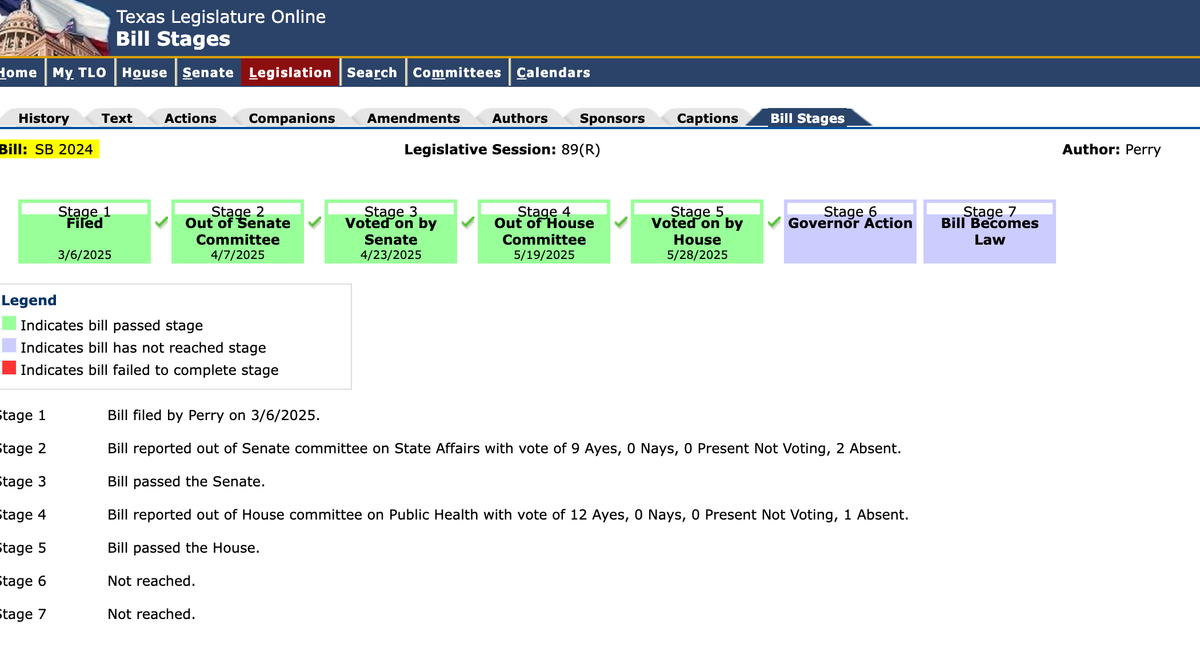
Currently, the bill is still in the "Governor Action" stage, which is a crucial step in determining whether the bill will ultimately become law. In US law, major Governor Actions include:
Signing the bill: If the governor approves the bill, he/she will sign it, and the bill will then become law on the designated effective date. This is the most common way for a bill to become law.
Veto the bill: If the governor does not agree with the bill, he/she can choose to veto it. Veto usually means the bill will not become law.
·The legislative body has the opportunity to override the governor's veto with a supermajority vote (such as two-thirds of the vote), allowing a bill to become law without the governor's approval.
We welcome news tips, article submissions, interview requests, or comments on this piece.
Please contact us at info@2firsts.com, or reach out to Alan Zhao, CEO of 2Firsts, on LinkedIn
Notice
1. This article is intended solely for professional research purposes related to industry, technology, and policy. Any references to brands or products are made purely for objective description and do not constitute any form of endorsement, recommendation, or promotion by 2Firsts.
2. The use of nicotine-containing products — including, but not limited to, cigarettes, e-cigarettes, nicotine pouchand heated tobacco products — carries significant health risks. Users are responsible for complying with all applicable laws and regulations in their respective jurisdictions.
3. This article is not intended to serve as the basis for any investment decisions or financial advice. 2Firsts assumes no direct or indirect liability for any inaccuracies or errors in the content.
4. Access to this article is strictly prohibited for individuals below the legal age in their jurisdiction.
Copyright
This article is either an original work created by 2Firsts or a reproduction from third-party sources with proper attribution. All copyrights and usage rights belong to 2Firsts or the original content provider. Unauthorized reproduction, distribution, or any other form of unauthorized use by any individual or organization is strictly prohibited. Violators will be held legally accountable.
For copyright-related inquiries, please contact: info@2firsts.com
AI Assistance Disclaimer
This article may have been enhanced using AI tools to improve translation and editorial efficiency. However, due to technical limitations, inaccuracies may occur. Readers are encouraged to refer to the cited sources for the most accurate information.
We welcome any corrections or feedback. Please contact us at: info@2firsts.com