Tunisia drafts e-cigarette regulation to combat teen usage

May.08.2023
Tunisia drafts e-cigarette regulation to combat teen usage
Tunisia drafts e-cigarette regulation to combat increasing teen use and unregulated sales of new tobacco products.

Recently, according to a report by "New Arab People's Daily", the Tunisian government is drafting a law to regulate electronic cigarettes in order to address the growing problem of youth e-cigarette use in Tunisia.


The regulation of electronic cigarettes lacks a reliable standard to follow.


According to the report, there is a significant increase in demand for e-cigarettes amongst Tunisian teenagers and students, with an increasing number of shops selling new tobacco products.


Tunisia's neighboring countries have taken measures to regulate the electronic cigarette market, providing smokers with more opportunities to access new, less harmful nicotine alternatives.


However, Tunisian laws were established in 1998 which only apply to traditional cigarettes.


Electronic cigarette regulation is set to be rolled out soon.


Many smokers in Tunisia believe that using e-cigarettes can help them quit smoking, as they are more concerned with the health risks associated with traditional cigarettes.


Officials believe that smokers are ignoring the dangers of the components in electronic cigarettes. Faisal Al-Samali, the head of the national smoking ban program, stated that.


The harm caused by electronic cigarettes is as severe as that caused by traditional cigarettes.


According to Samali, the proposed legislation by the government will classify electronic cigarettes as tobacco products. He added, "The new legislation is based on the 2010 World Health Organization Framework Convention on Tobacco Control.


Samali believes that electronic cigarettes need to be regulated because "those traded electronic cigarettes are not subject to any regulations, and their composition is also unknown.


Tunisian government officials believe that unlicensed electronic cigarettes could pose a threat to public safety and health.


Samari stated that the national anti-smoking program aims to increase people's awareness of the harm caused by all types of tobacco.


He said:


The quit-smoking center is still focusing on helping those who want to quit traditional smoking methods.


Bibliography:


Electronic cigarettes are taking over Tunisia in the absence of regulation.


This document has been generated through artificial intelligence translation and is provided solely for the purposes of industry discourse and learning. Please note that the intellectual property rights of the content belong to the original media source or author. Owing to certain limitations in the translation process, there may be discrepancies between the translated text and the original content. We recommend referring to the original source for complete accuracy. In case of any inaccuracies, we invite you to reach out to us with corrections. If you believe any content has infringed upon your rights, please contact us immediately for its removal.


 FDA Begins Review of 22nd Century’s VLN MRTP Renewal Applications
FDA Begins Review of 22nd Century’s VLN MRTP Renewal Applications
The U.S. Food and Drug Administration (FDA) has initiated scientific review of renewal applications for 22nd Century Group’s VLN reduced-nicotine cigarettes under the Modified Risk Tobacco Product (MRTP) pathway, with current authorizations set to expire in December 2026.
News
May.13
Turkey’s New Tobacco Bill Draft Would Cover E-Cigarettes and Heated Tobacco Products
A Turkey’s draft would impose major limits on the use of tobacco products in public buildings, educational and healthcare institutions, children’s areas, and outdoor events, while setting a 2040 target for a complete ban on the production, sale, and consumption of tobacco products. The draft also broadens the definition of tobacco products to include e-cigarettes, heated tobacco products, and all nicotine-containing systems.
Apr.13 by 2FIRSTS.ai
Philip Morris Says Its Smoke-Free Transition in Spain Now Has Economic Impact Above EUR 3.3 Billion
Philip Morris said it is accelerating its transition toward smoke-free products in Spain and claimed that the related economic impact now exceeds EUR 3.3 billion. Philip Morris also said that more than 90% of nicotine consumption in Spain still comes from conventional cigarettes, leaving room for growth in smoke-free categories, while regulation and taxation remain major obstacles in its view.
Apr.21 by 2FIRSTS.ai
Cross-Party Romanian Lawmakers Propose Ban on E-Cigarettes and Heated Tobacco Use in All Enclosed Public Spaces
Lawmakers from Romania’s USR, PSD and PNL have submitted a bill that would ban e-cigarettes, vapes and heated tobacco devices in all enclosed public spaces. The proposal would redefine “smoking” so that inhaling aerosols produced by heating or vaporizing products containing tobacco, nicotine or other substances intended for inhalation would also be considered smoking, except for medical-use products.
Apr.17 by 2FIRSTS.ai
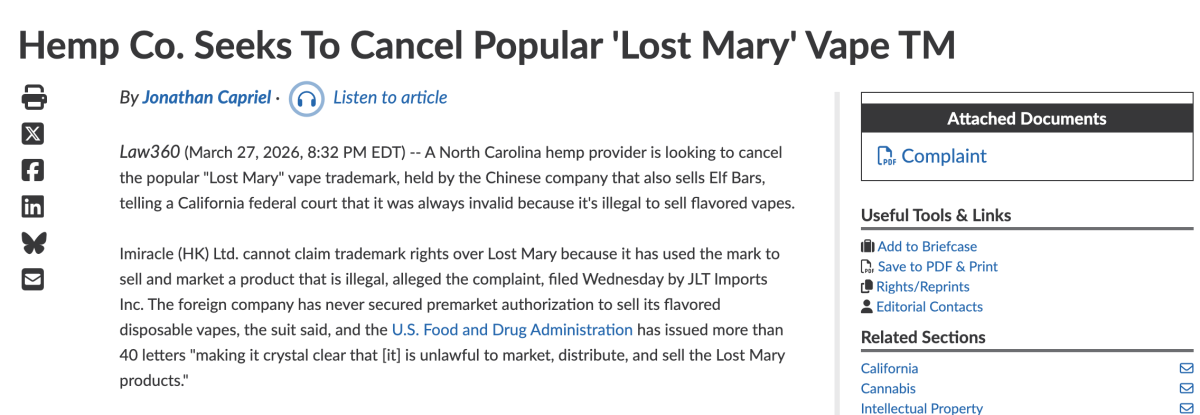
U.S. Company Seeks Cancellation of “Lost Mary” Vape Trademark
North Carolina hemp provider JLT Imports Inc. has filed suit in California federal court seeking cancellation of the “Lost Mary” vape trademark held by Chinese company Imiracle (HK) Ltd.
Mar.30 by 2FIRSTS.ai
Acting CTP Director Says FDA Cut Premarket Tobacco Application Backlog by About 70% Over the Past Year
FDA Center for Tobacco Products Acting Director Bret Koplow said at the American Tobacco and Nicotine Forum that the agency has reduced its premarket tobacco application backlog by about 70% over the past year and eliminated the acceptance queue. He said FDA has reviewed about 27 million applications, but only a small number have been authorized, mainly because most submissions lacked the scientific data needed to demonstrate public health benefits.
Apr.23 by 2FIRSTS.ai