Key Points
- IKE Tech has released a white paper showing that youth vaping rates in the UK and U.S. remain persistently high. 62% of respondents said current age-verification checks are easy to bypass, with peer pressure (83%), cheaper prices (78%), and lack of age checks (77%) identified as key drivers pushing minors to illicit products.
- Public opinion is divided: only 55% believe current regulations help, while 46% think youth vaping will decline by 2030 and 25% expect it to stay the same.
- The report highlights strong support for technology-driven safeguards: 70% back real-time ID verification, 54% of teens see point-of-use checks as most effective, and 85% of adult vapers said they would purchase such devices.
- Editor’s note: Age-verification technology must be judged on effectiveness, feasibility, and safety. Innovation should be encouraged, but caution is needed to avoid viewing it as a silver bullet without assessing its long-term impacts and risks.
2Firsts, Sept 4,2025 – Youth vaping rates remain persistently high in the UK and U.S. despite recent restrictions, with illicit sales surging and existing age checks failing to prevent underage access, according to a new white paper released on Thursday by IKE Tech. The company called for governments to adopt stronger technology-driven safeguards.
The report, “The First Vape-Free Youth Generation: The Critical Role of Technology to End Underage Access and Illicit Sales,” surveyed 5,000 respondents across both countries, including 1,000 teenagers aged 15–17. It found that 62% of respondents said current age-verification checks are easy for minors to bypass, while peer pressure and social factors (83%), cheaper prices (78%), and lack of age checks (77%, with 84% among UK youth) were identified as leading reasons why underage users turn to illicit vapes.

Rising prevalence and health concerns
In the UK, 7% of children aged 11–17 said they vape, with 40% of them reporting daily use. In the U.S., 5.9% of middle and high school students reported current use.
The report cited health professionals warning of a rise in adolescents aged 12–15 presenting with vaping-related symptoms such as elevated heart rate, anxiety, headaches and respiratory issues. “What begins as experimentation with friends or siblings quickly progresses to daily use as adolescents develop a dependence on nicotine,” said Hannah Sims, MSN, RN, Clinical Nurse Manager in California, as quoted in the report.
Illicit market fuels access
The study highlighted the rapid growth of illicit and non-compliant vaping products. These often feature higher nicotine strengths, larger liquid capacities, elevated metal levels, and inaccurate labeling that omits health warnings. In weakly enforced environments, such products are easier to access, creating additional health and compliance risks.
“At present, the biggest problem we’re seeing in this space is the illicit trade of vapes, with rogue retailers and criminal gangs the beneficiaries,” said Atul Sodha, an independent UK retailer quoted in the report. “Technology to tag imported consignments could help distinguish legitimate from illegal products.”
Divided public opinion on regulation
Public views remain split. Only 55% of respondents said regulations are helping reduce youth vaping, while 28% said there has been no change. Among American adults, 33% said current measures are not working.
The UK has proposed a Tobacco and Vapes Bill that includes a ban on disposable vapes and advertising restrictions. But the report notes that such bans alone may not be sufficient and could risk driving more youth toward black-market channels. “Disposable bans could push more teenagers into black-market channels,” said Dr. Jasmine Khouja of the University of Bristol, as quoted in the report.
Technology-driven safeguards
The white paper emphasized strong support for tech-based solutions. About 70% of respondents backed real-time identity verification, such as biometrics or digital IDs. Among 15–17-year-olds, 54% said point-of-use verification—requiring users to unlock devices via a digital check—would be the most effective way to prevent underage access.
The report noted that 85% of current adult vapers said they would purchase age-restricted devices if they knew it helped stop youth use. Similarly, 78% of all respondents said they would support point-of-use age verification if it truly blocked underage usage.
IKE Tech presented blockchain-based point-of-use verification as a possible model. Consumers would scan a government-issued ID and complete a biometric check via a mobile app, pairing their identity with the device over Bluetooth. Devices would remain locked unless verified, with encrypted data stored on a blockchain.
“Anonymous, secure, and frictionless, our approach brings trust back to age verification at every touchpoint,” said Thomas Chen, Partner at IKE Tech.
Collaboration still required
Still, the report warned that technology alone will not solve the challenge. It called for stronger retailer penalties, more robust regulatory frameworks, and closer cooperation among governments, industry, educators and public health advocates. “Age verification isn’t a silver bullet—real progress happens when the government, industry and retailers unite,” said Jason Carignan, Chief Commercial Officer of IKE Tech.
The report also showed that the public sees the top three measures for the future as tougher penalties (44%), better education (41%), and smarter technology (38%).
Looking ahead, 46% of respondents said underage vaping will decrease by 2030, 25% said it will stay the same, and 16% said it will increase.
The survey was commissioned by Clarity Global on behalf of IKE Tech and conducted by research firm OnePoll between June 3 and June 10, 2025. OnePoll is a Market Research Society company partner and a member of the British Polling Council.
Editor’s Note
Since 2024, age-verification technology has been increasingly discussed, with regulators and industry seeing it as a potential solution to youth vaping and flavor-related risks.
In my view, age-verification technology must be evaluated on three dimensions: effectiveness, feasibility, and safety.
● Effectiveness: whether it truly addresses age verification and cannot be easily bypassed or hacked.
● Feasibility: covering economic impact and consumer experience. Economic feasibility means the added costs of new technology can be accepted by the market; consumer feasibility means the process is not overly complex so as to hinder normal use.
● Safety: ensuring consumer data privacy and preventing misuse of the technology by regulatory powers to infringe on the freedoms of legitimate adult consumers.
For the application of age-verification technology in vaping, we should remain open and imaginative, continually developing new technologies and applications. At the same time, we must remain cautious, avoid the illusion of a “silver bullet,” and carefully assess its long-term impacts and risks.
— Alan Zhao, Co-Founder and CEO of 2Firsts
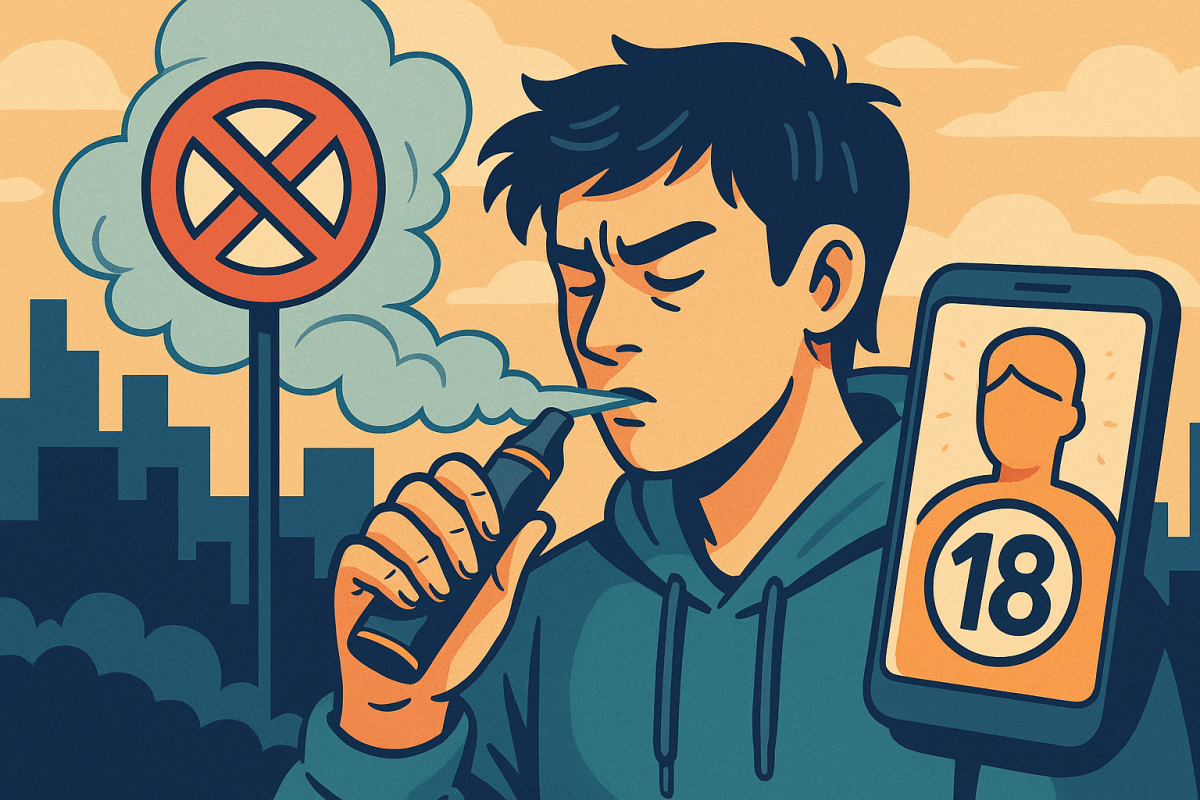
Cover image generated by ChatGPT