BAT Japan Introduces Innovative StickSeal Technology

Innovation by 2FIRSTS.ai
Apr.23.2024
BAT Japan Introduces Innovative StickSeal Technology
British American Tobacco Japan announced the launch of "neo" with StickSeal technology for their heated tobacco product "glo.

According to a report by Impress Watch on April 23, British American Tobacco Japan recently announced that their heated tobacco product "glo" will be incorporating a new technology called "StickSeal" in their exclusive tobacco stick "neo". This technology ensures that the cigarette leaf does not fall into the device. Additionally, the company will launch two regular blend varieties on May 7 and will apply the new technology to eight new product lines.


The working principle of StickSeal technology is to seal the front end of the pod, preventing any tobacco residue from being left inside the device after use, thus eliminating the need for cleaning with a brush.


The new products include two exclusive varieties of glo hyper, "Neo Classic Tobacco" and "Neo Smooth Tobacco". The new series, including the new "Neo Mild Tobacco", feature carefully selected tobacco leaves and a new formula. These tobacco products use premium Virginia and Oriental tobacco as ingredients, with the addition of the aromatic and rare leaf portion "web leaf", and undergo minimal processing to maintain a high-quality taste and improve the quality of flavor components.


We welcome news tips, article submissions, interview requests, or comments on this piece.

Please contact us at info@2firsts.com, or reach out to Alan Zhao, CEO of 2Firsts, on LinkedIn


Notice

1.  This article is intended solely for professional research purposes related to industry, technology, and policy. Any references to brands or products are made purely for objective description and do not constitute any form of endorsement, recommendation, or promotion by 2Firsts.

2.  The use of nicotine-containing products — including, but not limited to, cigarettes, e-cigarettes, nicotine pouchand heated tobacco products — carries significant health risks. Users are responsible for complying with all applicable laws and regulations in their respective jurisdictions.

3.  This article is not intended to serve as the basis for any investment decisions or financial advice. 2Firsts assumes no direct or indirect liability for any inaccuracies or errors in the content.

4.  Access to this article is strictly prohibited for individuals below the legal age in their jurisdiction.


Copyright


This article is either an original work created by 2Firsts or a reproduction from third-party sources with proper attribution. All copyrights and usage rights belong to 2Firsts or the original content provider. Unauthorized reproduction, distribution, or any other form of unauthorized use by any individual or organization is strictly prohibited. Violators will be held legally accountable.

For copyright-related inquiries, please contact: info@2firsts.com


AI Assistance Disclaimer


This article may have been enhanced using AI tools to improve translation and editorial efficiency. However, due to technical limitations, inaccuracies may occur. Readers are encouraged to refer to the cited sources for the most accurate information.

We welcome any corrections or feedback. Please contact us at: info@2firsts.com

As Regulators Focus on Nicotine Pouch Child Safety, Safeguard Pursues an External Packaging Route
As regulators pay closer attention to child safety in nicotine pouches, manufacturers face a practical challenge: how to strengthen child-resistant packaging without unnecessarily reworking products, production lines and regulatory submissions already in place. In a written interview with 2Firsts, Chemular detailed Safeguard’s external packaging approach, its customer-specific testing requirements and possible PMTA pathways. The model remains early-stage, but it offers a new way to think about an increasingly important regulatory and manufacturing issue.
Industry Insight
Sep.19
STIIIZY Redesign Fails to Escape PAX Labs Patent Import Ban as Section 337 Case Also Involves China ALD
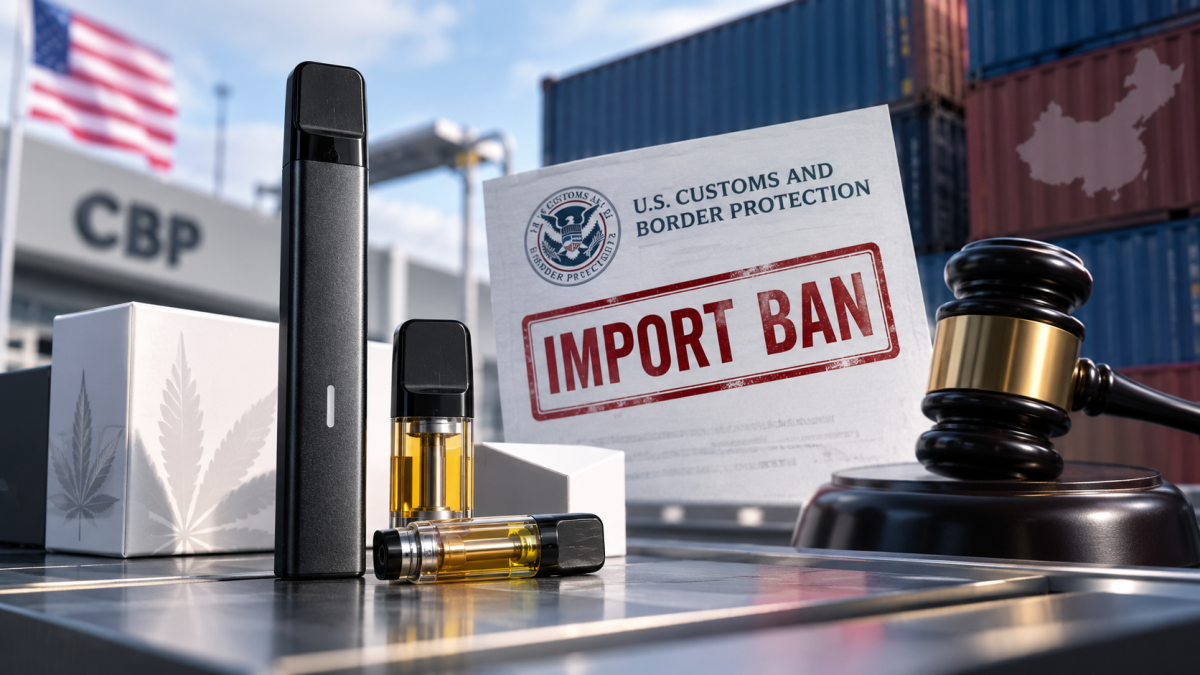
U.S. Customs and Border Protection ruled that STIIIZY had not shown that the redesigned cannabis-vape products covered by its latest request fall outside an ITC limited exclusion order tied to PAX Labs patents. CBP accepted some of STIIIZY’s claim-construction and non-infringement arguments, but the company did not address two additional claims in the same patent. Earlier STIIIZY redesigned cartridges and certain associated components imported with them had received separate CBP clearance.
Sep.16
NAS 2026 | Cliff Douglas: Risk Continuum Should Play a Central Role in Tobacco Policy
Cliff Douglas, a veteran U.S. tobacco-control and public health policy figure, told NAS 2026 that the “continuum of risk” should play a central role in tobacco policy. He called for clearer market pathways, stronger risk communication, differentiated regulation and enforcement, and said possible FDA reforms to PMTA reviews could be a “welcome correction” if they create a more efficient, predictable route for scientifically substantiated lower-risk products. Read 2Firsts’ on-site coverage.
Sep.26
U.S. Rep. Krishnamoorthi Questions FDA Over Planned PMTA Rewrite, Seeks Communications With Altria and Reynolds
U.S. Rep. Raja Krishnamoorthi on Oct. 6 questioned the FDA over its plan to reassess and potentially replace the 2021 PMTA regulatory framework, asking the agency to identify provisions it may change or eliminate, state whether current scientific evidentiary standards will be maintained, and disclose communications with Altria, Reynolds and other parties challenging the rule. Krishnamoorthi led a congressional investigation into JUUL and youth vaping in 2019 and has since remained active on e-cigarette regulation and enforcement.
Regulations
Oct.08
EU Commission Clarifies Vaping, Smokeless Nicotine Use in Proposed Cardiovascular Checks
The European Commission has clarified to 2Firsts that its proposed cardiovascular health checks would assess smoking, vaping and the use of smokeless nicotine products as part of patients’ medical histories. The Commission also said Member States may organise additional checks within their healthcare systems. In the same response, it pointed to JRC research on e-cigarettes, heated tobacco products and nicotine pouches that has fed into the evaluation of EU tobacco legislation.
Nov.09
New York City Opens Lottery for 55 Vape Retail License Slots Across 23 Community Districts, Including 28 in Brooklyn
New York City's Department of Consumer and Worker Protection (DCWP) opened applications on November 2, 2026, for a lottery covering tobacco and electronic cigarette retail dealer licenses, with a deadline of 5 p.m. New York local time on November 30. According to the city's October 1 notice, 55 electronic cigarette retail license slots are available across 23 community districts, including 28 in Brooklyn, alongside 322 tobacco retail license slots across 41 districts. Businesses must enter the lottery and, if invited, complete licensing requirements within 65 days. New York City continues to restrict e-cigarette retail sales to tobacco-flavored or unflavored products, while city retail licenses do not replace FDA product marketing authorization.
Market
Nov.04