Key Points
- CBP ruled on August 14 that STIIIZY had not established that the redesigned products at issue were outside the PAX Labs-related limited exclusion order.
- CBP accepted some of STIIIZY’s patent interpretations and non-infringement arguments, but the company did not address two other claims in the same patent.
- CBP previously cleared certain redesigned STIIIZY cartridges in May and, in June, certain associated components when imported together with those cleared cartridges.
- The underlying ITC Section 337 case also involves China-based vaping-device company ALD Group Limited and its Hong Kong affiliate. A Federal Circuit appeal, CBP redesign proceedings and an ITC enforcement investigation are proceeding in parallel.
2Firsts
September 16, 2026
According to Law360 on September 14, 2026, U.S. Customs and Border Protection ruled that cannabis-vape brand STIIIZY had not shown that the redesigned products covered by its request fall outside a limited exclusion order issued by the U.S. International Trade Commission in a patent dispute with PAX Labs.
CBP issued the ruling on August 14. While the agency accepted some of STIIIZY’s claim-construction and non-infringement arguments, it found that the company had not addressed all relevant patent claims and therefore had not established that the products were outside the exclusion order.
CBP Accepts Some Arguments but Finds Showing Incomplete
The dispute involves several vaporization patents held by PAX Labs.
For one patent, STIIIZY argued that language in the claim preamble referring to a “vaporizing cartridge” should be treated as limiting. CBP agreed, finding that the preamble provided essential structure for understanding the remaining elements of the claim.
CBP also accepted STIIIZY’s proposed construction of “vaporizer cartridge” as a component that mates with and may be installed into a vaporizer base to form a vaporizer device.
STIIIZY established that its products did not infringe one claim in that patent. However, CBP said the company made no non-infringement arguments regarding two other claims in the same patent.
The ruling therefore did not find that every disputed claim was infringed. Rather, CBP concluded that STIIIZY had not met its burden of showing that the redesigned products as a whole fell outside the exclusion order.
For another patent, PAX Labs did not contest STIIIZY’s evidence, and CBP found that the products did not practice the relevant limitations.
Some Redesigned Products Previously Won CBP Clearance
STIIIZY has repeatedly used CBP’s Part 177 ruling process to seek product-specific determinations on whether redesigned products fall within the ITC exclusion order.
In May 2026, CBP determined that a group of “Post-FD Redesigned Cartridges” did not infringe the relevant patent claims and therefore were not covered by the order.
In June, CBP further determined that certain associated components were also outside the order when imported together with those previously cleared Post-FD Redesigned Cartridges.
Law360 reported that CBP issued at least two rulings in July carving certain additional STIIIZY vape products out of the exclusion order.
Those determinations apply to specific product designs, import configurations and patent claims and do not amount to a blanket exemption for all future STIIIZY products.
ITC Had Previously Reviewed STIIIZY Redesigns
PAX Labs launched the underlying Section 337 investigation in 2024 against STIIIZY, China-based vaping-device company ALD Group Limited and its Hong Kong affiliate.
The patents at issue include U.S. Patent Nos. 11,369,756, 11,766,527, 11,369,757 and 11,759,580.
During the original investigation, the ITC reviewed three redesigned STIIIZY products and ultimately found that they still infringed certain claims of U.S. Patent No. 11,759,580.
STIIIZY subsequently made further design changes and sought new Part 177 rulings from CBP covering later redesigns.
In January 2026, the ITC issued its final determination, finding Section 337 violations involving STIIIZY and ALD and entering a limited exclusion order against covered infringing products. The commission also issued a cease-and-desist order against STIIIZY.
The August 14 CBP ruling was requested by STIIIZY, not ALD. The Chinese company remains relevant as a respondent in the underlying ITC case and related enforcement proceedings.
Appeal, CBP Proceedings and ITC Enforcement Continue in Parallel
STIIIZY appealed the ITC’s final determination to the U.S. Court of Appeals for the Federal Circuit in March and sought a stay of the remedial orders while the appeal proceeds. The ITC subsequently declined to suspend the exclusion order.
At the same time, STIIIZY has continued modifying product designs and seeking Part 177 rulings from CBP on whether newer versions fall outside the order.
PAX Labs, meanwhile, asked the ITC to investigate whether STIIIZY and ALD had violated the commission’s existing remedial orders. The ITC opened an enforcement investigation in June.
The Federal Circuit appeal, CBP proceedings involving redesigned products and the ITC enforcement case are now moving forward in parallel.
The latest ruling shows that a product redesign does not by itself secure an exemption from an ITC exclusion order. In a Part 177 proceeding, the importer must still establish non-infringement with respect to the relevant patent claims covered by the order. For vaping-device companies and their supply chains, the effects of a Section 337 exclusion order can extend into product redesign, import eligibility and CBP border enforcement.
Follow 2Firsts for timely updates on global tobacco and nicotine industry developments, corporate strategy and market trends.
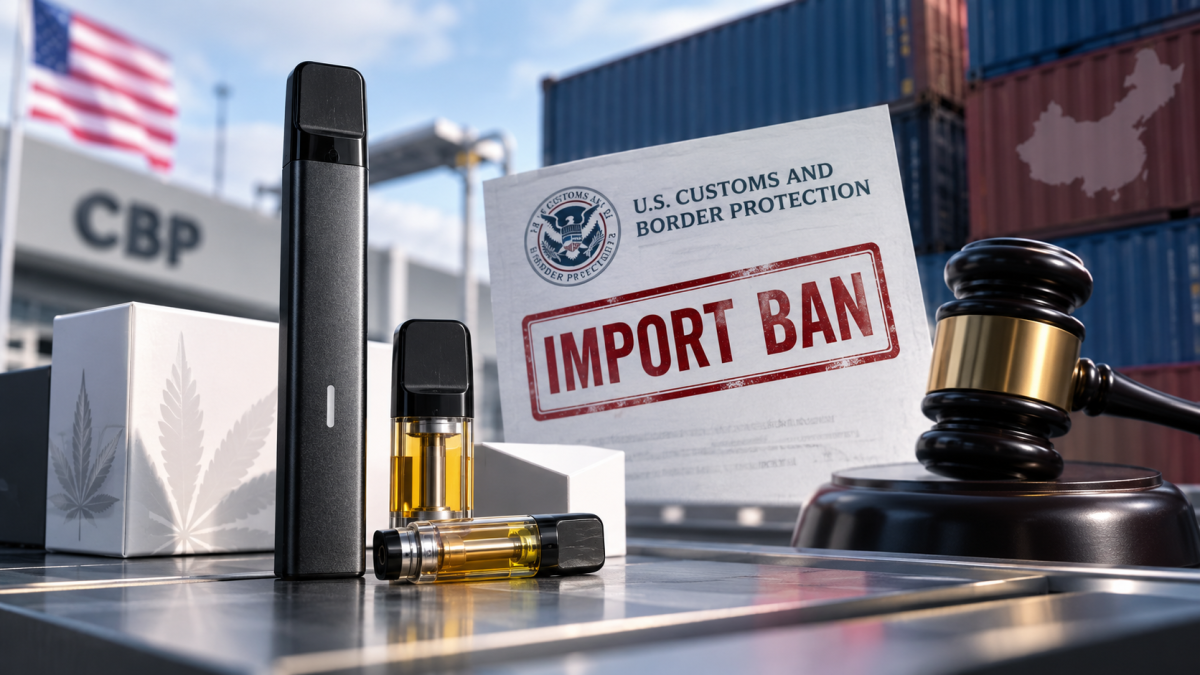
Cover Image generated by AI
Disclaimer
This article is provided solely for professional research, industry discussion, and informational purposes. Any references to brands, companies, products, technologies, or policies are made for factual reporting and analytical purposes only, and do not constitute endorsement, recommendation, promotion, or advertising by 2Firsts.
Nicotine-containing products, including but not limited to cigarettes, e-cigarettes, heated tobacco products, and nicotine pouches, carry significant health risks. Readers are responsible for complying with all applicable laws and regulations in their respective jurisdictions, including age restrictions and access limitations.
The information contained in this article should not be regarded as investment, legal, medical, regulatory, or commercial advice. While 2Firsts strives to ensure the accuracy and reliability of its content, it does not assume liability for any direct or indirect loss arising from errors, omissions, inaccuracies, or reliance on the information contained herein.
This article is not intended for individuals below the legal age for accessing tobacco or nicotine-related information in their jurisdiction.
Copyright Notice
This article is either original content produced by 2Firsts or content reproduced, translated, summarized, or adapted from third-party sources with attribution where applicable. The intellectual property rights of the original content remain with 2Firsts or the respective original rights holders.
No individual or organization may copy, reproduce, distribute, republish, modify, translate, or otherwise use this content without prior authorization. Any unauthorized use may result in legal action.
For copyright-related inquiries, corrections, or removal requests, please contact: info@2firsts.com.
AI-Assisted Translation and Editing Notice
Portions of this article may have been translated, edited, or reviewed with the assistance of artificial intelligence tools to improve efficiency and readability. Due to the limitations of AI-assisted translation and editing, discrepancies, omissions, or inaccuracies may exist when compared with the original source.
Where applicable, readers are advised to refer to the original source for the most complete and accurate information. If you identify any errors or believe that any content infringes upon your rights, please contact us at info@2firsts.com, and we will review and address the matter promptly.