Key Points
- Vuse Pro is being sold in Ohio and selected other U.S. markets with four initial flavors: Peach, Berry, Watermelon and Fresh Mint.
- Consumers must complete third-party identity verification through a smartphone application and activate the device using Bluetooth. The system also includes automatic and proximity-based locking.
- Vuse Pro has not received FDA marketing authorization. Reynolds submitted a PMTA in June 2024 containing nearly 80,000 pages and 97 studies.
- BAT plans to place the product in about 25,000 retail outlets in the third quarter of 2026 and add another 25,000 in the fourth quarter.
- Unauthorized products accounted for an estimated 69.4% of e-cigarette dollar sales in U.S. convenience and grocery retail channels as of December 2025. The share reached 97.6% for disposable e-cigarettes.
2Firsts
September 9, 2026
British American Tobacco’s Reynolds American has begun selling flavored Vuse Pro e-cigarettes equipped with mandatory age-verification technology in the United States, offering four non-tobacco flavors before the products have received marketing authorization from the U.S. Food and Drug Administration.
STAT reported on September 8 that one of its journalists found Vuse Pro at a GetGo gas station and convenience store in suburban Ohio. Pods on sale included Peach, Berry, Watermelon and Fresh Mint. Reynolds said the product was available in Ohio and selected other markets but did not identify all the states or disclose how many stores currently carry it.
Reynolds spokesperson Luis Pinto told STAT that sales of Vuse Pro complied with applicable state regulations and that the company had introduced measures including identification requirements and purchase limits to reduce youth access.
Vuse Pro does not appear on the FDA’s list of authorized e-cigarettes. Under federal law, new tobacco products generally require FDA marketing authorization before they can be legally sold in the United States.

Four Flavors and Mandatory Age Verification
Vuse Pro consists of a reusable device, prefilled pods and a smartphone application. According to its user guide, consumers must complete age verification and activate the device through Bluetooth before using it.
A third-party service verifies that the user is at least 21 years old. Once verification is completed, the application pairs with the device and releases its initial lock. The device cannot be used before that process is completed, according to the guide.
Vuse Pro also includes manual, automatic and proximity-based locks. The device can lock when it moves beyond a designated distance from the paired smartphone and must reconnect to the application before use resumes.
Reynolds submitted a premarket tobacco product application for Vuse Pro in June 2024. The company said the submission contained nearly 80,000 pages and 97 scientific studies covering areas including toxicology, product chemistry, consumer behavior and the risk of youth access. It identified age verification, application-based activation, automatic locking and proximity locking as central safeguards.
The initial pods are Peach, Berry, Watermelon and Fresh Mint. Reynolds has not publicly disclosed their nicotine strengths, e-liquid capacity, recommended retail prices or complete state-by-state rollout schedule.
BAT Plans Distribution Across About 50,000 Outlets in 2026
The Vuse Pro launch formed part of BAT’s previously announced U.S. strategy for 2026.
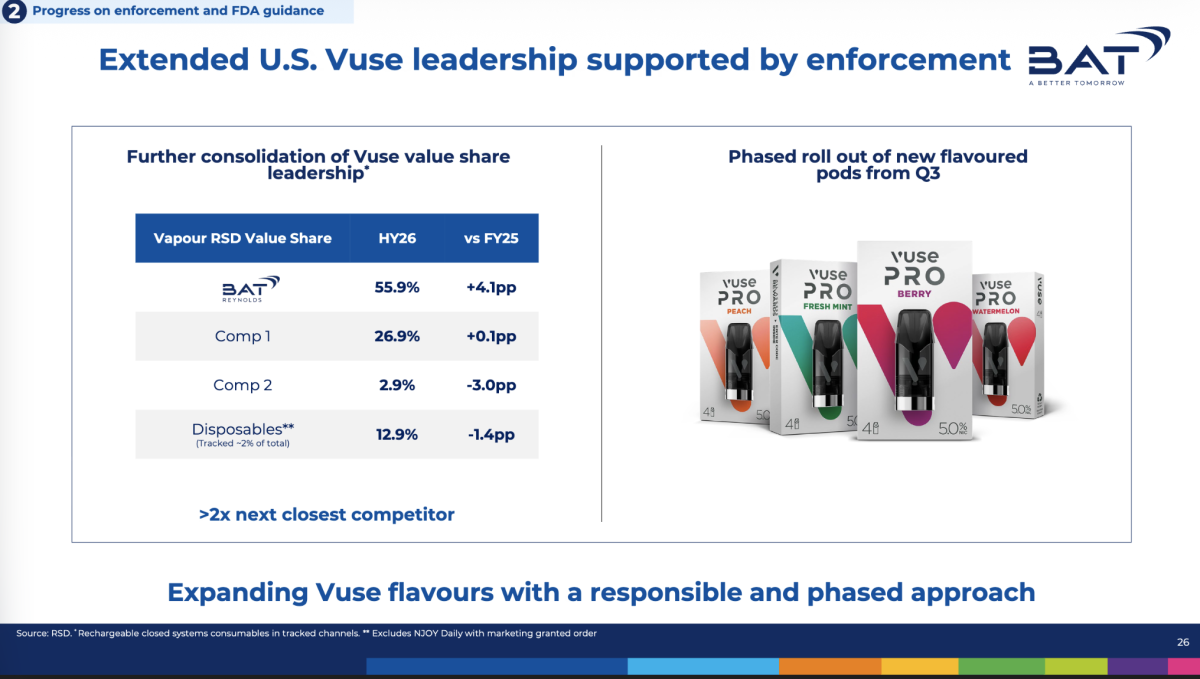
When reporting interim results on July 30, BAT said it would introduce new adult-focused Vuse flavors in the United States from the third quarter, initially covering about 25,000 retail outlets.
Chief Executive Tadeu Marroco provided details of a second phase during the company’s results call. BAT plans to reach about 25,000 outlets in the third quarter, add another 25,000 in the fourth and expand further from that base.
Marroco said participating retailers would be required to scan customer identification and follow the company’s sales and compliance procedures.
BAT has not disclosed how many stores currently carry Vuse Pro. Its announced third- and fourth-quarter phases provide for combined distribution through about 50,000 outlets during 2026.
Vuse already has a substantial U.S. retail base. BAT said its retail contracts cover about 90% of the U.S. market and are supported by approximately 1,500 sales representatives. U.S. Vuse revenue rose 20% in the first half of 2026. Its value share of tracked consumables for rechargeable closed systems reached 55.9%, up 4.1 percentage points from the end of 2025.
FDA Begins Accepting Age Verification as a Risk-Control Measure
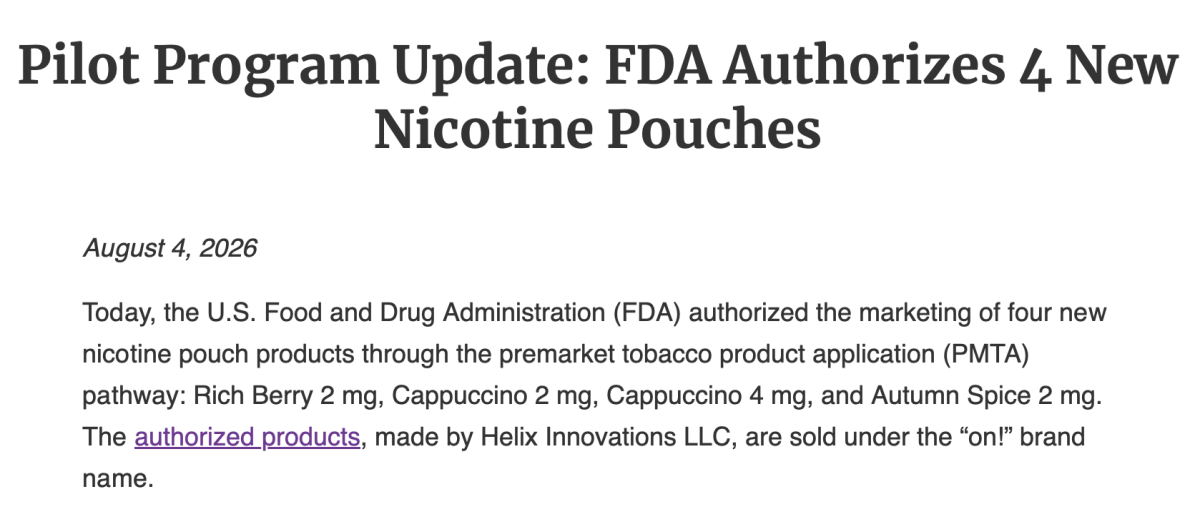
The launch comes as the FDA changes how it prioritizes enforcement against unauthorized e-cigarettes and begins accepting stronger device-access restrictions in product reviews.
The agency issued revised enforcement guidance in May 2026. All new tobacco products without marketing authorization remain illegally marketed, but the FDA said it generally would not prioritize enforcement against certain products undergoing review.
Products must meet several conditions, including having applications that the FDA has accepted and filed. For non-tobacco-flavored e-cigarettes, the agency also expects applications to contain the data needed to assess whether marketing the products would be appropriate for the protection of public health. Products with youth-appealing designs, safety concerns or other regulatory violations may remain enforcement priorities.
The guidance concerns the allocation of enforcement resources. It does not provide temporary marketing authorization or indicate whether the FDA will ultimately authorize an application.
Reynolds submitted the Vuse Pro PMTA in 2024. The company has not disclosed whether the FDA has accepted and filed every flavor application or whether the products fall within the guidance’s lower-priority category.
Glas and JUUL2 Establish Regulatory Precedents
The FDA authorized age-verified Glas G2 products in two stages during 2026.
The first authorization covered the Glas G2 device and Blonde Tobacco pod. In May, the agency authorized four additional pods: Gold, Sapphire, Classic Menthol and Fresh Menthol. Gold and Sapphire are mango- and blueberry-flavored, respectively.
The Glas system requires consumers to verify their age using government-issued identification and a smartphone application before connecting the device through Bluetooth. Its controls include proximity locking and random biometric check-ins intended to confirm that the user is at least 21.
FDA review documents said the fruit- and menthol-flavored products did not show a statistically significant switching benefit over the tobacco flavor. The agency found that the mandatory access restrictions sufficiently mitigated youth risk, removing the need for the flavored pods to demonstrate an additional switching benefit.
On August 28, the FDA authorized the JUUL2 device and tobacco- and menthol-flavored pods. JUUL2 also includes age-verification capability, but the authorization did not cover fruit or sweet flavors.
The two rounds of Glas decisions showed that the FDA may authorize non-tobacco and non-menthol flavors when mandatory access restrictions sufficiently address youth-use risks. Vuse Pro’s four flavors have not undergone the same authorization.
Unauthorized Products Still Account for Most U.S. Vape Sales
Unauthorized products have long dominated the U.S. e-cigarette market, particularly in the flavored disposable segment.
A study published in NEJM Evidence in August 2026 used Circana retail scanner data to estimate that unauthorized products accounted for 69.4% of e-cigarette dollar sales in U.S. convenience and grocery retail channels as of December 2025.
Unauthorized products accounted for 97.6% of disposable e-cigarette sales in the tracked channels. All sales classified as fruit, sweet, candy, mint or other non-tobacco and non-menthol flavors were unauthorized at that time. The data covered convenience and grocery stores, drugstores, retail chains, gas stations, mass merchandisers and military bases. Vape shops, tobacco specialty stores and online retailers were excluded.
HHS said in September 2025 that up to 85% of e-cigarette devices and pods sold through U.S. retail outlets were illegal. Later that month, the FDA issued a separate estimate that as many as 54% of vaping products sold nationwide were illegal. The two government releases did not provide comparable methodologies and cannot be used to measure a change in the market following enforcement actions.
Brands including Geek Bar, Foger, Elf Bar and Lost Mary have built substantial sales in the U.S. disposable market, although the relevant products do not appear on the FDA’s authorized list. Federal agencies have pursued unauthorized products and their distribution networks through import seizures, warning letters, civil penalties and court actions.
State e-cigarette directory laws are also expanding. BAT said states with directories in place or under development covered about half of the U.S. vaping industry during the first half of 2026. The company said authorities had seized more than 18 million unauthorized products.
BAT cited stronger enforcement as one factor supporting Vuse’s first-half growth. Vuse Pro combines fruit flavors, mandatory age-verification technology and a pending PMTA in a single platform. Its retail expansion will test how the FDA’s revised enforcement framework applies to an unauthorized flavored product launched by a major tobacco company.
Any eventual authorization will depend on the FDA’s assessment of potential benefits for adults who smoke, risks of youth use and the real-world performance of the product’s age-verification system.
Follow 2Firsts for continuing coverage of FDA tobacco regulation, the U.S. vaping market and global next-generation nicotine products.
Image source: BAT
Disclaimer
This article is provided solely for professional research, industry discussion, and informational purposes. Any references to brands, companies, products, technologies, or policies are made for factual reporting and analytical purposes only, and do not constitute endorsement, recommendation, promotion, or advertising by 2Firsts.
Nicotine-containing products, including but not limited to cigarettes, e-cigarettes, heated tobacco products, and nicotine pouches, carry significant health risks. Readers are responsible for complying with all applicable laws and regulations in their respective jurisdictions, including age restrictions and access limitations.
The information contained in this article should not be regarded as investment, legal, medical, regulatory, or commercial advice. While 2Firsts strives to ensure the accuracy and reliability of its content, it does not assume liability for any direct or indirect loss arising from errors, omissions, inaccuracies, or reliance on the information contained herein.
This article is not intended for individuals below the legal age for accessing tobacco or nicotine-related information in their jurisdiction.
Copyright Notice
This article is either original content produced by 2Firsts or content reproduced, translated, summarized, or adapted from third-party sources with attribution where applicable. The intellectual property rights of the original content remain with 2Firsts or the respective original rights holders.
No individual or organization may copy, reproduce, distribute, republish, modify, translate, or otherwise use this content without prior authorization. Any unauthorized use may result in legal action.
For copyright-related inquiries, corrections, or removal requests, please contact: info@2firsts.com.
AI-Assisted Translation and Editing Notice
Portions of this article may have been translated, edited, or reviewed with the assistance of artificial intelligence tools to improve efficiency and readability. Due to the limitations of AI-assisted translation and editing, discrepancies, omissions, or inaccuracies may exist when compared with the original source.
Where applicable, readers are advised to refer to the original source for the most complete and accurate information. If you identify any errors or believe that any content infringes upon your rights, please contact us at info@2firsts.com, and we will review and address the matter promptly.