BAT's 2023 Financial Report: New Categories Drive Revenue Growth

BAT by 2FIRSTS.ai
Feb.09.2024
BAT's 2023 Financial Report: New Categories Drive Revenue Growth
BAT Releases 2023 Financial Report: Non-combustible category revenue now accounts for 16.5% of group revenue, increasing 170 basis points from 2022.

British American Tobacco (BAT) released its financial report for the year 2023 on February 8. The report highlights the robust sales of Vuse and Velo, which have driven the revenue growth in new categories including vaporization, heat-not-burn (HNB), and oral products. The income from non-combustible categories now accounts for 16.5% of the group's total revenue, representing an increase of 170 basis points compared to the fiscal year 2022.


Other key points are as follows:


The conglomerate's revenue has decreased by 1.3%, with an organic growth of 3.1% (measured at constant exchange rates), driven by a significant increase of 21.0% in organic revenue from new categories.


A new category, including atomized, HNB, and oral products, achieved profitability in 2023, surpassing the original goal by two years. This led to an increase in the group's profits by £398 million.


The conglomerate has reached a global settlement with Philip Morris International (PMI), resolving all ongoing patent infringement lawsuits between the two parties in relation to heated products (HP) and aerosol products.


The overall revenue for combustible products witnessed a marginal increase of 0.6%, while the organic price/composition experienced a positive growth of +6.1%. However, due to the macroeconomic pressures in the United States, there was a decline in total sales, specifically in the high-end market segment, affecting both geographic composition and sales volume.


AME (America and Europe Market) and APMEA (Asia Pacific Middle East Market) have demonstrated strong performance. The report shows that the new categories, including aerosol, heat-not-burn, and oral products, have achieved profits of 1.67 billion pounds and 610 million pounds respectively in these two markets.


The reported operating loss amounted to £15.751 billion (with a decline of 95.8 percentage points in the reported operating profit margin, reaching -57.7%), primarily influenced by a non-cash impairment charge of £27.6 billion associated with the US operations (£273 billion).


Adjusted organic operating profit increased by 3.9% at constant exchange rates, while the adjusted organic operating profit margin rose by 40 basis points to reach 45.6%.


According to the report, the diluted earnings per share amounted to -646.6 pence. However, after adjusting for organic factors, the diluted earnings per share saw a growth of 5.2% at a constant exchange rate.


The operating cash flow conversion rate has reached 100%, indicating that the company efficiently converts its operating cash flow into positive cash flow. However, the adjusted net debt-to-EBITDA ratio has declined to 2.6 times, reflecting a decrease in the company's financial leverage after adjusting for organic factors.


The dividend has grown by 2.0% to 235.52 pence, in line with the gradual increase in dividends.


Sustained ESG Progress - MSCI Rating Upgraded to A Grade in 2023 (2022: BBB) Two Years Ahead of Schedule, Exceeding Water Consumption and Waste Generation Targets.


We welcome news tips, article submissions, interview requests, or comments on this piece.

Please contact us at info@2firsts.com, or reach out to Alan Zhao, CEO of 2Firsts, on LinkedIn


Notice

1.  This article is intended solely for professional research purposes related to industry, technology, and policy. Any references to brands or products are made purely for objective description and do not constitute any form of endorsement, recommendation, or promotion by 2Firsts.

2.  The use of nicotine-containing products — including, but not limited to, cigarettes, e-cigarettes, nicotine pouchand heated tobacco products — carries significant health risks. Users are responsible for complying with all applicable laws and regulations in their respective jurisdictions.

3.  This article is not intended to serve as the basis for any investment decisions or financial advice. 2Firsts assumes no direct or indirect liability for any inaccuracies or errors in the content.

4.  Access to this article is strictly prohibited for individuals below the legal age in their jurisdiction.


Copyright


This article is either an original work created by 2Firsts or a reproduction from third-party sources with proper attribution. All copyrights and usage rights belong to 2Firsts or the original content provider. Unauthorized reproduction, distribution, or any other form of unauthorized use by any individual or organization is strictly prohibited. Violators will be held legally accountable.

For copyright-related inquiries, please contact: info@2firsts.com


AI Assistance Disclaimer


This article may have been enhanced using AI tools to improve translation and editorial efficiency. However, due to technical limitations, inaccuracies may occur. Readers are encouraged to refer to the cited sources for the most accurate information.

We welcome any corrections or feedback. Please contact us at: info@2firsts.com

Special Report | Vape bans and tougher rules: the South Caucasus takes different paths
Azerbaijan's sweeping e-cigarette ban has raised concerns over enforcement errors and the emergence of illicit sales, while neighboring Armenia is tightening technical rules and preparing higher excise taxes. Georgia, meanwhile, has resisted calls for broader vape restrictions and introduced preferential taxes for some domestically produced cigarettes. The divergent approaches across the South Caucasus highlight a regional policy dilemma: how to curb nicotine use and protect public health without encouraging black markets or creating unintended economic consequences for businesses and consumers.
Nov.03
BAT Adds Former Apple General Counsel Bruce Sewell to Board as Finance, Legal, Marketing and Regional Leadership Shift
British American Tobacco has appointed former Apple Senior Vice President, General Counsel and Secretary Bruce Sewell as an independent non-executive director, effective January 1, 2027. He will also join BAT's Audit and Nominations Committees. BAT Chair Luc Jobin highlighted Sewell's experience in technology, government and regulatory affairs, public-company governance and AI-company boards. Over the past 18 months, BAT has changed or announced changes to its CFO, general counsel, CMO and APMEA regional leadership, while the main board has also seen multiple changes. The appointment comes as BAT advances Horizon 2030 and its Fit2Win transformation while expanding New Categories and reshaping parts of its digital, technology and operating structure.
Business
Oct.29
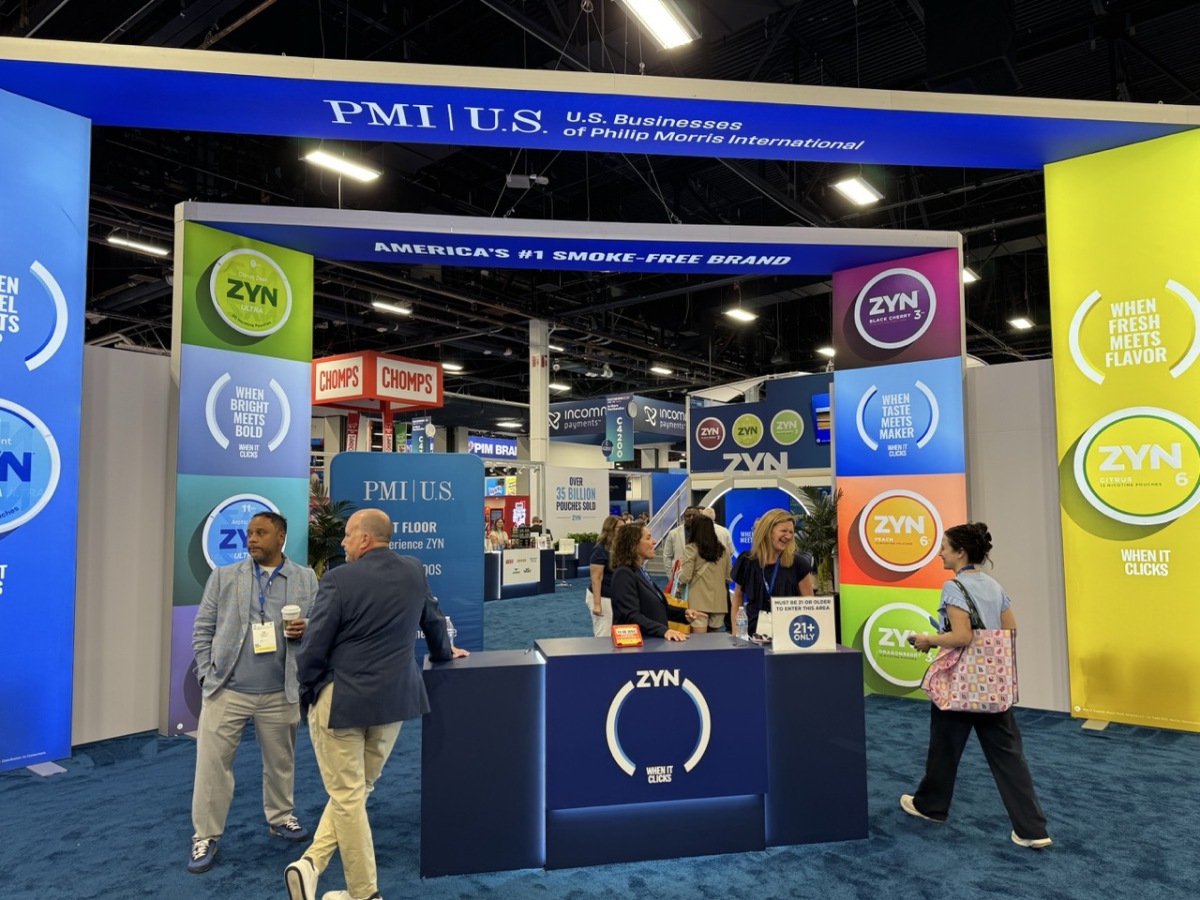
PMI Showcases ZYN, IQOS and U.S. Investments at NACS Show 2026
At the 2026 NACS Show in Las Vegas, Philip Morris International (PMI) showcased its ZYN nicotine pouches, IQOS heated tobacco products and U.S. investments. A 2Firsts review of FDA records found that several ZYN products displayed at the booth were not on the agency's marketing authorization list, including certain nicotine strengths and flavors. A PMI booth representative also confirmed that IQOS is currently sold in three U.S. states, while the newer IQOS ILUMA system remains under FDA review.
EXPO
Oct.10
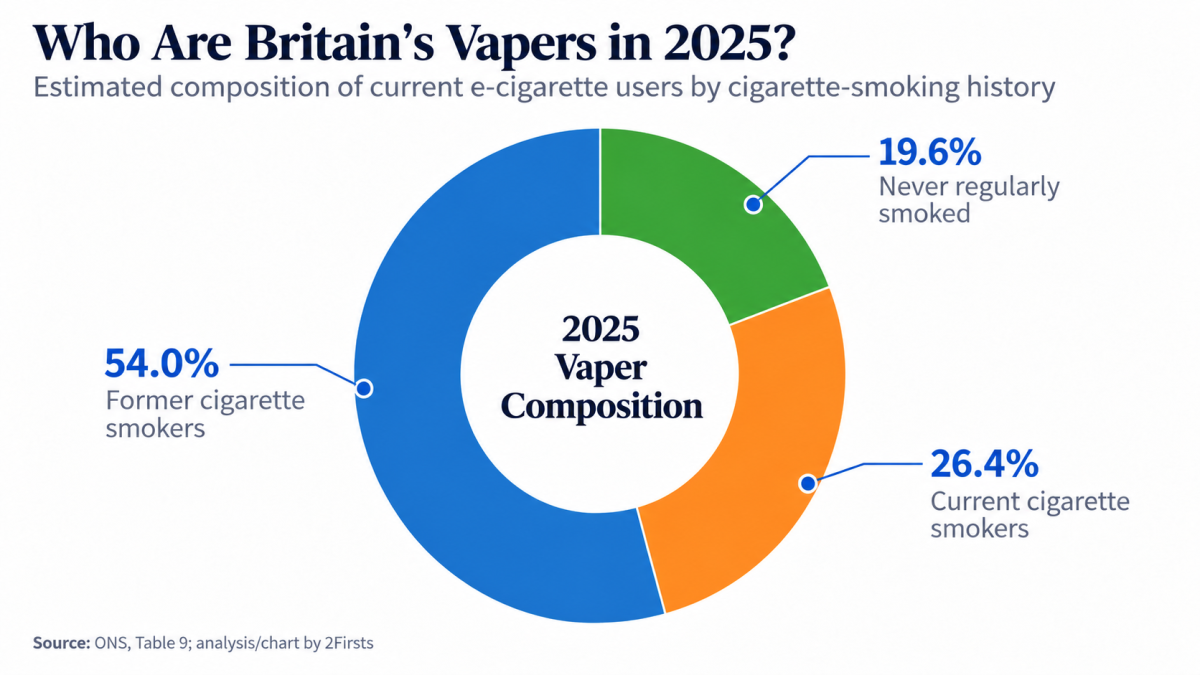
Latest UK ONS Data: 54% of Vapers Are Former Cigarette Smokers, 26% Also Smoke and 20% Never Smoked Regularly
Former cigarette smokers accounted for an estimated 54% of current e-cigarette users in Great Britain in 2025, while 26% also smoked cigarettes and 20% had never regularly smoked, according to a 2Firsts analysis of Office for National Statistics (ONS) data. Among former cigarette smokers who currently vape, approximately 81% used e-cigarettes daily, compared with about 50% of dual users. The ONS found that 33.8% of current cigarette smokers also vaped in 2025, up from 10.6% in 2014. Approximately 1.1 million adults who had never regularly smoked cigarettes used e-cigarettes, representing 2.9% of that population, compared with 0.2% in 2014. The figures highlight differences in the composition, frequency of use and long-term trends across Britain's vaping population.
DATA
Oct.14
Germany Probes 7.6 Million Illegal Vape Case With Estimated €33.3 Million Tax Loss; Four Chinese Manufacturer Employees Under Investigation, Some Packaging in Enforcement Images Resembles FUMOT Products
German prosecutors and customs authorities are conducting a criminal investigation into an alleged cross-border organised vape network. Authorities say that between January 2024 and March 2025, four employees of an unnamed Chinese e-cigarette manufacturer allegedly built a network of sales agents and wholesalers that brought more than 7.6 million nicotine disposable vapes into Germany, causing an estimated €33.3 million in excise-tax losses. The manufacturer has not been named. Some products visible in enforcement images have packaging resembling products from FUMOT’s portfolio. European regulatory records from 2024, FUMOT’s public overseas-sales materials and records involving German vape importer and distribution company Zamu-Pro GmbH also show FUMOT/RandM products and German distribution activity during the period covered by the investigation.
Sep.21
South Korea Constitutional Court Upholds Volume-Based E-Liquid Tax, With Challenged Rates at KRW 370 and KRW 628 per Milliliter
South Korea's Constitutional Court has upheld fixed taxes on nicotine-containing e-cigarette liquids based on solution volume, ruling that challenged provisions imposing KRW 370 per milliliter in individual consumption tax and KRW 628 per milliliter in tobacco consumption tax do not violate the Constitution. The cases stemmed from historical disputes involving importers that reported nicotine as being extracted from tobacco stems rather than leaves. South Korea has since broadened its tobacco definition to include synthetic nicotine, while current tax laws provide reduced rates for certain products not derived from tobacco.
Sep.18