China Customs Imposes Strict Penalties on E-Cigarette Company for False Export Declarations

Regulations2Firsts EventsNews by 2FIRSTS
Feb.18.2025
China Customs Imposes Strict Penalties on E-Cigarette Company for False Export Declarations
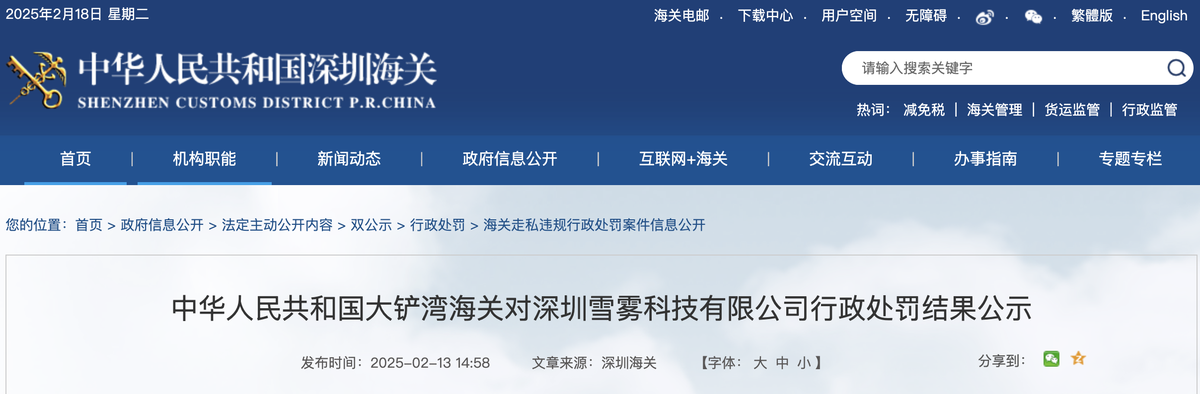
China Customs has imposed a fine of 85,300 CNY on Xuewu Technology, the company behind the SNOWPLUS e-cigarette brand, for serious violations related to false export declarations.

Recently, China Customs has imposed administrative penalties totaling 85,300 RMB on Xuewu Technology, the company behind the renowned e-cigarette brand SNOWPLUS, for serious violations related to false export declarations.


Specific Violations:


1. False Declaration of Destination Country:

On September 15, 2024, the company declared an export of 31,900 boxes of e-cigarettes to Malaysia. However, the actual destination country was Chile. This misrepresentation directly impacted the accuracy of customs statistics and export tax rebate management.


China Customs Imposes Strict Penalties on E-Cigarette Company for False Export Declarations
Penalty Document No. 10|Source: Shenzhen Customs Official Website


2. Goods Not Actually Exported:

On September 17, 2024, the company declared an export of 8,400 boxes of e-cigarettes that did not leave the country, violating customs supervision regulations and affecting national export tax rebate management.


China Customs Imposes Strict Penalties on E-Cigarette Company for False Export Declarations
Penalty document No. 9 | Image source: Shenzhen Customs Official Website


It's noteworthy that this is not the first instance of penalties within the e-cigarette industry in China. In November 2024, the State Tobacco Monopoly Administration (STMA) fined three e-cigarette brands—Mirui, Boulder, and Mevol—a total of nearly $700,000 for discrepancies between their products and the information provided during pre-market reviews. For more information, please refer to the following report: STMA Fines Three Domestic E-Cigarette Brands Nearly $700,000 for Selling Products Inconsistent with Pre-Market Review


We welcome news tips, article submissions, interview requests, or comments on this piece.

Please contact us at info@2firsts.com, or reach out to Alan Zhao, CEO of 2Firsts, on LinkedIn


Notice

1.  This article is intended solely for professional research purposes related to industry, technology, and policy. Any references to brands or products are made purely for objective description and do not constitute any form of endorsement, recommendation, or promotion by 2Firsts.

2.  The use of nicotine-containing products — including, but not limited to, cigarettes, e-cigarettes, nicotine pouchand heated tobacco products — carries significant health risks. Users are responsible for complying with all applicable laws and regulations in their respective jurisdictions.

3.  This article is not intended to serve as the basis for any investment decisions or financial advice. 2Firsts assumes no direct or indirect liability for any inaccuracies or errors in the content.

4.  Access to this article is strictly prohibited for individuals below the legal age in their jurisdiction.


Copyright


This article is either an original work created by 2Firsts or a reproduction from third-party sources with proper attribution. All copyrights and usage rights belong to 2Firsts or the original content provider. Unauthorized reproduction, distribution, or any other form of unauthorized use by any individual or organization is strictly prohibited. Violators will be held legally accountable.

For copyright-related inquiries, please contact: info@2firsts.com


AI Assistance Disclaimer


This article may have been enhanced using AI tools to improve translation and editorial efficiency. However, due to technical limitations, inaccuracies may occur. Readers are encouraged to refer to the cited sources for the most accurate information.

We welcome any corrections or feedback. Please contact us at: info@2firsts.com

South Korea Imports 12,126 Kg of Nicotine Analogues From April to August After Bringing Synthetic Nicotine Under Tobacco Law
South Korea's liquid-vape market is showing changes across raw-material imports, product types and sales channels after synthetic nicotine came under the Tobacco Business Act on April 24. Customs data show nicotine-analogue imports totaled 12,126 kilograms from April through August, while synthetic-nicotine imports over the same five months totaled 231,663 kilograms, just 39.3% of the amount imported in March alone. Physical liquid-vape stores tracked in Seoul and Gyeonggi Province fell 9.9%, unmanned outlets edged higher and online sales listings increased from 27,774 to 42,437. Government testing of 105 liquid inhalation products promoted as nicotine-free separately found nicotine in 13 and 6-methylnicotine in 12.
Sep.22
IVG Parent Secures HMRC Excise Warehouse and Duty Stamp Approvals Ahead of UK Vape Tax
Acme Vape Ltd, the company behind UK vaping brand IVG, has received HM Revenue & Customs approval to operate an excise warehouse for vaping products and participate in the Vaping Duty Stamps Scheme. The UK's Vaping Products Duty will take effect on October 1, 2026, at a flat rate of £2.20 per 10ml of vaping liquid. Acme Vape Ltd says its approved warehouse in Preston will become operational under the new regime on the same date.
Regulations
Sep.18 by 2Firsts Perspectives
Kumulus Vape2026 H1 Revenue Falls 8.3% but Profit Rises 24% as B2B Weakens and Consumer Channels Grow
French vaping company Kumulus Vape reported first-half 2026 revenue of €25.5 million, down 8.3% year over year, as its core B2B distribution business fell 11% to €21.6 million. B2C and store-network revenue rose 5.6% and 17.8%, respectively. Commercial margin increased to 26.3% from 21.7%, while net profit rose 24.1% to €0.8 million. The company attributed the profitability improvement to catalog optimization, logistics restructuring and the ramp-up of Labster, its in-house production unit for proprietary brands.
Market
Sep.17 by 2Firsts Perspectives
Canada Health Minister Says She Is Not Considering Looser Nicotine Pouch Retail Rules as PMI-Linked Group Pushes for Wider Access
Canadian Health Minister Marjorie Michel says she is not considering loosening retail restrictions on nicotine pouches. Canada regulates pouches containing 4 mg or less of nicotine per unit as non-prescription nicotine replacement therapy and requires newer NRT formats such as pouches to be sold from behind pharmacy counters. Meanwhile, Unsmoke Canada, linked to Philip Morris International's Canadian business, is pushing to allow pouches in convenience stores and other general retail outlets. Health Canada also acknowledges continued unauthorized sales, while recent research shows rising pouch use among Canadian youth aged 16 to 19.
Sep.24
NAS 2026 | Former FDA Tobacco Chief Mitch Zeller Calls for Shift From “End Game” to “End State”
At the 2026 New Approaches Summit in New York, former FDA Center for Tobacco Products Director Mitch Zeller called for the tobacco harm reduction debate to shift from the traditional “end game” toward defining a desired “end state.” He also highlighted unresolved concerns around dual use, argued that biomarkers of exposure may be more meaningful than cigarettes-per-day in assessing risk reduction, and said nicotine misperceptions remain a major barrier to public health progress.
Sep.25
Russia’s Vape Device Labeling Regime Enters Force: Registration Starts in September, Mandatory Coding in December
Russia's digital labeling regime for reusable e-cigarettes and similar personal vaping devices entered its first mandatory phase in September 2026. From September 1, manufacturers, importers and other market participants must register with the national Chestny ZNAK tracking system. From December 1, newly manufactured and imported covered devices will be required to carry digital identification codes and be reported as entering circulation. Russia has also issued new operational guidance for imports, marking the transition from a voluntary pilot to phased mandatory implementation.
Sep.15