Key Points
- The 2026 update included 80 randomized controlled trials and 29,861 adult smokers, with nine new trials added; the review’s main conclusions did not change.
- Across 11 trials involving 4,114 participants, nicotine e-cigarettes produced higher quit rates than nicotine replacement therapy, with a risk ratio of 1.61 and high-certainty evidence.
- In absolute terms, about 10 in 100 people using nicotine e-cigarettes may quit for at least six months, compared with about 6 in 100 using NRT.
- Evidence on long-term safety, newer-generation products and differences across device categories remains more limited.
2Firsts
August 26, 2026
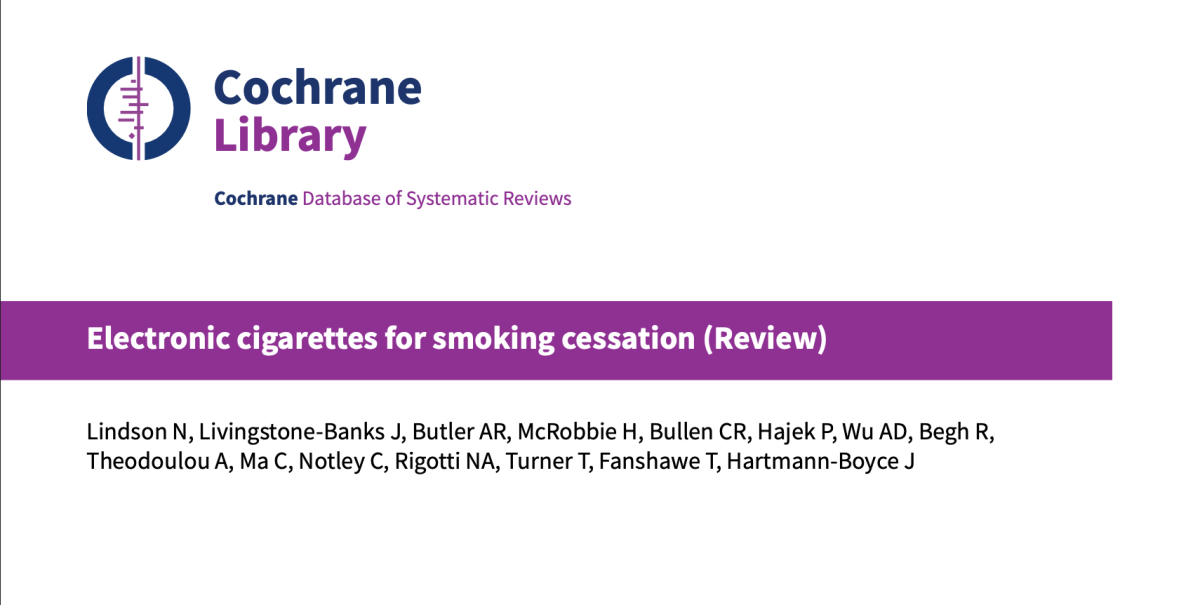
Cochrane’s 2026 update of its living systematic review on electronic cigarettes for smoking cessation included 80 randomized controlled trials involving 29,861 adult smokers and added nine new trials. The review retained its high-certainty conclusion that nicotine e-cigarettes increase quit rates compared with nicotine replacement therapy, or NRT, while the authors said the main conclusions had not changed from the previous version.
The review, Electronic cigarettes for smoking cessation, was published in Issue 8 of the Cochrane Database of Systematic Reviews. The research team included investigators from the University of Oxford, Queen Mary University of London, the University of Auckland, the University of Michigan, the University of East Anglia, Massachusetts General Hospital and Harvard Medical School, Monash University and the University of Massachusetts Amherst. Searches for the 2026 update covered evidence available through January 1, 2026.
Evidence Base Expanded, Main Conclusions Unchanged
The 80 studies included in the 2026 review were all randomized controlled trials, representing a total of 29,861 participants. Nine completed trials were newly added in this update.
The evidence base is not directly comparable with earlier versions simply by study count. Following a 2025 protocol update, the review no longer included uncontrolled single-arm studies and restricted eligibility to randomized trials.
Of the 80 included studies, 40 were conducted in the United States and 16 in the United Kingdom, with others conducted in Australia, Greece, Italy, New Zealand, Canada and several other countries. All participants were adults who smoked cigarettes.
Thirty-four studies reported smoking abstinence outcomes at six months or longer, 35 contributed data on adverse events and 48 reported serious adverse events.
The review examined nicotine e-cigarettes against NRT, non-nicotine e-cigarettes, behavioural support or no support, and other cessation treatments. It also included smaller bodies of evidence on different e-cigarette device types, nicotine strengths and flavour conditions.
Nicotine E-Cigarettes Outperformed NRT on Smoking Cessation
The strongest comparison in the review involved nicotine e-cigarettes versus NRT.
Pooled data from 11 randomized controlled trials involving 4,114 participants showed higher quit rates among people assigned to nicotine e-cigarettes. The risk ratio was 1.61, with a 95% confidence interval of 1.23 to 2.12. Cochrane rated the evidence as high certainty.
In absolute terms, the review estimated that around 6 in 100 people using NRT would quit smoking for at least six months, compared with around 10 in 100 using nicotine e-cigarettes. That corresponds to about four additional quitters per 100 people treated.
The review also examined whether the result differed depending on whether comparator groups received single-form or combination NRT. Sensitivity analyses excluding studies at high risk of bias or studies with tobacco or vaping industry funding did not change the overall direction of the result.
Evidence Was Weaker for Other Comparators
Seven randomized trials involving 1,918 participants compared nicotine e-cigarettes with non-nicotine e-cigarettes.
Nicotine e-cigarettes were associated with higher long-term quit rates, with a risk ratio of 1.34, 95% CI 1.05 to 1.69. Cochrane rated this evidence as moderate certainty.
In absolute terms, about 6 in 100 people using non-nicotine e-cigarettes were estimated to quit, compared with around 8 in 100 using nicotine e-cigarettes.
The review also found higher quit rates when nicotine e-cigarettes were compared with behavioural support alone or no support. Across 11 trials involving 7,214 participants, the pooled risk ratio was 1.75, 95% CI 1.39 to 2.20.
However, this comparison was rated as low-certainty evidence. The review authors cited the difficulty of blinding participants in these studies and differences in the level of support provided between groups, which increased the risk of performance bias.
Serious Adverse Event Rates Did Not Clearly Differ From NRT
Ten studies involving 4,045 participants contributed data on serious adverse events in comparisons between nicotine e-cigarettes and NRT.
The pooled analysis found no clear difference between the two groups, with a risk difference of 0.01, 95% CI -0.01 to 0.02. The evidence was rated as moderate certainty.
For non-serious adverse events, eight studies involving 3,107 participants also found no clear difference between nicotine e-cigarettes and NRT, although the evidence was rated as low certainty because of imprecision and inconsistency across studies.
The authors said the review did not detect evidence of serious short-term harm from nicotine e-cigarettes used for smoking cessation, but larger and longer trials are still needed to fully assess safety.
The review focused on regulated nicotine-containing e-cigarettes. The authors said illicit products and products containing other active substances, including tetrahydrocannabinol, may have different risk profiles.
Product Generation May Matter, but Comparative Evidence Remains Thin
The evidence base included a range of e-cigarette formats, including refillable devices, cartridge products, pod systems and disposable e-cigarettes.
The review noted that nicotine delivery can differ substantially across product types and may influence cessation outcomes. Newer pod-based systems using nicotine salts can deliver higher nicotine levels and may more closely approximate the nicotine pharmacokinetic profile of combustible cigarettes.
However, the number of randomized trials within individual device categories remains too small to support robust subgroup analysis by product type.
As a result, the review does not establish that different generations or categories of e-cigarettes have equivalent cessation effectiveness, nor does it provide a firm ranking of newer versus older product formats.
Cochrane also highlighted newer e-cigarette products as an area where further evidence is needed, particularly because improved nicotine delivery could affect smoking cessation outcomes.
What the Review Means for Industry and Regulators
For regulators, the findings strengthen the evidence base around the use of regulated nicotine e-cigarettes by adult smokers seeking to quit combustible cigarettes, while also reinforcing the need to distinguish those products from illicit devices and products containing other active substances.
For manufacturers and the supply chain, the review indicates that device design and nicotine delivery may matter, but current evidence is not sufficient to determine whether particular product generations or formats produce materially better cessation outcomes.
For investors and industry researchers, the review strengthens the evidence behind one of the most important potential use cases for nicotine e-cigarettes, while leaving major uncertainties around long-term safety, comparative product performance and future regulatory treatment across markets.
For distributors and retailers, the evidence applies specifically to smoking cessation among adults who smoke. It should not be extrapolated to people who have never smoked or to general nicotine use outside a smoking cessation context.
61 Trials Remain Ongoing
The review is maintained as a living systematic review, with searches run regularly and the evidence updated as new studies become available.
In addition to the 80 completed randomized trials included in the 2026 update, the review identified 61 ongoing studies.
After the addition of nine new randomized trials, the authors did not change their central conclusion: evidence that nicotine e-cigarettes increase quit rates compared with NRT remains high certainty, while evidence on long-term safety, newer device types and several other comparisons remains less developed.
Cochrane is an international evidence-synthesis network that evaluates and summarizes medical research through standardized systematic review methods. Its reviews are widely used in clinical, public health and policy decision-making.
Follow 2Firsts for timely updates on tobacco and nicotine science, research developments and industry applications.
Cover Image: Cochrane
Disclaimer
This article is provided solely for professional research, industry discussion, and informational purposes. Any references to brands, companies, products, technologies, or policies are made for factual reporting and analytical purposes only, and do not constitute endorsement, recommendation, promotion, or advertising by 2Firsts.
Nicotine-containing products, including but not limited to cigarettes, e-cigarettes, heated tobacco products, and nicotine pouches, carry significant health risks. Readers are responsible for complying with all applicable laws and regulations in their respective jurisdictions, including age restrictions and access limitations.
The information contained in this article should not be regarded as investment, legal, medical, regulatory, or commercial advice. While 2Firsts strives to ensure the accuracy and reliability of its content, it does not assume liability for any direct or indirect loss arising from errors, omissions, inaccuracies, or reliance on the information contained herein.
This article is not intended for individuals below the legal age for accessing tobacco or nicotine-related information in their jurisdiction.
Copyright Notice
This article is either original content produced by 2Firsts or content reproduced, translated, summarized, or adapted from third-party sources with attribution where applicable. The intellectual property rights of the original content remain with 2Firsts or the respective original rights holders.
No individual or organization may copy, reproduce, distribute, republish, modify, translate, or otherwise use this content without prior authorization. Any unauthorized use may result in legal action.
For copyright-related inquiries, corrections, or removal requests, please contact: info@2firsts.com.
AI-Assisted Translation and Editing Notice
Portions of this article may have been translated, edited, or reviewed with the assistance of artificial intelligence tools to improve efficiency and readability. Due to the limitations of AI-assisted translation and editing, discrepancies, omissions, or inaccuracies may exist when compared with the original source.
Where applicable, readers are advised to refer to the original source for the most complete and accurate information. If you identify any errors or believe that any content infringes upon your rights, please contact us at info@2firsts.com, and we will review and address the matter promptly.