Consensus on Harm Reduction Products: Results of EU Consultation

Business by 2FIRSTS.ai
Jan.17.2024
Consensus on Harm Reduction Products: Results of EU Consultation
Global e-cigarette alliance (WVA) revealed EU citizens' consensus on harm reduction products' effectiveness in quitting smoking, urging policy reconsideration.

According to reports from Brussels media on January 15th, the World Vapers' Alliance (WVA) has recently released the latest results of the public consultation on the European Union Tobacco Products Directive (TPD). These results indicate a significant consensus among citizens, non-governmental organizations, and scientific institutions regarding the effectiveness of harm reduction products for smokers who wish to quit smoking.


According to public consultation data, 77% of respondents believe that harm reduction products are effective in helping smokers quit, with only 9% of EU citizens expressing opposition. Furthermore, as many as 82% of respondents disapprove the notion that new nicotine alternatives pose a risk to public health, with only 6% perceiving them as a threat.


Michael Landl, Director of the World Vapers' Alliance (WVA), expressed his concerns regarding the European Commission's current stance on harm reduction, stating that it not only lags behind but also blatantly disregards the perspective of consumers and scientific evidence. He emphasized the need for the Commission to acknowledge the fact that harm reduction products are not enemies, but rather crucial allies in the fight against smoking.


The successful harm reduction experiences in countries such as Sweden have become exemplars, highlighting the remarkable achievements of consumer-friendly harm reduction methods in reducing smoking rates. However, the European Commission's hostilities towards these approaches have been perplexing and have even had a negative impact on public health efforts.


Randall further pointed out: "Sweden's success story confirms the achievements that sensible harm reduction policies can bring. It is bewildering and even irresponsible that the European Commission continues to oppose these lifesaving products. The Commission should align its policies with clear evidence and public opinion, instead of clinging to outdated and ineffective approaches."


WVA urges the European Commission to reconsider its position and adopt a more evidence-based harm reduction approach, especially in the context of the upcoming Tobacco Products Directive (TPD) update. The recent consultation results should serve as a warning, emphasizing the urgency for policies that genuinely reflect public health and the needs of EU citizens.


We welcome news tips, article submissions, interview requests, or comments on this piece.

Please contact us at info@2firsts.com, or reach out to Alan Zhao, CEO of 2Firsts, on LinkedIn


Notice

1.  This article is intended solely for professional research purposes related to industry, technology, and policy. Any references to brands or products are made purely for objective description and do not constitute any form of endorsement, recommendation, or promotion by 2Firsts.

2.  The use of nicotine-containing products — including, but not limited to, cigarettes, e-cigarettes, nicotine pouchand heated tobacco products — carries significant health risks. Users are responsible for complying with all applicable laws and regulations in their respective jurisdictions.

3.  This article is not intended to serve as the basis for any investment decisions or financial advice. 2Firsts assumes no direct or indirect liability for any inaccuracies or errors in the content.

4.  Access to this article is strictly prohibited for individuals below the legal age in their jurisdiction.


Copyright


This article is either an original work created by 2Firsts or a reproduction from third-party sources with proper attribution. All copyrights and usage rights belong to 2Firsts or the original content provider. Unauthorized reproduction, distribution, or any other form of unauthorized use by any individual or organization is strictly prohibited. Violators will be held legally accountable.

For copyright-related inquiries, please contact: info@2firsts.com


AI Assistance Disclaimer


This article may have been enhanced using AI tools to improve translation and editorial efficiency. However, due to technical limitations, inaccuracies may occur. Readers are encouraged to refer to the cited sources for the most accurate information.

We welcome any corrections or feedback. Please contact us at: info@2firsts.com

Special Report|Virginia Vape Directory Shows Contrast Between Vuse and JUUL Pod Systems and CrossBar 20K, Loon Flavored Disposables
A 2Firsts analysis of Virginia's liquid nicotine and vapor product certification directory identified 213 product records from 15 manufacturers. Companies associated with BAT, Altria, Imperial Brands, JTI and JUUL account for 127 entries. The directory also includes independent brands CrossBar 20K, Loon and Breeze. CrossBar advertises a 13mL disposable capable of up to 20,000 puffs, while Loon has 16 disposable entries featuring fruit, cooling and beverage-related flavors. Of all records, 120 are labeled as under FDA PMTA review. Virginia introduced revised penalties on October 1, 2026, including a minimum first-violation civil penalty of $5,000 per unlisted product, alongside new retail tobacco permitting requirements.
Regulations
Oct.30
South Korea Extends Vape Rules to Unmanned Stores After Bringing Synthetic Nicotine Under Tobacco Law
South Korea's Ministry of Gender Equality and Family said on September 14 that it plans to designate unmanned e-cigarette stores as businesses where minors are prohibited from entering or working. Operators would be required to verify customers' ages and display notices restricting access by minors. The proposal is open for public comment through October 6. The move follows an April expansion of South Korea's statutory tobacco definition that brought products made with natural or synthetic nicotine under the Tobacco Business Act. Nicotine-free liquids and products using nicotine analogues such as 6-methylnicotine, however, remain an emerging regulatory issue.
Sep.21
UK ONS Data: Vaping Rate Among Women Aged 25–34 Reaches 18.3%, Compared With 14.4% for Men
The vaping rate among women aged 25 to 34 in Great Britain reached 18.3% in 2025, up from 13.7% in 2024 and 8.3% in 2020, according to data from the Office for National Statistics (ONS). The figure was the highest for this group since records began in 2014 and exceeded the 14.4% recorded among men of the same age. Adults aged 25 to 34 also overtook those aged 16 to 24 as the age group with the highest vaping prevalence. Overall, about 5.4 million adults in Great Britain used e-cigarettes in 2025, broadly unchanged from the previous year.
DATA
Oct.13
Kelly White Bets on Female Consumers as Nicotine Pouch Competition Intensifies | 2Firsts Interview
Swedish nicotine pouch brand Kelly White is building its strategy around adult female consumers. Founder and CEO Sophia Wilsby told 2Firsts that women accounted for around 70% of the brand’s repeat customers on HAYPP in Sweden in 2025. The interview explores female consumer segmentation, product and design differentiation, gender stereotypes, packaging regulation, and how independent brands can compete with global players such as ZYN and VELO while considering funding, partnerships and future ownership options.
Business
Sep.24
As Regulators Focus on Nicotine Pouch Child Safety, Safeguard Pursues an External Packaging Route
As regulators pay closer attention to child safety in nicotine pouches, manufacturers face a practical challenge: how to strengthen child-resistant packaging without unnecessarily reworking products, production lines and regulatory submissions already in place. In a written interview with 2Firsts, Chemular detailed Safeguard’s external packaging approach, its customer-specific testing requirements and possible PMTA pathways. The model remains early-stage, but it offers a new way to think about an increasingly important regulatory and manufacturing issue.
Industry Insight
Sep.19
Japan's Heated Tobacco Use Rises From 0.1% to 14.9% Over a Decade as Growth Extends Beyond Cigarette Switching
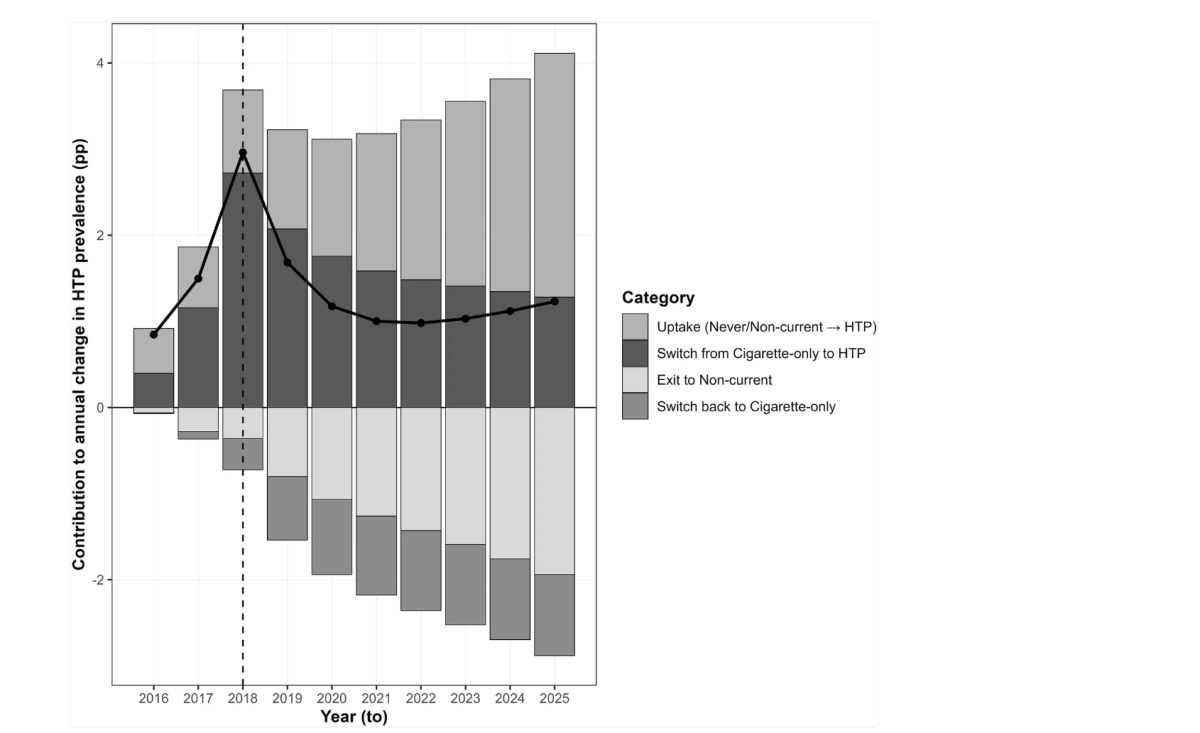
A decade-long study published in The Lancet Regional Health – Western Pacific found that heated tobacco product use in Japan increased from 0.1% in 2015 to 14.9% in 2025, although growth slowed after 2018. Switching from conventional cigarettes remained an important source of HTP uptake, while the contribution from previously non-current users increased. Approximately 56% of HTP users also smoked conventional cigarettes in 2025. Separate industry data show that Japan's heated tobacco sales reached 73.4 billion units in fiscal 2025, approaching conventional cigarette sales of 78.2 billion units.
SCIENCE
Nov.10