EU Health Ministers Discuss Proposal to Restrict Nicotine Product Flavors

Regulations by 2FIRSTS.ai
Jun.21.2024
EU Health Ministers Discuss Proposal to Restrict Nicotine Product Flavors
EU health ministers discuss proposals to restrict e-cigarette and nicotine product flavors, potentially affecting millions of consumers.

According to a report by Vaping360 on June 21st, today (the 21st), health ministers from all 27 European Union (EU) member states discussed proposals to restrict e-cigarette and other nicotine product flavors (including nicotine pouches). Their stance could lead to stricter regulations on e-cigarettes for millions of nicotine consumers in Europe.


The Employment, Social Policy, Health, and Consumer Affairs Committee (EPSCO), one of the 10 "agencies" of the European Commission, will consider proposals from Latvia and Denmark to support a ban on flavorings and crack down on cross-border sales within the EU.


Latvia's proposal also received support from delegations from Cyprus, Estonia, Ireland, Lithuania, Luxembourg, Malta, Portugal, Slovenia, and Spain. Denmark's suggestion was endorsed by Estonia, Finland, France, Germany, Ireland, Luxembourg, Malta, the Netherlands, Poland, Slovenia, and Spain.


If the health ministers reach a consensus on these proposals, the next step will be to ask the European Commission to draft legislation, which will ultimately be voted on by the Council and the European Parliament. During this process, elections in various countries may soften or strengthen support for bans on certain flavors.


Currently, seven countries in the European Union have passed laws banning e-cigarette flavors: Denmark, Estonia, Finland, Hungary, Lithuania, the Netherlands, and Slovenia. Spain recently completed a public consultation on a proposal to ban flavors, while Latvia is introducing flavor restrictions. Currently, no European country has passed a total ban on e-cigarettes.


The existing Tobacco Products Directive (TPD) regulates nicotine and tobacco product standards within the European Union, allowing each member state to establish its own flavor regulations.


However, according to Latvia's recommendations, individual bans are ineffective because "there is no complete ban on cross-border remote sales of tobacco or related products (including e-cigarettes) at the EU level, and cross-border sales are not prohibited.


Due to continued discrepancies among member states in the regulation of flavors and additives in e-cigarette liquids, as well as cross-border distance sales, it is necessary to establish further common regulations at the EU level.


Denmark's proposal calls for stricter requirements and urges the European Union to allow member states to ban specific categories of nicotine products.


These initiatives should include a ban on flavored nicotine products, restrictions on nicotine content in these products, and the ability to prohibit certain products when necessary. More broadly, we call on the European Commission to initiate a debate on nicotine products and allow for a review of various possible regulations that would enable member states to potentially ban defined product categories.


The European Tobacco Harm Reduction Advocates (ETHRA) has written a letter to all EU health ministers, opposing the proposed flavor ban and explaining its consequences. "We hope to proceed cautiously in the discussion and provide some factual background. The proposed measures are unlikely to protect young people and may have more disadvantages than benefits. A total or partial ban on the production and supply of new nicotine products will not eliminate the basic demand for nicotine. All safer nicotine products have some form of flavor (including tobacco flavor), so a flavor ban is effectively a substantial ban on the products.


Prohibition will not make the banned products disappear or diminish demand.


ETHRA has provided four strategies to reduce teenagers' exposure to e-cigarettes and other nicotine products:

  • Legal regulated market; 
  • Age verification retail system; 
  • Marketing control; 
  • Taste description control. 


The organization is calling on EU health ministers to base the upcoming revision of the major EU Tobacco Products Directive on "evidence, careful consideration, and meaningful consultation.


These directives could have life-threatening or life-saving implications for European citizens, and we should not begin revising based on preconceived outcomes that rely on weak or misleading evidence.


We welcome news tips, article submissions, interview requests, or comments on this piece.

Please contact us at info@2firsts.com, or reach out to Alan Zhao, CEO of 2Firsts, on LinkedIn


Notice

1.  This article is intended solely for professional research purposes related to industry, technology, and policy. Any references to brands or products are made purely for objective description and do not constitute any form of endorsement, recommendation, or promotion by 2Firsts.

2.  The use of nicotine-containing products — including, but not limited to, cigarettes, e-cigarettes, nicotine pouchand heated tobacco products — carries significant health risks. Users are responsible for complying with all applicable laws and regulations in their respective jurisdictions.

3.  This article is not intended to serve as the basis for any investment decisions or financial advice. 2Firsts assumes no direct or indirect liability for any inaccuracies or errors in the content.

4.  Access to this article is strictly prohibited for individuals below the legal age in their jurisdiction.


Copyright


This article is either an original work created by 2Firsts or a reproduction from third-party sources with proper attribution. All copyrights and usage rights belong to 2Firsts or the original content provider. Unauthorized reproduction, distribution, or any other form of unauthorized use by any individual or organization is strictly prohibited. Violators will be held legally accountable.

For copyright-related inquiries, please contact: info@2firsts.com


AI Assistance Disclaimer


This article may have been enhanced using AI tools to improve translation and editorial efficiency. However, due to technical limitations, inaccuracies may occur. Readers are encouraged to refer to the cited sources for the most accurate information.

We welcome any corrections or feedback. Please contact us at: info@2firsts.com

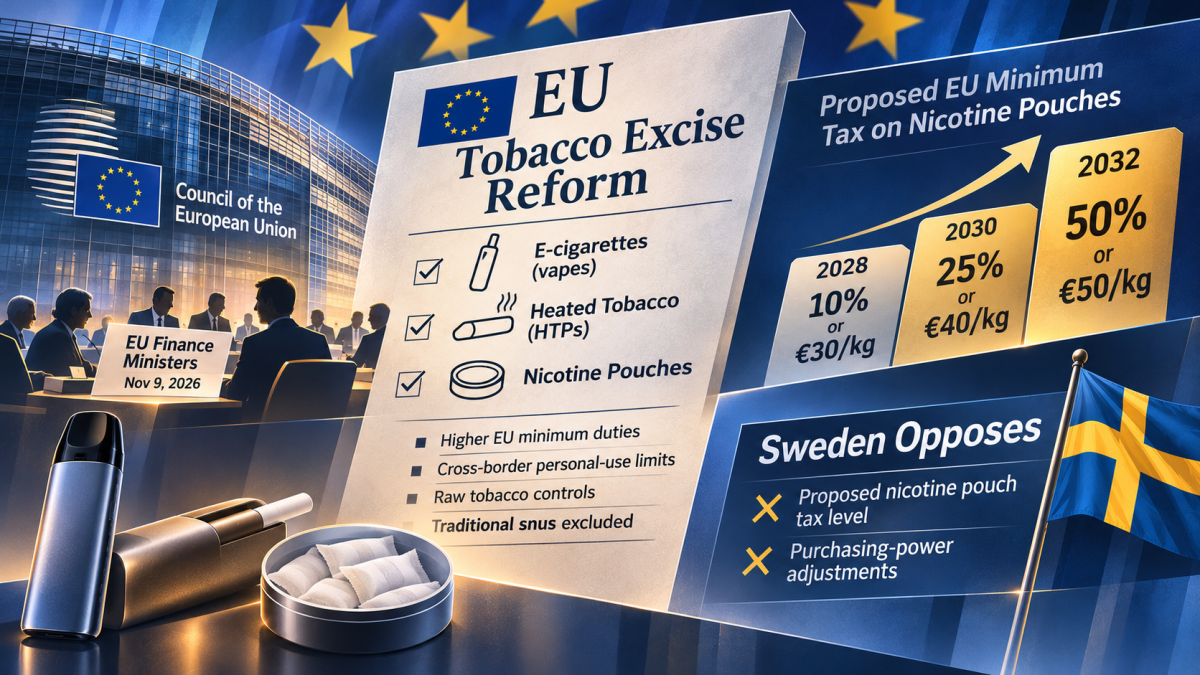
EU Vape, Heated Tobacco and Nicotine Pouch Tax Reform Reaches Ministerial Talks: Sweden Opposes Proposed 2032 Minimum of 50% of Retail Price or €50/kg for Nicotine Pouches
EU finance ministers are scheduled to discuss tobacco excise reform on November 9, 2026, seeking agreement on higher minimum duties for conventional tobacco and a common EU minimum tax framework covering e-cigarettes, heated tobacco and nicotine pouches. A November 5 Council document identifies nicotine pouch taxation as the main outstanding issue. The Irish Council presidency proposes phased increases, reaching 50% of retail selling price or €50 per kilogram in 2032. Sweden has formally said it cannot support the current compromise, objecting to both the proposed nicotine pouch tax burden and the adjustment of minimum rates based on national purchasing power. The package also addresses cross-border personal-use reference quantities, raw tobacco controls and the continued exclusion of traditional tobacco snus.
Regulations
Nov.10
FDA Appoints Former Tobacco Enforcement Deputy Jessica Zeller as Director as Agency Weighs PMTA Framework Changes
The U.S. Food and Drug Administration (FDA) has named Jessica Zeller director of the Center for Tobacco Products' (CTP) Office of Compliance and Enforcement (OCE), effective November 1, 2026. Zeller, the office's inaugural deputy director, returns from medical device manufacturer Edwards Lifesciences with more than 20 years of regulatory and legal experience. The appointment follows CTP leadership changes and adjustments to tobacco regulation. Bret Koplow became permanent CTP director in September; the FDA revised enforcement priorities for unauthorized e-cigarettes and nicotine pouches in May and announced faster PMTA review procedures. On September 28, the agency said it would evaluate changes to the existing PMTA regulatory framework, including potential rulemaking to replace it.
FDA
Oct.20 by 2Firsts Perspectives
Special Report | Can Nicotine Be Replaced? 6-MN Is Already on the Market While Key Human Evidence Is Still Missing
Nicotine analogues such as 6-methylnicotine are already appearing in e-cigarettes and oral pouches, even as key human evidence remains limited. A new Nixodine-S study adds nonclinical data showing differences from nicotine in cytotoxicity and receptor activity, while independent studies point to a more complex toxicological picture. With supply-chain activity growing and FDA seeking clearer authority over nicotine analogues, the industry now faces a larger question: what evidence is needed before these substances can credibly replace nicotine?
SCIENCE
Sep.23
Reynolds Puts Nearly 183,000 U.S. Contracted Outlets Under Age-Verification Rules, Covering 94% of Volume — Can It Shift an Unauthorized Vape Market?
Reynolds American says nearly 183,000 U.S. retail outlets are under contract, with its Retail Marketing Plan Contract covering about 94% of company volume and requiring point-of-sale age verification. The company combines those contracts with We Card, TruAge, NACS-linked infrastructure and POS integration, while enhanced Vuse Pro retail rules add ID scanning, purchase limits and stronger underage-sales accountability. The initial Vuse Pro rollout targets about 50,000 stores. The system is taking shape as unauthorized vapor products remain dominant in parts of the U.S. market: a 2026 study estimated they accounted for 69.4% of tracked brick-and-mortar e-cigarette dollar sales in December 2025.
Special Report
Oct.15
Italy Proposes Earlier Vape and HTP Tax Hikes, New Rules for E-Liquid Pricing, Exclusive Deals and Distribution
Italy's proposed 2027–2029 budget would bring forward scheduled tax increases for e-cigarette liquids and heated tobacco products from January 1, 2028, to July 1, 2027. The consumption tax coefficient for nicotine-containing e-liquids would rise from 20% to 22%, that for nicotine-free liquids and applicable flavorings from 15% to 17%, and the heated-tobacco coefficient from 41% to 42%. The bill would also introduce official retail price schedules for e-liquids, restrict exclusive agreements between retailers and suppliers, and limit single-brand-dominated displays, sales incentives and bundled offers. Importing, authorized warehousing and retailer sourcing arrangements would also change. The proposals remain subject to parliamentary approval and subsequent implementing regulations.
Regulations
Nov.04
US ITC Judge Finds Glas Infringed Two JUUL Vape Patents, Recommends Restrictions on Related Imports——Glas Received FDA Marketing Authorization for Four Vape Pods in May 2026; Proposed Restrictions Remain Under Commission Review
A U.S. International Trade Commission (USITC) administrative law judge issued an initial determination on October 20, 2026, finding that certain Glas vaping devices, cartridges and components infringed 12 claims across two patents asserted by JUUL, constituting a violation of Section 337 of the Tariff Act of 1930. The judge recommended a limited exclusion order and a cease and desist order against the Glas respondents. Five months earlier, the FDA authorized four Glas e-cigarette pods, including mango, blueberry and two menthol variants. The patent investigation concerns device and cartridge structures and is separate from FDA premarket review. The proposed import restrictions have not become final, and their product-level scope remains unresolved.
company
Nov.05