FDA Renews Authorization for 8 General Snus Products with Reduced Risk Claim Until 2032

Nov.08.2024
FDA Renews Authorization for 8 General Snus Products with Reduced Risk Claim Until 2032
FDA has announced the renewal of the risk modification authorization for eight general snus products from Swedish Match, allowing them to remain on the market until 2032.

On November 7, 2023, U.S. Food and Drug Administration (FDA) announced on its official website that, after a rigorous scientific review, it has renewed the Modified Risk Tobacco Product (MRTP) order for eight snus products from Swedish Match USA, Inc. 


With this renewal, these products will continue to be sold (having been approved for sale since 2019) and will carry the following updated risk claim: “Using General Snus instead of cigarettes puts you at a lower risk of mouth cancer, heart disease, lung cancer, stroke, emphysema, and chronic bronchitis.”


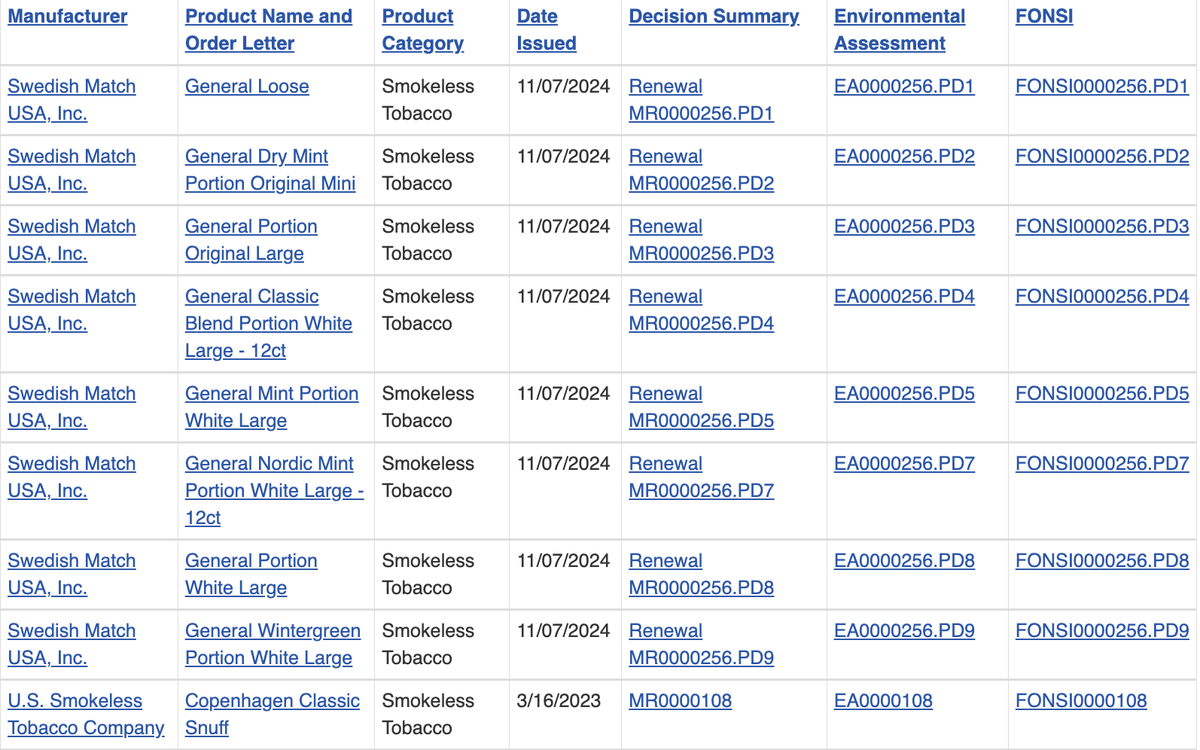
The products granted the risk modification include:

  • General Loose
  • General Dry Mint Portion Original Mini
  • General Portion Original Large
  • General Classic Blend Portion White Large-12ct
  • General Mint Portion White Large
  • General Nordic Mint Portion White Large-12ct
  • General Portion White Large
  • General Wintergreen Portion White Large


FDA's renewed risk modification order is valid until November 7, 2032. If, at any time, the agency determines that continued sales of these products are no longer beneficial to public health, it may revoke the order.


FDA stated that the review confirmed that the risk-reduction claim is supported by scientific evidence, that consumers understand the claim, and that consumers correctly perceive the relative risk of these products compared to cigarettes. FDA found that when used by consumers, these risk-reducing products significantly reduce harm and the risk of tobacco-related diseases, benefiting overall public health. 


Specifically, existing scientific evidence, including long-term epidemiological studies, indicates that using these products in place of smoking can lower the risk of oral cancer, heart disease, lung cancer, stroke, emphysema, and chronic bronchitis. Furthermore, current evidence does not suggest a significant uptake of these products by adolescents.


FDA emphasized that the modified risk order does not permit the company to market these products with any other modified risk claims that might mislead consumers into believing the products are FDA-approved or considered safe by FDA. There is no safe tobacco product, and individuals who do not use tobacco should not begin using these products.


FDA noted that this is the first renewal of a Modified Risk Tobacco Product (MRTP) order.


  • These products were originally authorized for marketing in the U.S. via the premarket tobacco product application pathway in 2015
  • In October 2019, the products were then authorized to be marketed as modified risk tobacco products.
  • Those 2019 orders permitting marketing of General Snus products as modified risk tobacco products were valid for 5 years.
  • To continue marketing the products after the set terms of the 2019 orders, Swedish Match USA, Inc. submitted modified risk tobacco product renewal applications. 
 

FDA Renews Authorization for 8 General Snus Products with Reduced Risk Claim Until 2032
Modification of Risk Approval Order | Image source: FDA


We welcome news tips, article submissions, interview requests, or comments on this piece.

Please contact us at info@2firsts.com, or reach out to Alan Zhao, CEO of 2Firsts, on LinkedIn


Notice

1.  This article is intended solely for professional research purposes related to industry, technology, and policy. Any references to brands or products are made purely for objective description and do not constitute any form of endorsement, recommendation, or promotion by 2Firsts.

2.  The use of nicotine-containing products — including, but not limited to, cigarettes, e-cigarettes, nicotine pouchand heated tobacco products — carries significant health risks. Users are responsible for complying with all applicable laws and regulations in their respective jurisdictions.

3.  This article is not intended to serve as the basis for any investment decisions or financial advice. 2Firsts assumes no direct or indirect liability for any inaccuracies or errors in the content.

4.  Access to this article is strictly prohibited for individuals below the legal age in their jurisdiction.


Copyright


This article is either an original work created by 2Firsts or a reproduction from third-party sources with proper attribution. All copyrights and usage rights belong to 2Firsts or the original content provider. Unauthorized reproduction, distribution, or any other form of unauthorized use by any individual or organization is strictly prohibited. Violators will be held legally accountable.

For copyright-related inquiries, please contact: info@2firsts.com


AI Assistance Disclaimer


This article may have been enhanced using AI tools to improve translation and editorial efficiency. However, due to technical limitations, inaccuracies may occur. Readers are encouraged to refer to the cited sources for the most accurate information.

We welcome any corrections or feedback. Please contact us at: info@2firsts.com

Special Report | Vape bans and tougher rules: the South Caucasus takes different paths
Azerbaijan's sweeping e-cigarette ban has raised concerns over enforcement errors and the emergence of illicit sales, while neighboring Armenia is tightening technical rules and preparing higher excise taxes. Georgia, meanwhile, has resisted calls for broader vape restrictions and introduced preferential taxes for some domestically produced cigarettes. The divergent approaches across the South Caucasus highlight a regional policy dilemma: how to curb nicotine use and protect public health without encouraging black markets or creating unintended economic consequences for businesses and consumers.
Nov.03
Sweden Finds ZYN Ingredient Labels Noncompliant Over Generic Flavoring Disclosure, Swedish Match Faces SEK 2 Million Monthly Penalty
Sweden's Public Health Agency has found ingredient labels on ZYN nicotine pouches sold by Philip Morris International subsidiary Swedish Match to be noncompliant, according to Dagens industri. The products' packaging listed 10 to 13 ingredients, compared with 11 to 42 in regulatory submissions, with multiple flavoring ingredients grouped under the generic term "aromer." The agency ordered corrective action, warning of a conditional penalty of SEK 2 million per month for noncompliance. The order applies only to products manufactured after the decision becomes legally effective and does not require recalls. Swedish Match disputes the agency's interpretation and plans to appeal.
PMI
Oct.22
How Many Nicotine Pouch Factories Does Europe Need? 2Firsts Interviews AIRSCREAM on the OEM Market
At InterTabac 2026, nicotine pouch growth was visible not only in brands but across equipment, raw materials and OEM manufacturing. 2Firsts interviewed AIRSCREAM commercial head Steve Moore on how many pouch factories Europe may ultimately need and where manufacturers can differentiate, from formulation and flavour to pouch materials, production consistency and customer service. The category continues to expand, but questions remain over future capacity, consolidation and the long-term structure of the supply chain.
Sep.18
Special Report | Altria's NACS Booth Raises Questions Over U.S. Tobacco Advertising Warnings
During its coverage of Altria's booth at NACS Show 2026, 2Firsts documented product displays that prompted questions about U.S. tobacco advertising warning requirements. Following public comments from a former FDA official, 2Firsts sought responses from Altria and independently consulted U.S. regulatory lawyer Azim Chowdhury. Altria maintained that its B2B communications complied with applicable laws, while Chowdhury explained that federal warning rules provide no general trade-show exemption for e-cigarettes and nicotine pouches. The special report examines the broader regulatory implications.
Nov.04
JTI Proposes 25-Cent Irish Cigarette Tax Increase, Says It Could Raise €45 Million
Japan Tobacco International's Irish business has proposed a €0.25 tax increase on a pack of 20 cigarettes in its pre-Budget 2027 submission, below the €0.50-or-more increases typically imposed in recent Irish budgets. JTI says the proposal could generate around €45 million in additional Exchequer revenue while limiting further movement toward illicit and non-Irish-tax-paid tobacco. Revenue's existing estimate for a comparable €0.25 increase, including pro-rata rises on other tobacco products, is about €18 million for a full year.
JTI
Sep.18 by 2Firsts Perspectives
Reynolds Showcases Vuse Pro Flavors and VELO Nicotine Pouches at NACS Show 2026
Reynolds American, a BAT subsidiary, showcased four Vuse Pro flavored e-cigarette pods and its VELO nicotine pouch portfolio at NACS Show 2026. Booth staff confirmed to 2Firsts that the Vuse Pro flavors are sold in the U.S., although they have not received FDA marketing authorization. BAT outlined plans to expand Vuse retail distribution and reported that VELO held a 30.5% year-to-date volume share of the U.S. modern oral nicotine category through August 2026. The booth also featured the newly launched VELO MAX range and merchandising displays combining cigarettes, vaping products and oral nicotine brands.
EXPO
Oct.09