JTI Proposes 25-Cent Irish Cigarette Tax Increase, Says It Could Raise €45 Million

JTI
Sep.18
JTI Proposes 25-Cent Irish Cigarette Tax Increase, Says It Could Raise €45 Million
Japan Tobacco International's Irish business has proposed a €0.25 tax increase on a pack of 20 cigarettes in its pre-Budget 2027 submission, below the €0.50-or-more increases typically imposed in recent Irish budgets. JTI says the proposal could generate around €45 million in additional Exchequer revenue while limiting further movement toward illicit and non-Irish-tax-paid tobacco. Revenue's existing estimate for a comparable €0.25 increase, including pro-rata rises on other tobacco products, is about €18 million for a full year.

Key Points

  • JTI has proposed a €0.25 increase in tax on a pack of 20 cigarettes for Budget 2027.
  • Ireland has raised cigarette tax by at least €0.50 in each of the past 10 budgets; the last three increases were €0.75, €1 and €0.50.
  • JTI estimates a €0.25 increase could generate €45 million in additional revenue, compared with Revenue's existing full-year estimate of about €18 million.
  • JTI says 39.5% of tobacco products consumed in Ireland in 2025 generated no Irish tax revenue, up from 22% in 2021.

2Firsts

September 18, 2026

Japan Tobacco International's Irish business has proposed a €0.25 increase in Tobacco Products Tax on a pack of 20 cigarettes in its pre-Budget 2027 submission, The Irish Times reported on September 17.

The proposed increase is below the level applied in recent Irish budgets. According to The Irish Times, every one of the past 10 budgets has included an increase of at least €0.50 on a pack of 20 cigarettes.

JTI said a €0.25 increase could raise Exchequer revenue while limiting further movement by consumers toward illicit and non-Irish-tax-paid tobacco. The company estimates the proposal would generate an additional €45 million.

JTI's €45 Million Estimate Exceeds Revenue's Existing Projection

Revenue's post-Budget 2026 Ready Reckoner estimates that a €0.25 increase on a pack of 20 cigarettes, including pro-rata increases on other tobacco products, would generate about €18 million in a full year.

The same Revenue model estimates approximately €35 million from a €0.50 increase and €69 million from a €1 increase. The figures include VAT.

Revenue's €18 million estimate is below the €45 million figure cited by JTI in its latest submission.

Publicly available material does not show that the two estimates use identical assumptions on volumes, consumer behaviour or market changes, and the figures therefore should not be treated as directly comparable outputs from the same model.

JTI described the €0.25 increase as its preferred option for delivering additional Exchequer revenue while limiting displacement toward illicit supply.

Recent Cigarette Tax Increases Were €0.75, €1 and €0.50

Ireland has repeatedly increased cigarette taxes in recent budgets.

Budget 2024 raised excise on a pack of 20 cigarettes by €0.75, with pro-rata increases on other tobacco products.

Budget 2025 increased the tax by a further €1 per pack, taking the most popular price category to €18.05.

Budget 2026 added another €0.50 per pack, again with corresponding increases for other tobacco products.

JTI's proposed €0.25 increase is one-third of the Budget 2024 rise, one-quarter of the Budget 2025 rise and half of the Budget 2026 increase.

JTI Says 39.5% of Tobacco Consumption Generated No Irish Tax

JTI said 39.5% of tobacco products consumed in Ireland in 2025 generated no Irish tax revenue, up from 22% in 2021.

The company estimates the resulting loss in excise and VAT at more than €1 billion.

The 39.5% figure is not equivalent to an illicit-market share. The Irish Times noted that the total includes tobacco legally brought into Ireland from abroad, products taxed in other jurisdictions or purchased duty-free, as well as illicit and counterfeit tobacco.

Separate Revenue data also point to a substantial volume of non-Irish-tax-paid tobacco consumption. Its latest Tobacco Consumption Survey found that more than one-third of cigarettes and almost half of roll-your-own tobacco packs consumed in Ireland had not been taxed in Ireland.

Revenue subsequently tightened rules for tobacco brought into Ireland from other EU member states from December 9, 2025. Current reference quantities include 800 cigarettes, 400 cigarillos, 200 cigars and one kilogram of other tobacco products. Quantities above those levels can be treated as evidence that the products are not for personal use.

Revenue's survey and JTI's 39.5% figure use different product and statistical definitions and are not directly interchangeable.

Ireland Has Also Extended Excise to E-Liquids

Ireland has also expanded excise taxation beyond conventional tobacco.

The E-liquid Products Tax took effect on November 1, 2025, applying to both nicotine-containing and nicotine-free e-liquids at €500 per litre, equivalent to €0.50 per millilitre.

The tax applies on the first supply of an e-liquid product by a business in Ireland, with the liable supplier responsible for registration, filing and payment.

The publicly available Irish Times report on JTI's Budget 2027 submission focuses on conventional tobacco taxation and does not disclose whether the company made separate proposals covering e-liquids, heated tobacco products or nicotine pouches.

JTI Ireland distributes cigarette brands including Benson & Hedges, Silk Cut and Camel.

Follow 2Firsts for timely updates on global tobacco and nicotine industry developments, corporate strategy and market trends.


Cover Image: The Irish Times

 

German Tobacco Tax Revenue Falls 10.8% Through August as Tax-Paid Cigarette Volume Drops 12.6%
Germany collected €9.789 billion in total tobacco tax revenue from January through August 2026, down 10.8% from a year earlier, according to the Federal Ministry of Finance. Germany's tobacco tax base covers not only cigarettes and fine-cut tobacco but also heated tobacco and vaping liquids taxed as tobacco substitutes. The German Association of the Tobacco Industry and Novel Products, or BVTE, citing federal statistical data, said tax-paid cigarette volume fell 12.6% to 40.6 billion sticks. BVTE is using the latest figures to argue against further tax increases planned from 2027 through 2030, while Germany's parliament is scheduled to hold a first reading of the bill on September 24.
Sep.23
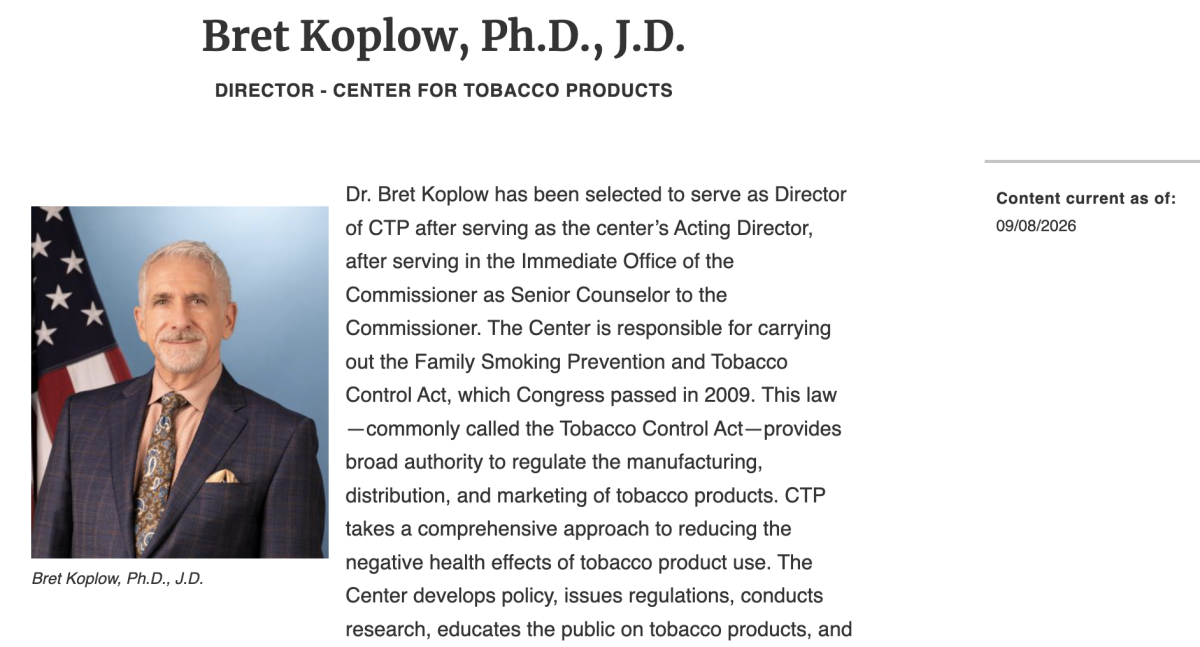
Bret Koplow Takes Permanent Charge of FDA Tobacco Center After Pushing Faster PMTA Reviews, as HHS Emphasizes Innovation and Access to Lower-Risk Alternatives
The U.S. Department of Health and Human Services has named Bret Koplow permanent director of the FDA’s Center for Tobacco Products, ending his period as acting chief. Koplow has spent years working on tobacco regulation, law and policy inside the FDA and, while serving as acting director, pushed for faster PMTA reviews and nicotine pouch review pilots. HHS also said CTP will prioritize innovation and access to less harmful alternatives for adult smokers while continuing efforts to protect youth.
Sep.09
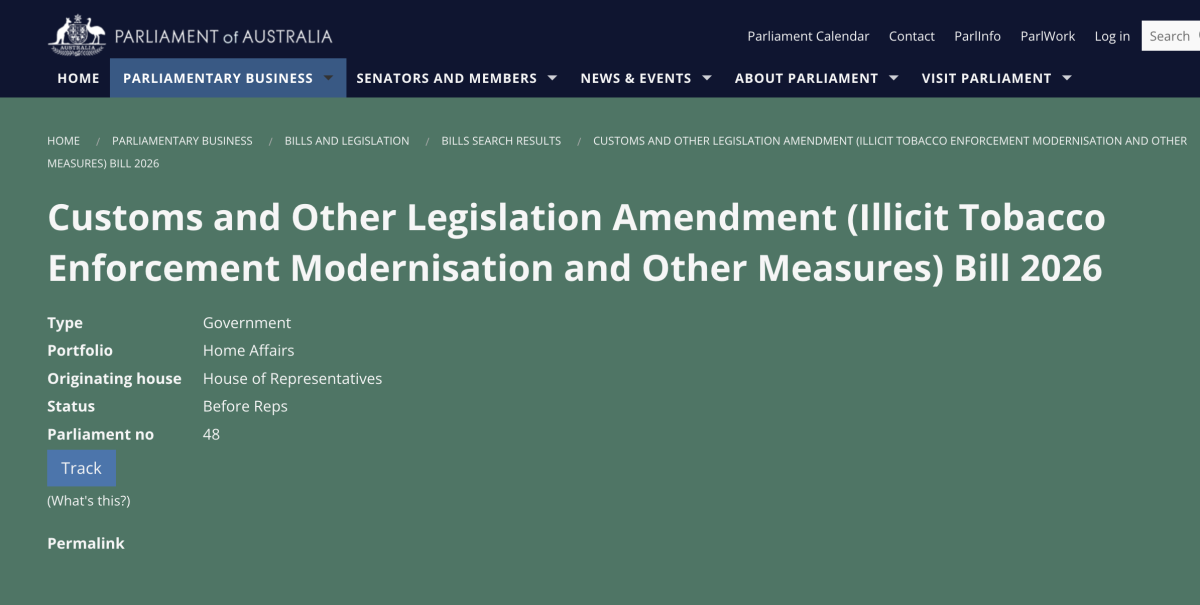
Australia Extends Illicit Tobacco Crackdown From Tougher Penalties to Customs and Logistics Supply Chains
Australia's federal government introduced a new illicit tobacco enforcement bill on September 10 that would strengthen evidentiary presumptions, representative sampling, seizure and forfeiture procedures, proceeds-of-crime powers and obligations for customs and logistics operators. The proposal follows the Combatting Illicit Tobacco Act 2026, which took effect in August and increased penalties while expanding investigative and asset-recovery tools. Together, the reforms extend Australia's crackdown from tougher criminal sanctions into import, logistics and evidentiary enforcement.
Sep.14
JUUL2 Sued Within a Week of FDA Authorization as AJ Marketing Alleges Infringement of Programmable Vape Patent
Less than a week after JUUL2 received U.S. FDA marketing authorization on August 28, 2026, JUUL Labs was sued for patent infringement in federal court in Delaware. AJ Marketing LLC filed the complaint on September 3, alleging that both JUUL 1 and JUUL2 infringe U.S. Patent No. 8,851,068 B2. The patent covers aspects of programmable electronic vaporization devices, including controls over dose delivery, usage frequency and operating parameters. The plaintiff is seeking reasonable royalties and ongoing royalties tied to the remaining life of the patent. JUUL has not yet publicly responded to the case.
Sep.10
Canada Health Minister Says She Is Not Considering Looser Nicotine Pouch Retail Rules as PMI-Linked Group Pushes for Wider Access
Canadian Health Minister Marjorie Michel says she is not considering loosening retail restrictions on nicotine pouches. Canada regulates pouches containing 4 mg or less of nicotine per unit as non-prescription nicotine replacement therapy and requires newer NRT formats such as pouches to be sold from behind pharmacy counters. Meanwhile, Unsmoke Canada, linked to Philip Morris International's Canadian business, is pushing to allow pouches in convenience stores and other general retail outlets. Health Canada also acknowledges continued unauthorized sales, while recent research shows rising pouch use among Canadian youth aged 16 to 19.
Sep.24
Special Report | From New York to Washington: How FDA’s Tobacco Center Is Reworking Product Review
FDA’s Center for Tobacco Products is reshaping how it approaches tobacco product review. Based on 2Firsts’ on-site reporting in New York and Washington, this report traces CTP’s emerging direction: stronger links between PMTA and tobacco harm reduction, more category-specific review, greater emphasis on decision-relevant science, more predictable timelines and expanded use of sPMTA for product modifications. CTP also acknowledged major constraints, including just nine PMTA review teams, persistent backlogs and limits on hiring capacity.
Regulations
Oct.08