German Customs Seize Thousands of Illegal Disposable E-Cigarettes

Sep.27.2024
German Customs Seize Thousands of Illegal Disposable E-Cigarettes
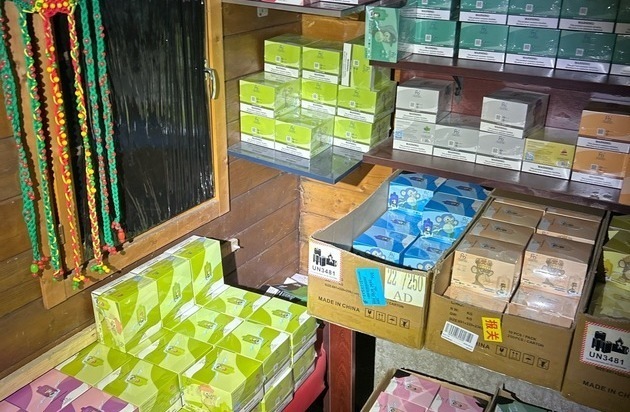
German customs officials in Dortmund seized over 7,000 illegal disposable e-cigarettes, resulting in potential tax losses of €28,080.

According to Presseportal on September 26th, officials from the Customs Traffic Route Control Department in Dortmund, Germany conducted an inspection on a wholesale dealer in Dortmund on September 24th after receiving relevant tips.


During the inspection, customs officials found a total of 7,030 non-compliant disposable e-cigarettes in the wholesaler's garden shed. These e-cigarettes contained a total of 140.4 liters of e-cigarette liquid.


Borussia Dortmund customs spokesperson Andrea Münch stated that


Due to the windows of this garden shed being covered with black film and claimed to not be within the scope of commercial operations, we were forced to enter the premises based on a judge's order. The results proved that customs officials have a very keen sense of smell, as all the e-cigarette liquid stored there exceeded two milliliters in content, thus not meeting regulations.


This case is expected to result in a tax revenue loss of 28,080 euros, and tax criminal investigation procedures have been initiated against the individuals involved at the scene.


Starting from July 1, 2022, e-liquids used for e-cigarettes will be subject to tobacco tax. The tax rate will increase from 0.16 euros to 0.20 euros on January 1, 2024, and will further rise to 0.26 euros on January 1, 2025.


According to Article 14 of the Tobacco Products Act, the capacity of disposable e-cigarette liquid must not exceed two milliliters (equivalent to a maximum of 800 puffs), otherwise it will be prohibited from being sold.


We welcome news tips, article submissions, interview requests, or comments on this piece.

Please contact us at info@2firsts.com, or reach out to Alan Zhao, CEO of 2Firsts, on LinkedIn


Notice

1.  This article is intended solely for professional research purposes related to industry, technology, and policy. Any references to brands or products are made purely for objective description and do not constitute any form of endorsement, recommendation, or promotion by 2Firsts.

2.  The use of nicotine-containing products — including, but not limited to, cigarettes, e-cigarettes, nicotine pouchand heated tobacco products — carries significant health risks. Users are responsible for complying with all applicable laws and regulations in their respective jurisdictions.

3.  This article is not intended to serve as the basis for any investment decisions or financial advice. 2Firsts assumes no direct or indirect liability for any inaccuracies or errors in the content.

4.  Access to this article is strictly prohibited for individuals below the legal age in their jurisdiction.


Copyright


This article is either an original work created by 2Firsts or a reproduction from third-party sources with proper attribution. All copyrights and usage rights belong to 2Firsts or the original content provider. Unauthorized reproduction, distribution, or any other form of unauthorized use by any individual or organization is strictly prohibited. Violators will be held legally accountable.

For copyright-related inquiries, please contact: info@2firsts.com


AI Assistance Disclaimer


This article may have been enhanced using AI tools to improve translation and editorial efficiency. However, due to technical limitations, inaccuracies may occur. Readers are encouraged to refer to the cited sources for the most accurate information.

We welcome any corrections or feedback. Please contact us at: info@2firsts.com

Russia's State Duma Passes Tobacco and Nicotine Ingredient Disclosure Bill, Targeting 2027 End to Trade-Secret Protection for Certain Harmful Ingredient Data
Russia's State Duma passed a government-sponsored amendment on November 11, 2026, by 414 votes to none, seeking to prevent businesses from classifying information on the presence and number of types of certain harmful ingredients in tobacco and nicotine-containing products as trade secrets. The measure covers ingredients capable of increasing nicotine dependence or exhibiting toxic, carcinogenic, mutagenic or reproductive toxicity, including substances that acquire such properties during heating or smoldering. Bill No. 1286415-8 would amend Article 5 of Federal Law No. 98-FZ on Commercial Secrets and is scheduled to take effect on January 1, 2027. The bill has cleared all three readings in the State Duma but has not completed the remaining legislative procedures.
Regulations
Nov.12 by 2Firsts Perspectives
Special Report | From New York to Washington: How FDA’s Tobacco Center Is Reworking Product Review
FDA’s Center for Tobacco Products is reshaping how it approaches tobacco product review. Based on 2Firsts’ on-site reporting in New York and Washington, this report traces CTP’s emerging direction: stronger links between PMTA and tobacco harm reduction, more category-specific review, greater emphasis on decision-relevant science, more predictable timelines and expanded use of sPMTA for product modifications. CTP also acknowledged major constraints, including just nine PMTA review teams, persistent backlogs and limits on hiring capacity.
Regulations
Oct.08
Canada Health Minister Says She Is Not Considering Looser Nicotine Pouch Retail Rules as PMI-Linked Group Pushes for Wider Access
Canadian Health Minister Marjorie Michel says she is not considering loosening retail restrictions on nicotine pouches. Canada regulates pouches containing 4 mg or less of nicotine per unit as non-prescription nicotine replacement therapy and requires newer NRT formats such as pouches to be sold from behind pharmacy counters. Meanwhile, Unsmoke Canada, linked to Philip Morris International's Canadian business, is pushing to allow pouches in convenience stores and other general retail outlets. Health Canada also acknowledges continued unauthorized sales, while recent research shows rising pouch use among Canadian youth aged 16 to 19.
Sep.24
PMI Pushes Smoke-Free Business in Latin America as Argentina Lifts Heated Tobacco Ban, Mexico City Share Tops 7%
Philip Morris International (PMI) showcased IQOS heated tobacco systems and nicotine pouch products at Technovation 2026 in Buenos Aires on October 7–8, presenting research on consumer attitudes, regulatory developments and illicit cigarette trade across Latin America. PMI Chief Global Growth Officer Stefano Volpetti said smoke-free products accounted for more than 7% of the Mexico City market. Argentina repealed its heated tobacco ban in May 2026 and introduced registration requirements for tobacco and nicotine products, while local media reported nicotine pouch sales in Mendoza. A PMI-commissioned survey found that only 8% of respondents across four Latin American countries were familiar with nicotine pouches. A separate KPMG study estimated illicit cigarette consumption at 77 billion sticks across 11 markets in Latin America and Canada in 2025.
PMI
Oct.13
2Firsts Hosts China Market Forum at InterTabac as Global Industry Attention to China’s Tobacco Sector Deepens
On September 16, 2Firsts hosted a China-focused industry forum during InterTabac in Dortmund, bringing together more than 30 participants from North America, Europe, India, South Korea and other markets. The session covered traditional tobacco, next-generation products, exports, technology, regulation and supply chains, while examining how China’s tobacco sector operates, where its transformation may be heading, and why its growing role matters increasingly to companies across the global tobacco and nicotine industry.
Sep.21
JUUL Purchasers Ask Ninth Circuit to Preserve Antitrust Classes in Case Over Altria’s $12.8 Billion Investment
Private antitrust litigation stemming from Altria's 2018 $12.8 billion investment for a 35% economic interest in JUUL is advancing before the U.S. Court of Appeals for the Ninth Circuit. Direct purchasers, indirect purchasers and indirect resellers of JUUL products filed answering briefs this week seeking to preserve class certifications granted by a California federal court in February. Altria and JUUL argue that individual consumers and large distributors differ too much in purchasing terms to remain in a single direct-purchaser class, while a separate dispute concerns whether California antitrust law can apply to indirect purchasers across 27 jurisdictions. A September trial has been put on hold during the appeal.
Sep.23