The Indonesian National Narcotics Agency: Will not directly follow Singapore's ban on e-cigarettes; any ban must be based on real data

Aug.26.2025
The Indonesian National Narcotics Agency: Will not directly follow Singapore's ban on e-cigarettes; any ban must be based on real data
The head of Indonesia's National Narcotics Agency stated that whether Indonesia will follow Singapore in banning e-cigarettes requires further research and multi-stakeholder discussions. He noted that some e-cigarettes are being used as a medium for drug delivery, but any ban must be supported by real data.

Key points: 

·The Indonesian National Narcotics Agency (BNN) stated that further research and discussion are needed to determine whether e-cigarettes should be banned. 

·Singapore's ban: Singapore has taken the lead in banning e-cigarettes and has strengthened penalties for violators, including imprisonment and high fines. 

·Risk of drug smuggling: Some e-cigarettes are used as a means of smuggling drugs, but a ban requires real data to support it. 

·BNN's actions: BNN will continue to crack down on drug abuse, emphasizing a stance of conducting a "humane war against drugs." 

·Illegal production network: BNN has seized 1800 e-cigarettes containing ketamine and methamphetamine and has exposed an illegal production network.


According to a report by VIVA on August 26th, the head of Indonesia's National Narcotics Agency (BNN), General Police Suyudi Ario Seto, recently shared his views on whether Indonesia will follow in Singapore's footsteps in banning e-cigarettes. Currently, Singapore has taken the lead in banning the use of e-cigarettes in the country.


Suyudi stated that further research and discussion among all parties will be needed to determine whether an e-cigarette ban should be implemented. He pointed out that some e-cigarettes are used as a medium for drug delivery, but this alone cannot be the immediate basis for a ban, as real data support is needed.


At the same time, Sudhudi reiterated that BNN will continue to crack down on the issue of drug abuse in the country, emphasizing their firm stance on conducting a "humanized war against drugs.


Singapore has announced that the regulation of e-cigarettes will be tightened. Prime Minister Lawrence Wong stated in a national address on August 19 that those who illegally use e-cigarettes will face harsher penalties, including imprisonment and hefty fines. This move by Singapore is driven by the increased awareness among the public of the health and environmental risks associated with e-cigarettes.


Recently, BNN found 1800 e-cigarettes containing additives such as ketamine and etomidate, which were being shipped to Indonesia and were stopped from spreading in time. Former BNN chief Marthinus Hukom stated that while this was a small-scale seizure, it was enough to affect 1800 people.


Further investigation revealed the existence of a hidden laboratory suspected of illegally producing or modifying e-cigarettes containing psychoactive substances, indicating the presence of an organized network of illegal production. In Indonesia, ketamine and etizolam, while not classified as drugs, belong to the category of psychoactive substances.


The World Health Organization (WHO) is concerned about the situation in Indonesia, as the use of e-cigarettes among young people, particularly from sixth grade to high school students, continues to rise. These fruit-flavored e-cigarettes have caught the attention of the younger generation, and the Indonesian government still appears to be lacking in controlling this addictive substance. In contrast, Singapore has taken action by completely banning the use of e-cigarettes.


According to the Global Adult Tobacco Survey in 2021, the usage rate of e-cigarettes among individuals aged 15 to 24 reached 7.5%, significantly higher than the 3.1% among those aged 25 to 44. Even more shocking, the Global School Health Survey in 2023 revealed that 12.4% of students aged 13 to 17 are currently using e-cigarettes.


Dr. N. Paranietharan, the representative of the World Health Organization in Indonesia, stated in a press release on World No Tobacco Day on May 31st that it is particularly concerning that the use of e-cigarettes continues to rise among young people.


We welcome news tips, article submissions, interview requests, or comments on this piece.

Please contact us at info@2firsts.com, or reach out to Alan Zhao, CEO of 2Firsts, on LinkedIn


Notice

1.  This article is intended solely for professional research purposes related to industry, technology, and policy. Any references to brands or products are made purely for objective description and do not constitute any form of endorsement, recommendation, or promotion by 2Firsts.

2.  The use of nicotine-containing products — including, but not limited to, cigarettes, e-cigarettes, nicotine pouchand heated tobacco products — carries significant health risks. Users are responsible for complying with all applicable laws and regulations in their respective jurisdictions.

3.  This article is not intended to serve as the basis for any investment decisions or financial advice. 2Firsts assumes no direct or indirect liability for any inaccuracies or errors in the content.

4.  Access to this article is strictly prohibited for individuals below the legal age in their jurisdiction.


Copyright


This article is either an original work created by 2Firsts or a reproduction from third-party sources with proper attribution. All copyrights and usage rights belong to 2Firsts or the original content provider. Unauthorized reproduction, distribution, or any other form of unauthorized use by any individual or organization is strictly prohibited. Violators will be held legally accountable.

For copyright-related inquiries, please contact: info@2firsts.com


AI Assistance Disclaimer


This article may have been enhanced using AI tools to improve translation and editorial efficiency. However, due to technical limitations, inaccuracies may occur. Readers are encouraged to refer to the cited sources for the most accurate information.

We welcome any corrections or feedback. Please contact us at: info@2firsts.com

Special Report | How Capital Is Reassessing the Global Tobacco and Modern Nicotine Industry: Lessons from a New York Forum
Capital is reassessing the global tobacco and modern nicotine industry as heated tobacco, vaping and nicotine pouches reshape demand, profitability and regulation. At the 2026 New Approaches Summit in New York, investors and analysts examined whether smoke-free growth can sustain earnings, how regulation shapes startup value, and whether shareholder engagement can be more effective than divestment. The debate points to a broader shift: tobacco transition is increasingly becoming a capital-allocation, governance and valuation question.
Capital Markets
Oct.05
Product | OXVA Introduces XLIM PRO 4 With Liquid-Level Anti-Burn Technology and Dedicated Pods
Vaping brand OXVA introduced the XLIM PRO 4 refillable pod system in October 2026, featuring Anti-Burn Tech (ABT) based on smart e-liquid-level detection. The system can issue refill alerts and stop power output when e-liquid levels become too low. ABT requires the XLIM PRO 4 device and a dedicated XLIM ABT cartridge. Standard XLIM pods remain compatible but do not support ABT protection. OXVA previously introduced temperature-based anti-burn technology in the XLIM Pro 2 DNA, developed with Evolv. The new device features a 1,800mAh battery, 5–30W output and a 0.98-inch HD color screen. OXVA's official store lists the device at $37.90 and dedicated ABT replacement cartridges at $12.99. Independent testing confirmed the low-liquid protection response but recorded varying cartridge lifespans.
product
Oct.30
India Duty-Free Nicotine Pouch Sales Face Regulatory Test as ZYN, FOX Classification Remains Open
The Bombay High Court has ruled that airport duty-free shops are not exempt from India's domestic regulatory laws merely because they operate beyond the customs barrier, leaving in place a sales halt covering ZYN and FOX nicotine pouches at Mumbai's international airport. The court, however, did not determine that the products necessarily qualify as "drugs" under India's Drugs and Cosmetics Act. The retailers have four weeks to submit product information to the appropriate authorities, including CDSCO, which must complete its review within 30 days of receiving the submissions.
Sep.24
EU Tobacco Tax Reform Stalls as Malta Withholds Support Despite Backing From 26 States
EU finance ministers failed to reach agreement on tobacco excise reform at the November 9, 2026 Economic and Financial Affairs Council (ECOFIN) meeting in Brussels. The Irish Council presidency's compromise secured support from 26 of the EU's 27 member states, but Malta withheld consent, preventing the Council from reaching a general approach requiring unanimity. The reform would raise minimum taxes on conventional tobacco and bring e-cigarette liquids, heated tobacco and nicotine pouches into a common EU minimum excise framework. Finland and Estonia accepted further concessions during the meeting, while the presidency proposed separating the inclusion of nicotine pouches in the framework from setting their precise minimum tax rates. Another compromise would allow ten qualifying member states until 2036 to meet certain tobacco excise requirements. Ireland intends to continue negotiations in December.
Regulations
Nov.11
As Regulators Focus on Nicotine Pouch Child Safety, Safeguard Pursues an External Packaging Route
As regulators pay closer attention to child safety in nicotine pouches, manufacturers face a practical challenge: how to strengthen child-resistant packaging without unnecessarily reworking products, production lines and regulatory submissions already in place. In a written interview with 2Firsts, Chemular detailed Safeguard’s external packaging approach, its customer-specific testing requirements and possible PMTA pathways. The model remains early-stage, but it offers a new way to think about an increasingly important regulatory and manufacturing issue.
Industry Insight
Sep.19
Latest UK ONS Data: Vaping Rate Edges Down to 9.9% in 2025, a Year After Overtaking Cigarette Smoking
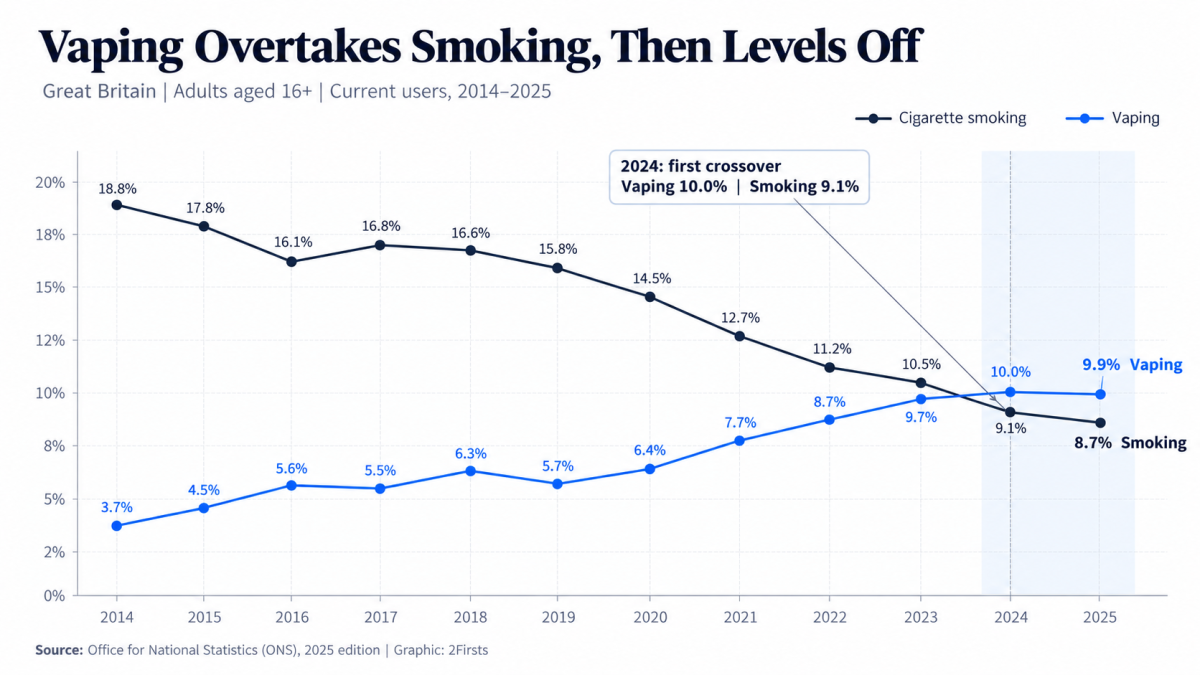
Vaping prevalence in Great Britain edged down to 9.9% in 2025 from 10.0% in 2024, with the number of adult users holding at approximately 5.4 million for a second consecutive year, according to the Office for National Statistics (ONS). E-cigarette use had risen from 6.4% in 2020 to 10.0% in 2024, when it exceeded cigarette smoking prevalence for the first time. Cigarette smoking continued to decline to 8.7% in 2025, widening the gap to 1.2 percentage points. Daily vaping declined slightly, while usage among adults aged 25–34 increased despite falling rates in other age groups.
DATA
Oct.14