Key Points
- Lightec surveyed 1,088 people aged 20 to 70 online from Sept. 1 to Sept. 7, 2026.
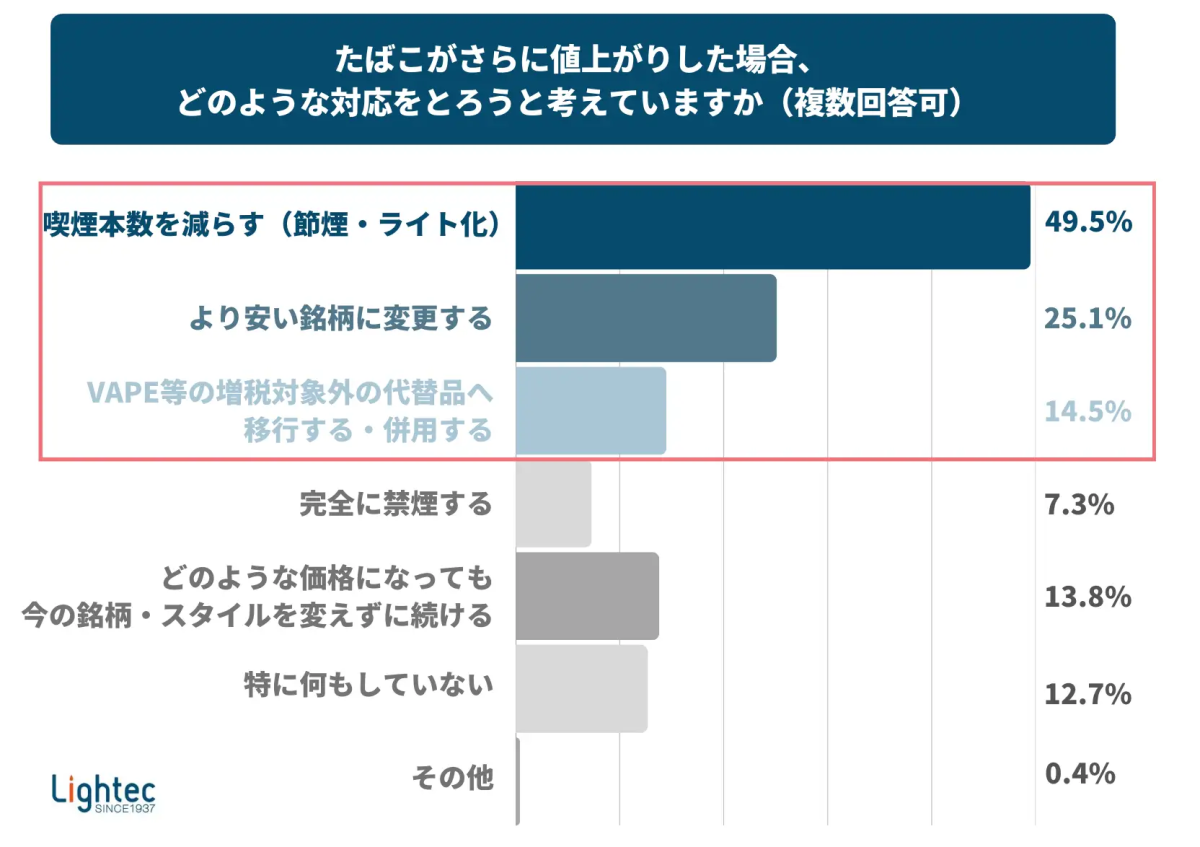
- If tobacco prices rose further, 49.5% said they would cut consumption, 25.1% would consider cheaper brands and 14.5% would consider alternatives including vapes and nicotine-free herbal sticks.
- A combined 64.6% said they were very or somewhat interested in nicotine-free vaping and herbal-stick alternatives.
- Among 655 heated tobacco users, 63.8% said they had considered returning to cigarettes or dual use because of price or value.
- Lightec sells NICOLESS VAPE, nicotine-free herbal sticks and heated tobacco devices, giving the survey a direct commercial-interest context.
2Firsts
October 12, 2026
According to a consumer survey released by Japanese smoking-accessories and lifestyle-products company Lightec Inc. on Sept. 29, 49.5% of respondents said they would consider reducing tobacco consumption if prices rose further, while 25.1% would consider moving to cheaper brands and 14.5% would consider switching to or combining alternatives such as vaping products and nicotine-free herbal sticks.
The online survey was conducted from Sept. 1 to Sept. 7, 2026, and received 1,088 responses from people aged 20 to 70. The published methodology does not state whether the sample was weighted to reflect Japan's smoking population by age, sex, geography or product use, so the results should not be treated as nationally representative.
Nearly Half Say They Would Reduce Consumption
When asked how they would respond to further tobacco price increases, 49.5% selected reducing consumption, the largest response.
A further 25.1% selected moving to a cheaper brand, while 14.5% said they would consider switching to or combining products described by Lightec as alternatives, including vaping products, NICOLESS and herbal sticks.
The question allowed multiple responses, meaning these groups may overlap.
Lightec characterized 89.1% of respondents as considering some form of change if prices rise further, while 13.8% said they would maintain their current brand and consumption style regardless of price.
Because the published questionnaire allowed multiple responses and does not provide full cross-tabulated raw data, the 89.1% figure is best treated as a company-reported survey measure rather than a mutually exclusive population share.
¥600-¥700 Range Emerges as a Price-Sensitivity Zone
Asked at what price for a 20-stick pack they would seriously consider quitting or cutting consumption, 22.2% selected the ¥600 range and 21.5% selected the ¥700 range. Another 18% said they were already considering quitting or cutting use.
Among respondents in their 50s, 25% said they were already considering a change and 27.2% selected the ¥600 range.
For respondents in their 20s, responses were more dispersed, with 19.1% choosing the ¥700 range and 15.7% selecting the ¥800 range.
These figures measure stated intentions under hypothetical price scenarios, rather than observed purchasing behavior or future sales.
64.6% Express Interest in Nicotine-Free Alternatives
The survey also asked about interest in products described as untaxed under the current tobacco regime, nicotine-free and cost-efficient, including vapes and herbal sticks.
A total of 25.8% said they were “very interested,” while 38.8% were “somewhat interested,” giving a combined 64.6%.
The press-release subtitle associates the 64.6% figure with smokers in their 20s and 30s, but the detailed text presents the same figure without clearly limiting it to those age groups. 2Firsts therefore treats 64.6% as the published overall figure rather than a confirmed 20s-and-30s result.
In a separate age breakdown of intended responses to higher tobacco prices, 17.4% of respondents in their 20s selected switching to or combining alternatives, compared with 4.6% of respondents in their 50s.
63.8% of Heated Tobacco Users Have Considered Cigarettes or Dual Use
Among 655 heated tobacco users surveyed, 63.8% said they had at some point considered returning to combustible cigarettes or using both categories because of price or cost performance.
The finding is particularly relevant because Japan's 2026 tobacco-tax changes have focused on the tax treatment of heated tobacco products rather than a uniform tax increase across all tobacco categories.
Japan's Ministry of Finance is revising the method used to convert heated tobacco products into cigarette equivalents for taxation, with changes implemented in two stages on April 1 and Oct. 1, 2026.
Japan Tobacco said the Oct. 1 change led it to revise retail prices for 31 Ploom tobacco-stick products.
October 2026 Change Targets Heated Tobacco Taxation
Lightec's release repeatedly refers broadly to an October 2026 “tobacco tax increase.”
Official Ministry of Finance materials show that the 2026 measures specifically revise the tax-base calculation for heated tobacco products as part of an effort to narrow the tax-burden gap with cigarettes.
The change was phased in on April 1 and Oct. 1, 2026.
Separately, Japan plans to raise the national tobacco tax rate in three annual steps beginning in April 2027, with an increase of ¥0.5 per cigarette equivalent in April 2027, 2028 and 2029.
The price pressure examined by the Lightec survey should therefore be understood partly in the context of heated tobacco tax reform and related manufacturer price increases, rather than as a uniform October 2026 tax increase on every cigarette and tobacco product.
Survey Sponsor Sells Products Featured as Alternatives
Lightec has operated in the lighter and smoking-accessories business for more than 80 years and also sells several products directly related to the survey's discussion of alternatives.
Its NICOLESS portfolio includes NICOLESS VAPE 2, a nicotine-free disposable vaping product, and NICOLESS NiL, nicotine-free herbal sticks designed for induction-heating devices.
Lightec said in September that NICOLESS VAPE 2 had reached cumulative sales of 3.9 million units as of August 2026 and expanded with three additional flavors through selected FamilyMart stores and online channels.
The company also sells the FASOUL Q1 PRO heated tobacco device, marketed around the ability to use a tobacco stick twice as a cost-saving feature.
The survey release itself promotes NICOLESS and FASOUL products after presenting its consumer findings.
The results on consumer interest in alternatives and their potential market appeal should therefore be read as findings from a company-sponsored survey rather than independent market research.
Price Pressure Could Push Consumers in Multiple Directions
The survey indicates that consumer responses to higher tobacco prices may not move in a single direction.
Some respondents said they would reduce consumption, others would seek cheaper brands or nicotine-free alternatives, while a substantial share of heated tobacco users reported having considered cigarettes or dual use.
The data suggest that pricing pressure around Japan's heated tobacco tax reform could influence consumption frequency, brand choice and category mix simultaneously.
However, the survey measures self-reported intentions among 1,088 online respondents and was conducted by a supplier of products positioned as lower-cost alternatives. It does not establish how Japan's tobacco market will actually shift in sales terms.
Follow 2Firsts for timely updates on global tobacco and nicotine industry developments, corporate strategy and market trends.
Cover Image: Lightec Inc. / PR TIMES
Disclaimer
This article is provided solely for professional research, industry discussion, and informational purposes. Any references to brands, companies, products, technologies, or policies are made for factual reporting and analytical purposes only, and do not constitute endorsement, recommendation, promotion, or advertising by 2Firsts.
Nicotine-containing products, including but not limited to cigarettes, e-cigarettes, heated tobacco products, and nicotine pouches, carry significant health risks. Readers are responsible for complying with all applicable laws and regulations in their respective jurisdictions, including age restrictions and access limitations.
The information contained in this article should not be regarded as investment, legal, medical, regulatory, or commercial advice. While 2Firsts strives to ensure the accuracy and reliability of its content, it does not assume liability for any direct or indirect loss arising from errors, omissions, inaccuracies, or reliance on the information contained herein.
This article is not intended for individuals below the legal age for accessing tobacco or nicotine-related information in their jurisdiction.
Copyright Notice
This article is either original content produced by 2Firsts or content reproduced, translated, summarized, or adapted from third-party sources with attribution where applicable. The intellectual property rights of the original content remain with 2Firsts or the respective original rights holders.
No individual or organization may copy, reproduce, distribute, republish, modify, translate, or otherwise use this content without prior authorization. Any unauthorized use may result in legal action.
For copyright-related inquiries, corrections, or removal requests, please contact: info@2firsts.com.
AI-Assisted Translation and Editing Notice
Portions of this article may have been translated, edited, or reviewed with the assistance of artificial intelligence tools to improve efficiency and readability. Due to the limitations of AI-assisted translation and editing, discrepancies, omissions, or inaccuracies may exist when compared with the original source.
Where applicable, readers are advised to refer to the original source for the most complete and accurate information. If you identify any errors or believe that any content infringes upon your rights, please contact us at info@2firsts.com, and we will review and address the matter promptly.