Kosen Technology to Launch Heat-not-burn E-cigarettes in Vietnam

Jun.05.2023
Kosen Technology to Launch Heat-not-burn E-cigarettes in Vietnam
Kosen Technology's e-cigarette project is registered and will be based in Vietnam, with the first production project being a non-combustible e-cigarette.

Recently, listed company Kosen Technology disclosed the minutes of its investor survey on the Shanghai Stock Exchange. Kosen Technology stated that its electronic cigarette project has completed registration and will be launched in Vietnam.


Kosen Technology has announced the completion of registration procedures for the establishment of its company in Vietnam. The first mass-production project at the Vietnam factory will be a non-combustible electronic cigarette that heats up. Other projects under development are also being progressed.


Below is the original Q&A transcript:


Question: How is the progress of the production base in Vietnam? Can you provide an overview of the project pipeline for the production base in Vietnam?


Answer: The company has completed registration procedures for establishing a company in Vietnam and has received approval documents such as the "Overseas Investment Project Filing Notice" from relevant departments. The decision to invest and build production capacity in Vietnam was made after considering various factors. The first mass-production project of the Vietnamese factory is for a heat-not-burn electronic cigarette, and other reserved projects are also under development. From the perspective of protecting the domestic electronic cigarette industry, companies like PMI cannot be allowed to establish production capacity within China's borders. Therefore, in terms of the supply chain, the company will relocate the production capacity of heat-not-burn electronic cigarettes to Vietnam to help secure orders, while production capacity for products such as smartphones and tablets that have good consumer markets in China will remain within the country.


Here is the translation to standard journalistic English: Original Q&A | Image source: 2FIRSTS


According to reports, Kunshan Kosen Technology Co., Ltd. was established in 2010. It is a high-tech enterprise specializing in the research and development, manufacturing, and service of precision structural parts. The company provides precision metal and plastic structural parts as well as assembly services for end products such as consumer electronics, medical devices, new energy vehicles, electronic cigarettes, and photovoltaic power generation, among others.


On March 31st, 2023, Cosun Technology issued a statement disclosing plans to invest $43 million in establishing a subsidiary in Vietnam. The actual investment amount will be subject to approval by Chinese and local regulatory authorities. According to market demand and business progress, the company will implement phased construction of its Vietnamese production base.


The company stated that since 2018, it has been continuously providing heating not burning electronic cigarette components to international major clients. The company's main focus for electronic cigarettes remains on heating not burning products, and the major client strategy remains unchanged.


Reference:


Investor Relations Activity Log Form for June 1, 2023.


Disclaimer

This article is provided solely for professional research, industry discussion, and informational purposes. Any references to brands, companies, products, technologies, or policies are made for factual reporting and analytical purposes only, and do not constitute endorsement, recommendation, promotion, or advertising by 2Firsts.

Nicotine-containing products, including but not limited to cigarettes, e-cigarettes, heated tobacco products, and nicotine pouches, carry significant health risks. Readers are responsible for complying with all applicable laws and regulations in their respective jurisdictions, including age restrictions and access limitations.

The information contained in this article should not be regarded as investment, legal, medical, regulatory, or commercial advice. While 2Firsts strives to ensure the accuracy and reliability of its content, it does not assume liability for any direct or indirect loss arising from errors, omissions, inaccuracies, or reliance on the information contained herein.

This article is not intended for individuals below the legal age for accessing tobacco or nicotine-related information in their jurisdiction.


Copyright Notice

This article is either original content produced by 2Firsts or content reproduced, translated, summarized, or adapted from third-party sources with attribution where applicable. The intellectual property rights of the original content remain with 2Firsts or the respective original rights holders.

No individual or organization may copy, reproduce, distribute, republish, modify, translate, or otherwise use this content without prior authorization. Any unauthorized use may result in legal action.

For copyright-related inquiries, corrections, or removal requests, please contact: info@2firsts.com.


AI-Assisted Translation and Editing Notice

Portions of this article may have been translated, edited, or reviewed with the assistance of artificial intelligence tools to improve efficiency and readability. Due to the limitations of AI-assisted translation and editing, discrepancies, omissions, or inaccuracies may exist when compared with the original source.

Where applicable, readers are advised to refer to the original source for the most complete and accurate information. If you identify any errors or believe that any content infringes upon your rights, please contact us at info@2firsts.com, and we will review and address the matter promptly.


Arizona Turns to a 50% Retail Vape Tax as Tobacco Tax Revenue Falls 47% From 2008
Arizona's First Things First is pushing for an excise tax equal to 50% of the retail price of vaping products, estimating that the measure could generate about $100 million annually. The agency says its tobacco-tax revenue has fallen 47% from 2008 levels. Arizona has attempted to broaden its nicotine tax base in each of the past two years: a 2025 bill proposed a 50% wholesale-price tax, while a 2026 measure shifted to a 50% retail-price tax covering alternative nicotine products and vapor products. Separately, the state enacted HB 4001 this year to establish a new licensing and sales framework for alternative nicotine products.
Sep.21
Malaysia's Poisons Board Backs New Vape Nicotine Exemption After Unanimously Opposing 2023 Proposal
Malaysia's Poisons Board has endorsed Health Minister Dzulkefly Ahmad's proposal to exempt liquid nicotine used in vaping products from the Poisons List, according to a November 2, 2026, report by CodeBlue. The Board unanimously opposed a similar proposal in 2023, but the government proceeded with the exemption. The Kuala Lumpur High Court invalidated the 2023 decision in May 2026, and the government withdrew its appeal in August. No new ministerial order has been published. The development raises questions about the interaction between Malaysia's two regulatory frameworks and the treatment of RM354.51 million in excise duties collected on e-cigarette and vape products between May 2023 and June 11, 2026.
Regulations
Nov.03
On-Site Report | After FDA Announces Review of PMTA Framework, CTP Director Details Reform Priorities
FDA CTP Director Bret Koplow used his FDLI keynote in Washington to outline how the agency is rethinking the PMTA framework. He discussed category-specific review, nicotine pouch and sPMTA pilots, AI-assisted review, a 70% reduction in pending applications, and a major staffing constraint: CTP currently has only nine scientific review teams. He also reaffirmed tobacco harm reduction while stressing youth protection, flavored products, risk communication, and the challenge of unauthorized e-cigarettes.
Regulations
Oct.06
Philippines Mandates Safety Certification for Nicotine Pouches, Gives Industry 12 Months to Comply
The Philippines Department of Trade and Industry has placed nicotine pouches under mandatory product certification through Department Administrative Order No. 26-07, Series of 2026. Nicotine pouches must obtain a Philippine Standard, or PS, license before they can be manufactured, imported, packed, distributed or sold in the country. The regime requires testing for nicotine content, pH and water activity, while packaging must disclose nicotine strength, ingredients, allergens, batch information, the PS certification mark and prescribed health warnings. Existing market participants have a 12-month transition period to comply.
Regulations
Oct.12
Special Report|CrossBar's High-Puff Vapes Draw Attention on Pennsylvania's 163-Product Directory as Link Between Earlier 1.3mL PMTA Filings and New 13mL Products Remains Unclear
Pennsylvania began enforcing its electronic nicotine delivery system directory restrictions on October 19, 2026. Among 163 product listings recorded before enforcement, four CrossBar 20K disposables stood out with 13mL capacity, advertised puff counts of up to 20,000 and a flattened design distinct from conventional pod systems and compact disposables. Historical records identify earlier 1.3mL CrossBar products associated with Romo LLC, while newer 13mL products appeared in several state directories beginning in 2025 under entities including Blue Nine LLC. PMTA compliance expert Mr. K identified amendments and application ownership transfers as possible regulatory mechanisms, although neither has been confirmed in this case. Separately, Reynolds' $7.5 million acquisition of 16 PACHA products and related assets illustrates the commercial value of products linked to historic PMTA submissions.
Special Report
Oct.22
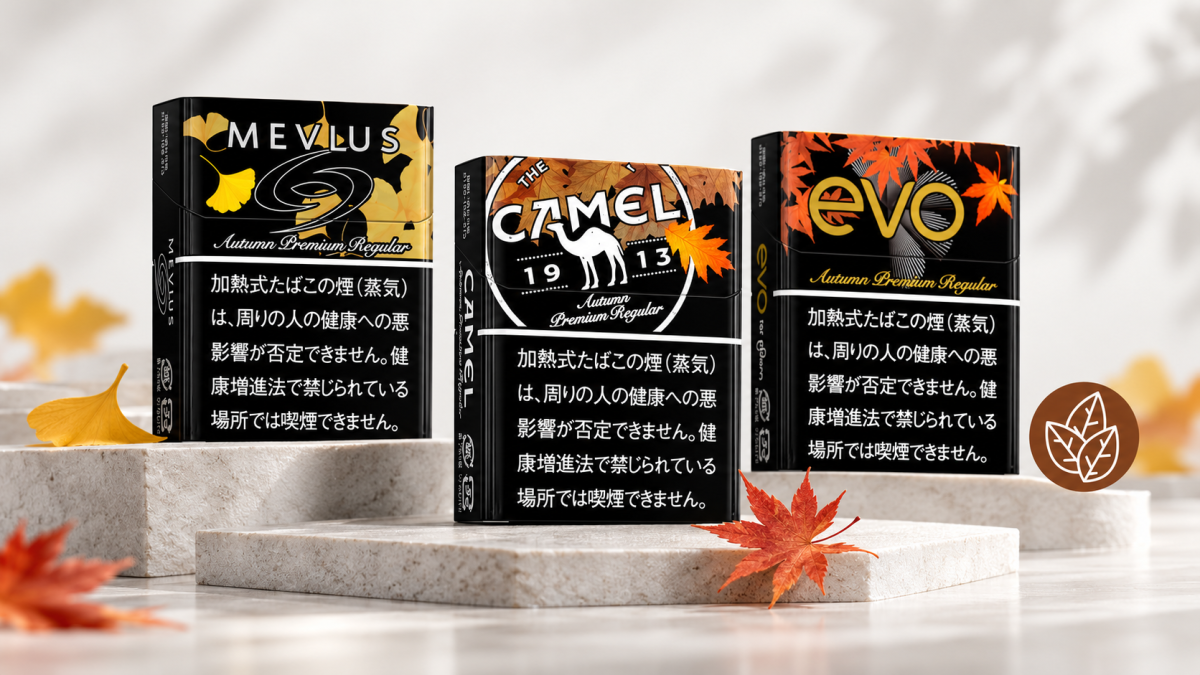
Product | JT Launches Three Autumn-Limited Ploom Tobacco Sticks in Japan Across EVO, MEVIUS and CAMEL Brands
Japan Tobacco Inc. (JT) launched three limited-edition autumn tobacco sticks for its Ploom heated tobacco devices in Japan on October 16, 2026, under the EVO, MEVIUS and CAMEL brands. All three are regular tobacco variants with seasonal packaging. Each pack contains 20 sticks, priced at ¥620, ¥590 and ¥570, respectively, including tax. The products are compatible with all Ploom devices and are sold in limited quantities exclusively through the CLUB JT online store while supplies last.
product
Oct.20