KT&G Restructures Business in Indonesia Amid Relaxed Regulations

Mar.10.2023
KT&G Restructures Business in Indonesia Amid Relaxed Regulations
KT&G restructures its Indonesian business through loan to subsidiary for new factory construction and merger of its three companies.

Thanks to the relaxation of local foreign investment regulations, KT&G is restructuring its business in Indonesia. It has issued loans to its subsidiaries for the construction of new factories.


On March 8th, industry insiders reported that KT&G's subsidiary, PT Trisakti Purwosari Makmur (Trisakti), had merged with PT KT&G Indonesia on January 1st. KT&G stated that the purpose of the merger was to establish a foundation for sustainable growth in the medium and long term by effectively reinvesting in local profits in Indonesia.


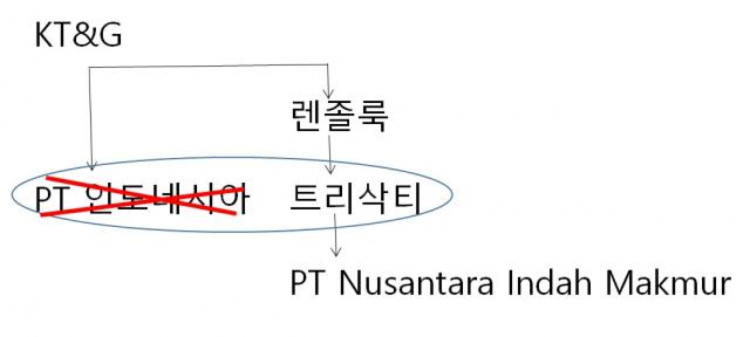
KT&G's business in Indonesia is operated by three companies: Trisakti, PT KT&G Indonesia, and PT Nusantara Indah Makmur. KT&G controls Trisakti and PT Nusantara Indah Makmur through its intermediate holding company, Renzolluk. PT KT&G Indonesia is a subsidiary of KT&G and is directly controlled by it. Through this restructuring, Indonesia's tobacco business will be unified under Renzolook's management.


Trisakti is a subsidiary of Renzolook. KT&G entered the local market in November 2011, acquiring 100% of Renzoluk's shares for 89.7 billion won, with Renzoluk owning a 51% stake in Indonesian cigarette manufacturer Trisakti. Sales company PT KT&G Indonesia was established in February 2013. The deal represents the integration of manufacturing and sales.


Due to Indonesia's local foreign investment regulations, KT&G separated its sales and manufacturing companies. With local regulations easing, the company has restructured its management system.


An official from KT&G stated that the relaxation of investment restrictions on foreign companies in Indonesia's "Omnibus Law" issued in 2021 has driven this merger. It is expected that management efficiency will be enhanced, such as reducing shared costs and tax savings.


Trisakti's sales and net profit for the previous year were KRW 208.8 billion and KRW 31.6 billion, respectively. PT KT&G Indonesia's sales and net profit, on the other hand, were KRW 291.4 billion and a loss of KRW 2.3 billion.


On January 18th, in accordance with a decision made by the board of directors, KT&G loaned $44.5 million to Trisakti last month to construct a new factory in Indonesia as part of their streamlined governance structure. The establishment of their second factory in Indonesia is expected to accelerate market penetration.


Indonesia is the largest country where KT&G operates its business. It is also one of the largest tobacco-consuming nations, with an estimated 70% of males over the age of 15 being smokers.


References:


KT&G to restructure its domination of Indonesian tobacco industry.


This document has been generated through artificial intelligence translation and is provided solely for the purposes of industry discourse and learning. Please note that the intellectual property rights of the content belong to the original media source or author. Owing to certain limitations in the translation process, there may be discrepancies between the translated text and the original content. We recommend referring to the original source for complete accuracy. In case of any inaccuracies, we invite you to reach out to us with corrections. If you believe any content has infringed upon your rights, please contact us immediately for its removal.

JTI Korea Introduces Ploom AURA With Four Heating Modes and Four Device Colors
JTI Korea announced that its next-generation heated tobacco device Ploom AURA will officially launch in South Korea on April 14. The company held a media event on March 31 at the Fairmont Ambassador Seoul Hotel to unveil the product in Korea for the first time.
Apr.01 by 2FIRSTS.ai
FDA Expands ENDS Market Access With First Authorization of Non-Tobacco and Non-Menthol Products
The U.S. Food and Drug Administration (FDA) announced on May 5, 2026 that it authorized the marketing of four Glas electronic nicotine delivery system (ENDS) products through the premarket tobacco product application (PMTA) pathway. The authorized products are Classic Menthol, Fresh Menthol, Gold and Sapphire pods, each containing 50mg/ml, or 5%, tobacco-derived nicotine.
May.06 by 2FIRSTS.ai
Indonesia to Step Up Vape Surveillance as Concerns Rise Over Drug-Laced E-Cigarettes
Indonesia will strengthen surveillance of vapes amid growing concerns over drug-laced e-cigarettes. The National Food and Drug Monitoring Agency, or BPOM, will soon take charge of monitoring nationwide vape distribution and said it will work with the National Narcotics Agency, or BNN. BNN recently floated a plan to completely ban e-cigarettes, saying a total ban was the only way to prevent liquid narcotics.
May.11 by 2FIRSTS.ai
The new regulations on nicotine in Argentina are creating caution, expectations, and doubts about the market, according to a local reference in harm reduction for smoking.
The new Argentine framework for tobacco and nicotine marks a shift from prohibition towards registration, traceability, and health surveillance. Juan Facundo Teme told 2Firsts that adult consumers and some of the commercial sector are cautiously optimistic, although concerns remain about flavors, registration costs, and market access.
May.11
Russia Moves Toward Full Ban on E-Cigarettes and Vapes, With Scope Still Under Discussion
Russia’s State Commission for Countering Illegal Trafficking in Industrial Products on March 25 supported an initiative to fully ban the production, import and circulation of electronic cigarettes, vapes and refill liquids in Russia.
Mar.26 by 2FIRSTS.ai
More Than 500 Stores in Russia’s Nizhny Novgorod Region Voluntarily Stop Selling Vapes
According to the Nizhny Novgorod regional government, 550 stores in the region have voluntarily removed vapes and e-liquids from their product assortments. Regional officials said a public offer encouraging businesses to self-restrict vape sales has been in place since September 2025, and that a large retail chain with more than 40 outlets in Nizhny Novgorod joined the initiative. The regional government also said a federal ban on vape sales is expected in the near future.
Apr.15 by 2FIRSTS.ai