Liu Sanjiang conducts tobacco research in Guangdong and Shenzhen

Feb.26.2025
Liu Sanjiang conducts tobacco research in Guangdong and Shenzhen
State Tobacco Monopoly Administration Deputy Director Liu Sanjiang conducts tobacco research in Guangdong and Shenzhen from February 19th to 21st.

Liu Sanjiang conducts tobacco research in Guangdong and Shenzhen.

Liu Sanjiang conducts tobacco research in Guangdong and Shenzhen


From February 19th to 21st, Liu Sanjiang, a member of the Party Group and Deputy Director of the State Tobacco Monopoly Administration, conducted tobacco research in Guangdong and Shenzhen.

Liu Sanjiang conducts tobacco research in Guangdong and Shenzhen


During this time, Mr. Liu Sanjiang conducted research at the Logistics Distribution Center and the First Management Center of Dongguan Tobacco Monopoly Bureau (Company), visited the Shenzhen Tobacco Monopoly Bureau's e-cigarette regulation exhibition, inspected some e-cigarette-related production enterprises in Dongguan and Shenzhen, visited some e-cigarette retailers in Dongguan, and thoroughly understood the party's construction, grassroots management, economic operations, monopoly regulation, e-cigarette research, production, sales, and regulation situations. He also listened to reports on the work of tobacco commercial enterprises in Guangdong and Shenzhen.


Liu Sanjiang affirmed the achievements of tobacco work in Guangdong and Shenzhen, emphasizing the need to adhere to the guidance of Xi Jinping Thought on Socialism with Chinese Characteristics for a New Era, comprehensively strengthen party building, persist in rectifying misconduct, and promote the deepening of strict governance of the party. He called for thorough implementation of the spirit of the National Tobacco Work Conference, using extraordinary measures to combat illegal activities related to tobacco, resolutely curb the proliferation of counterfeiting and smuggling, effectively safeguard national fiscal revenue and economic security. It is essential to grasp the relationships between top and bottom, internal and external, and individual and comprehensive aspects, actively seek support from party committees and governments at all levels, promote the implementation of multi-departmental joint mechanisms, take proactive measures, cascade pressure, enforce the law rigorously while maintaining order, focus on major cases and extend to other areas, and achieve new breakthroughs in combating counterfeiting and private selling. Furthermore, strengthening capacity building, continually deepening technological innovation and institutional innovation, exploring the application of new technologies and tools, improving relevant work mechanisms, and continuously enhancing the effectiveness of monopoly supervision is crucial. Additionally, refining relevant systems, clarifying division of responsibilities, improving assessment mechanisms, strict control and comprehensive supervision are necessary to sustainably consolidate the legalized and standardized governance of the e-cigarette industry.


The head of the National Bureau of e-cigarette supervision and management participated in the research.


We welcome news tips, article submissions, interview requests, or comments on this piece.

Please contact us at info@2firsts.com, or reach out to Alan Zhao, CEO of 2Firsts, on LinkedIn


Notice

1.  This article is intended solely for professional research purposes related to industry, technology, and policy. Any references to brands or products are made purely for objective description and do not constitute any form of endorsement, recommendation, or promotion by 2Firsts.

2.  The use of nicotine-containing products — including, but not limited to, cigarettes, e-cigarettes, nicotine pouchand heated tobacco products — carries significant health risks. Users are responsible for complying with all applicable laws and regulations in their respective jurisdictions.

3.  This article is not intended to serve as the basis for any investment decisions or financial advice. 2Firsts assumes no direct or indirect liability for any inaccuracies or errors in the content.

4.  Access to this article is strictly prohibited for individuals below the legal age in their jurisdiction.


Copyright


This article is either an original work created by 2Firsts or a reproduction from third-party sources with proper attribution. All copyrights and usage rights belong to 2Firsts or the original content provider. Unauthorized reproduction, distribution, or any other form of unauthorized use by any individual or organization is strictly prohibited. Violators will be held legally accountable.

For copyright-related inquiries, please contact: info@2firsts.com


AI Assistance Disclaimer


This article may have been enhanced using AI tools to improve translation and editorial efficiency. However, due to technical limitations, inaccuracies may occur. Readers are encouraged to refer to the cited sources for the most accurate information.

We welcome any corrections or feedback. Please contact us at: info@2firsts.com

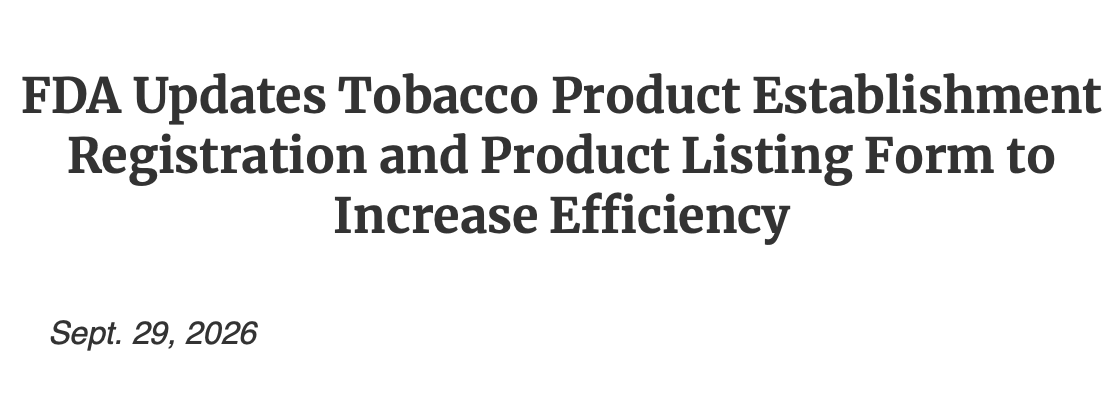
FDA Unifies Tobacco Registration and Product Listing Form Across Product Categories
The U.S. FDA has consolidated two tobacco establishment registration and product listing forms into a redesigned Form FDA 3741 covering all regulated product categories, including e-cigarettes, heated tobacco products and nicotine pouches. The current requirements remain limited to domestic establishments. Separately, the FDA has proposed extending registration and product listing requirements to foreign manufacturers, signaling greater regulatory attention to manufacturing entities and product-level information across the tobacco and nicotine supply chain.
FDA
Sep.30
Russia’s Vape Device Labeling Regime Enters Force: Registration Starts in September, Mandatory Coding in December
Russia's digital labeling regime for reusable e-cigarettes and similar personal vaping devices entered its first mandatory phase in September 2026. From September 1, manufacturers, importers and other market participants must register with the national Chestny ZNAK tracking system. From December 1, newly manufactured and imported covered devices will be required to carry digital identification codes and be reported as entering circulation. Russia has also issued new operational guidance for imports, marking the transition from a voluntary pilot to phased mandatory implementation.
Sep.15
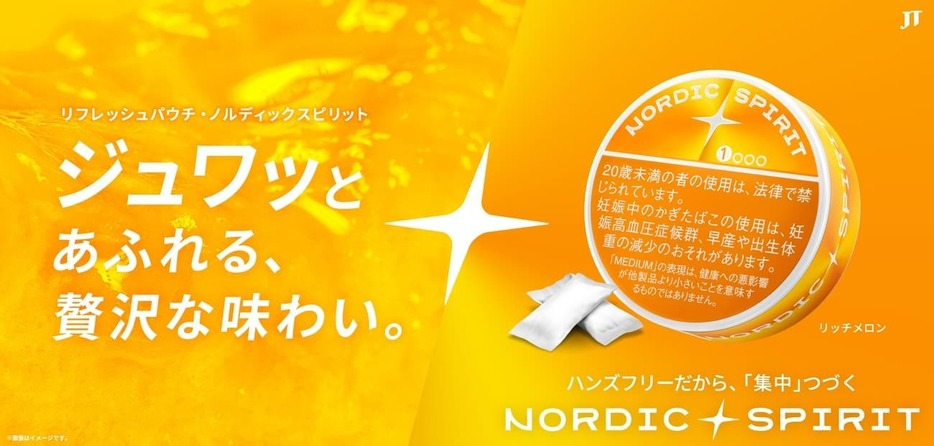
Product | Japan Tobacco Expands Nordic Spirit Nicotine Pouch Range to Eight SKUs in Japan, Launches Melon Variant and Broadens Mint Retail Distribution
Japan Tobacco Inc. (JT) launched Nordic Spirit Rich Melon Medium through selected tobacco retailers in Japan on November 2, 2026, while expanding physical retail distribution for three existing mint products previously sold through the CLUB JT online store. The melon launch brings Nordic Spirit's Japanese portfolio to eight SKUs. All four products are manufactured in Sweden, contain a standard 14 pouches per can and retail for ¥500 including tax. Since introducing Nordic Spirit in Japan in March, JT has expanded the brand's product lineup and distribution through its online store, convenience stores and selected tobacco retailers.
product
Nov.04
South Korea Constitutional Court Upholds Volume-Based E-Liquid Tax, With Challenged Rates at KRW 370 and KRW 628 per Milliliter
South Korea's Constitutional Court has upheld fixed taxes on nicotine-containing e-cigarette liquids based on solution volume, ruling that challenged provisions imposing KRW 370 per milliliter in individual consumption tax and KRW 628 per milliliter in tobacco consumption tax do not violate the Constitution. The cases stemmed from historical disputes involving importers that reported nicotine as being extracted from tobacco stems rather than leaves. South Korea has since broadened its tobacco definition to include synthetic nicotine, while current tax laws provide reduced rates for certain products not derived from tobacco.
Sep.18
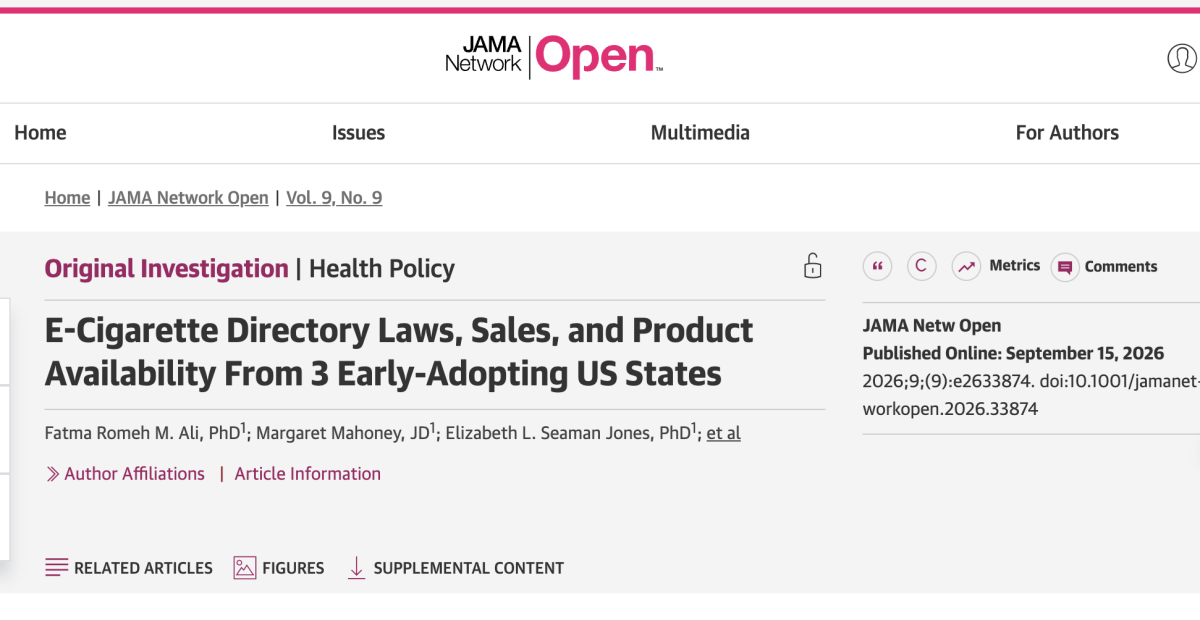
JAMA Study: U.S. Vape Directories Fail to Sustainably Curb Unlisted Sales as Product Shifts May Redistribute Brand Share 2Firsts Recommended
A study by CDC Foundation researchers found no sustained decline in e-cigarette sales across Alabama, Oklahoma and Louisiana, the first three U.S. states to implement e-cigarette directory laws. Louisiana initially saw a significant sales decline, followed by a rebound and a persistent reduction in product availability. Sales also shifted from nontobacco-flavored disposables toward prefilled cartridges, with Vuse Alto driving much of the increase in menthol cartridges. By April 2025, unlisted products still accounted for more than half of e-cigarette nicotine sales in all three states.
Sep.18
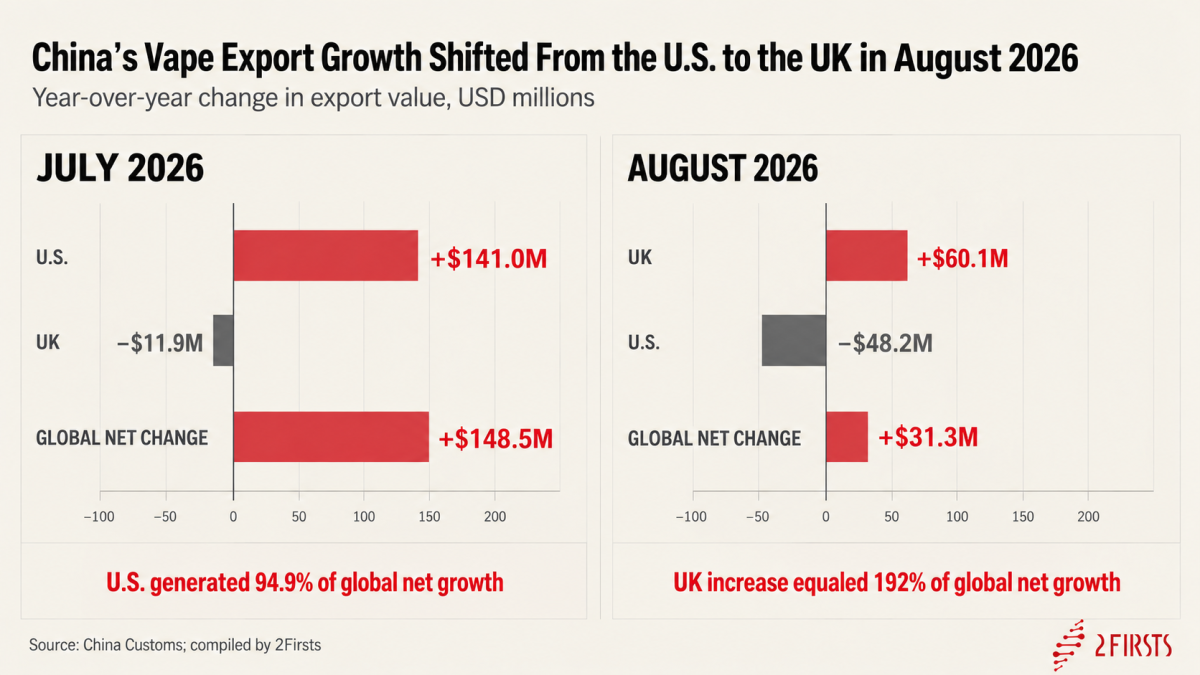
2Firsts Data|China’s Vape-Related Exports Rose 3.3% in August 2026 as UK Shipments Jumped 51.4% and U.S. Exports Fell 12.4%
China exported $979 million of vape-related products in August 2026, up 3.3% from a year earlier but down 6.4% from July. The UK replaced the U.S. as the main source of growth: UK-bound shipments jumped 51.4% to a 2026 high of $177 million, while exports to the U.S. fell 12.4% to $339 million. Shipments to markets outside the U.S. increased 14.2%, broadening growth beyond the market that had driven July’s rebound.
News
Sep.23 by 2Firsts Perspectives