Mexico Senate Approves Reform Banning E-Cigarettes and Fentanyl

Regulations by 2FIRSTS.ai
Dec.12.2024
Mexico Senate Approves Reform Banning E-Cigarettes and Fentanyl
Mexican Senate approves reform bill banning e-cigarettes and illegal use of fentanyl, to be voted on by local councils.

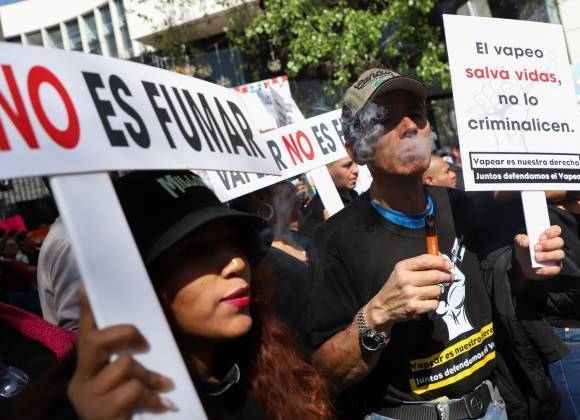
According to Vanguardia report on December 11th, the Mexican Senate recently approved a reform bill aimed at banning the use of e-cigarettes and the illegal use of fentanyl. In order for this reform to become a formal constitutional amendment, the bill will be submitted to the local legislatures of the 32 states in Mexico for a vote.


The Senate passed amendments to Articles 4 and 5 of the Constitution of Mexico with a vote of 110 in favor, 5 against, and 2 abstentions, explicitly banning the production, distribution, and sale of e-cigarettes, various e-cigarette devices, and similar products.


Senator Enrique Inzunza stated that the bill focuses on the serious issues society is currently facing, especially regarding the use of e-cigarettes, harmful substances, and synthetic drugs among adolescents.


Senator Alejandra Barrales of the National Revival Movement (Movimiento Ciudadano) opposes this reform, stating that it is aimed at criminalizing and punishing material consumption rather than regulating and preventing it, as proposed by any leftist ideology in the world.


She suggested,


First, elevate the ban on e-cigarettes, e-cigarette devices, or similar systems to constitutional status; second, establish and prohibit the production, sale, disposal of toxic substances, chemical resources, illegal use of fentanyl, and other unauthorized synthetic drugs.


The reform attempts to equate the use of e-cigarettes with the use of drugs like fentanyl, which is clearly unreasonable. While e-cigarettes are indeed harmful, their impact is not nearly as severe as fentanyl.


The bill still needs to be submitted to the local legislatures of the 32 states in Mexico, and upon receiving majority approval, the reform will be declared as having constitutional force.


We welcome news tips, article submissions, interview requests, or comments on this piece.

Please contact us at info@2firsts.com, or reach out to Alan Zhao, CEO of 2Firsts, on LinkedIn


Notice

1.  This article is intended solely for professional research purposes related to industry, technology, and policy. Any references to brands or products are made purely for objective description and do not constitute any form of endorsement, recommendation, or promotion by 2Firsts.

2.  The use of nicotine-containing products — including, but not limited to, cigarettes, e-cigarettes, nicotine pouchand heated tobacco products — carries significant health risks. Users are responsible for complying with all applicable laws and regulations in their respective jurisdictions.

3.  This article is not intended to serve as the basis for any investment decisions or financial advice. 2Firsts assumes no direct or indirect liability for any inaccuracies or errors in the content.

4.  Access to this article is strictly prohibited for individuals below the legal age in their jurisdiction.


Copyright


This article is either an original work created by 2Firsts or a reproduction from third-party sources with proper attribution. All copyrights and usage rights belong to 2Firsts or the original content provider. Unauthorized reproduction, distribution, or any other form of unauthorized use by any individual or organization is strictly prohibited. Violators will be held legally accountable.

For copyright-related inquiries, please contact: info@2firsts.com


AI Assistance Disclaimer


This article may have been enhanced using AI tools to improve translation and editorial efficiency. However, due to technical limitations, inaccuracies may occur. Readers are encouraged to refer to the cited sources for the most accurate information.

We welcome any corrections or feedback. Please contact us at: info@2firsts.com

Special Report|Japan Tobacco Buys CLEW: Can Its 160,000-Store Cigarette Network Help It Vie for U.S. Nicotine Pouch Share Against PMI and BAT?
Japan Tobacco Inc. (JT) announced on November 12, 2026, that it had acquired the U.S. assets of nicotine pouch brand CLEW from Nevcore Innovations Inc., including trademarks, intellectual property, product formulations and a Premarket Tobacco Product Application (PMTA). CLEW, currently distributed through selected outlets in 13 U.S. states, will immediately join the JTI LIGGETT portfolio. The transaction follows JT's approximately $2.4 billion acquisition of U.S. cigarette maker Vector Group in 2024. JTI LIGGETT says its existing cigarette brands reach more than 160,000 U.S. retail stores. During the 2026 NACS Show in October, JTI LIGGETT booth staff told 2Firsts that the company had not yet launched nicotine pouches in the United States. Although Nevcore previously announced FDA acceptance of CLEW's PMTA, the brand is absent from the agency's current list of authorized nicotine pouch products. JT has not disclosed a retail expansion plan for CLEW.
Business
Nov.12
Special Report | From New York to Washington: How FDA’s Tobacco Center Is Reworking Product Review
FDA’s Center for Tobacco Products is reshaping how it approaches tobacco product review. Based on 2Firsts’ on-site reporting in New York and Washington, this report traces CTP’s emerging direction: stronger links between PMTA and tobacco harm reduction, more category-specific review, greater emphasis on decision-relevant science, more predictable timelines and expanded use of sPMTA for product modifications. CTP also acknowledged major constraints, including just nine PMTA review teams, persistent backlogs and limits on hiring capacity.
Regulations
Oct.08
New York City Opens Lottery for 55 Vape Retail License Slots Across 23 Community Districts, Including 28 in Brooklyn
New York City's Department of Consumer and Worker Protection (DCWP) opened applications on November 2, 2026, for a lottery covering tobacco and electronic cigarette retail dealer licenses, with a deadline of 5 p.m. New York local time on November 30. According to the city's October 1 notice, 55 electronic cigarette retail license slots are available across 23 community districts, including 28 in Brooklyn, alongside 322 tobacco retail license slots across 41 districts. Businesses must enter the lottery and, if invited, complete licensing requirements within 65 days. New York City continues to restrict e-cigarette retail sales to tobacco-flavored or unflavored products, while city retail licenses do not replace FDA product marketing authorization.
Market
Nov.04
Kumulus Vape2026 H1 Revenue Falls 8.3% but Profit Rises 24% as B2B Weakens and Consumer Channels Grow
French vaping company Kumulus Vape reported first-half 2026 revenue of €25.5 million, down 8.3% year over year, as its core B2B distribution business fell 11% to €21.6 million. B2C and store-network revenue rose 5.6% and 17.8%, respectively. Commercial margin increased to 26.3% from 21.7%, while net profit rose 24.1% to €0.8 million. The company attributed the profitability improvement to catalog optimization, logistics restructuring and the ramp-up of Labster, its in-house production unit for proprietary brands.
Market
Sep.17 by 2Firsts Perspectives
Arizona Turns to a 50% Retail Vape Tax as Tobacco Tax Revenue Falls 47% From 2008
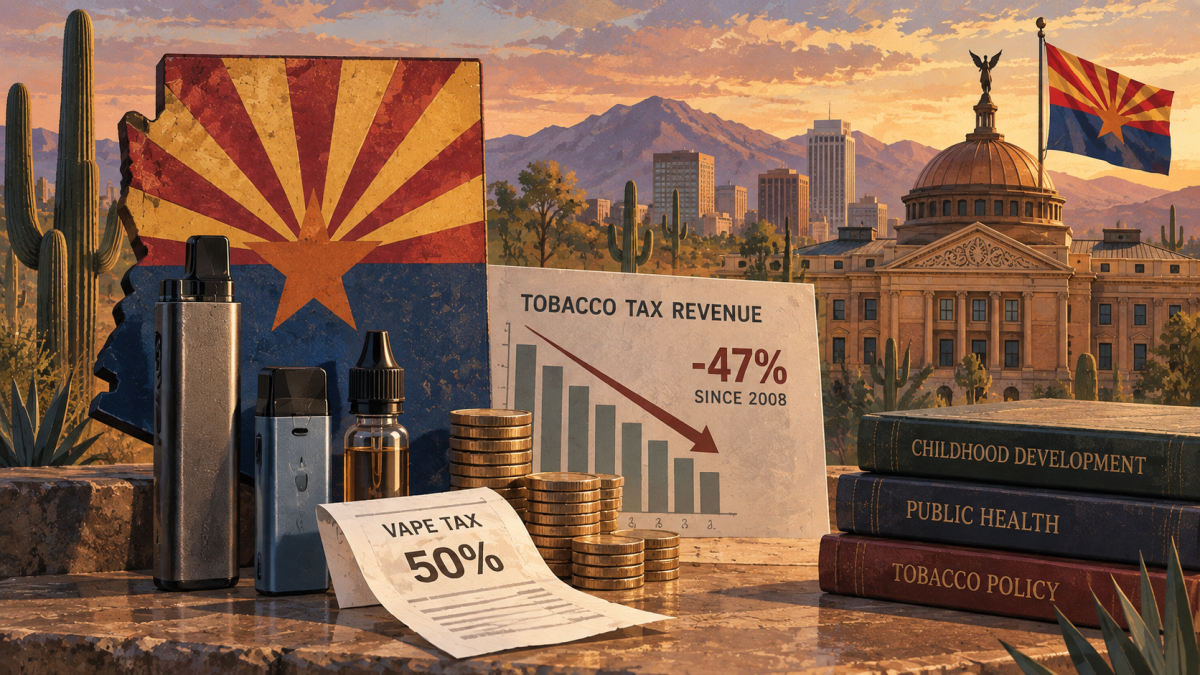
Arizona's First Things First is pushing for an excise tax equal to 50% of the retail price of vaping products, estimating that the measure could generate about $100 million annually. The agency says its tobacco-tax revenue has fallen 47% from 2008 levels. Arizona has attempted to broaden its nicotine tax base in each of the past two years: a 2025 bill proposed a 50% wholesale-price tax, while a 2026 measure shifted to a 50% retail-price tax covering alternative nicotine products and vapor products. Separately, the state enacted HB 4001 this year to establish a new licensing and sales framework for alternative nicotine products.
Sep.21
Texas Extends Tobacco Tax Interpretation to a 6-Methylnicotine Product, Citing VELO Ruling
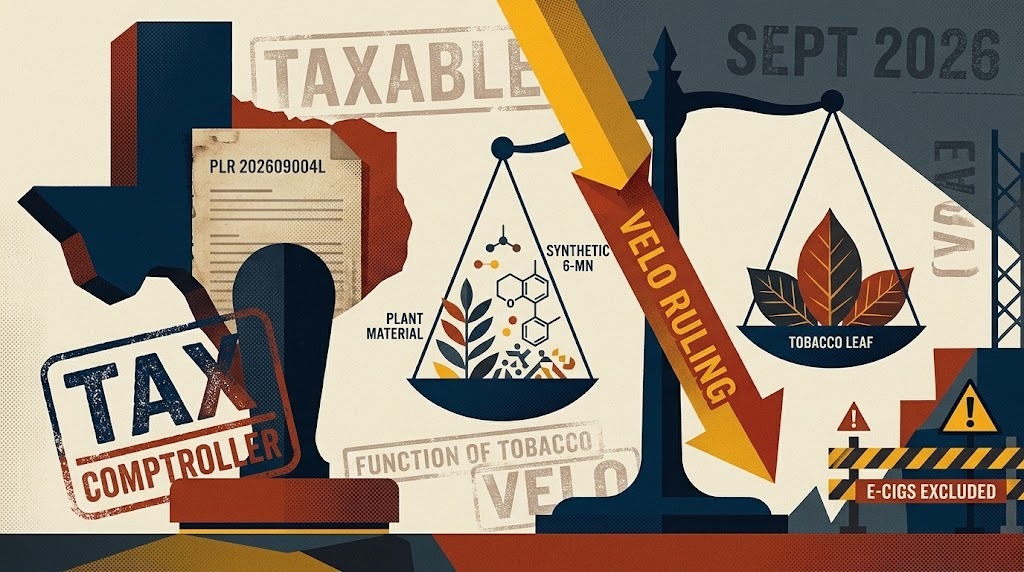
The Texas Comptroller of Public Accounts ruled in September 2026 that a combustible product made with non-tobacco plant material and 6-methylnicotine (6-MN), a synthetic nicotine analog, qualifies as a taxable tobacco product. The applicant said the product contained neither tobacco leaf nor measurable conventional nicotine. The determination applies reasoning from a May Texas Supreme Court decision involving VELO nicotine pouches, finding that the plant material and 6-MN together perform the functions of tobacco in a conventional smoking product. The ruling carries applicable tax, licensing and reporting obligations but is limited to the facts submitted by the taxpayer. It does not establish a blanket tax classification for all 6-MN products or extend the same conclusion to e-cigarettes.
Regulations
Nov.06