Key Points
- A Pennsylvania federal district court ruled on October 14 that Act 57 is not preempted by federal tobacco law, rejecting a challenge from vape manufacturers, distributors and retailers.
- Plaintiffs included Nova Distro, 101 Distributors and Tobacco Hut-related businesses. Court records identified approximately $2 million in Tobacco Hut inventory potentially subject to seizure.
- Federal appeals courts in the Fourth, Seventh and Eighth Circuits have issued decisions in 2026 supporting states' authority to restrict vape sales under similar directory laws.
- A September study in JAMA Network Open found that unlisted products accounted for 92.1%, 53.6% and 52.3% of tracked e-cigarette nicotine sales in Alabama, Oklahoma and Louisiana, respectively, in April 2025.
2Firsts
October 22, 2026
A U.S. federal court ruled on October 14 that Pennsylvania's electronic nicotine delivery system (ENDS) directory law is not preempted by federal tobacco regulations, rejecting a legal challenge brought by vape manufacturers, wholesalers and retailers. The state began enforcing restrictions on unlisted vaping products five days later, on October 19.
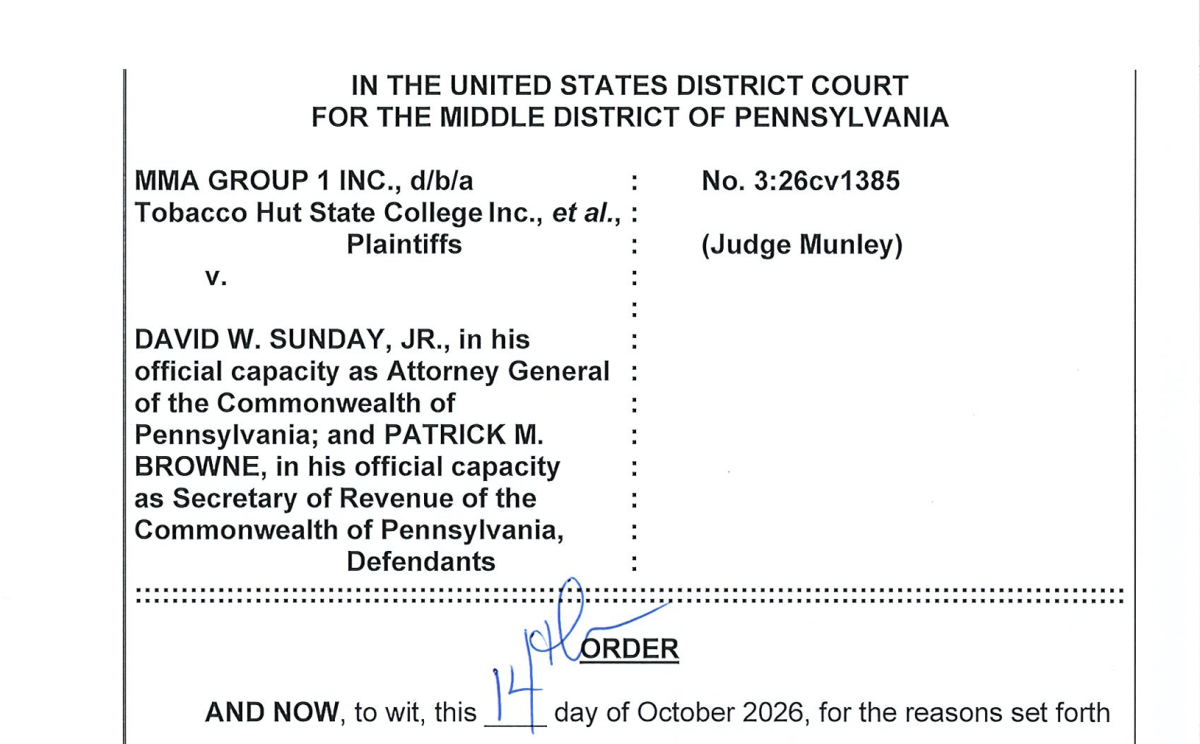
In MMA Group 1 Inc. v. Sunday, Jr., U.S. District Judge Julia K. Munley of the Middle District of Pennsylvania held that although Act 57 of 2025 uses conditions tied to the U.S. Food and Drug Administration's (FDA) premarket review process, the law regulates the sale and distribution of vaping products, an area of authority preserved for states under the federal Tobacco Control Act.
The court denied the plaintiffs' motions for summary judgment and granted summary judgment in favor of Pennsylvania Attorney General Dave Sunday and Revenue Secretary Patrick Browne, closing the case at the district court level.
Vape Manufacturers, Distributors and Retailers Challenge Law as $2 Million in Inventory Faces Risk
The lawsuit, filed on May 20, 2026, was brought by Nova Distro Inc., wholesale distributor 101 Distributors LLC and numerous companies operating Tobacco Hut and Tobacco Lux retail locations in Pennsylvania.
According to facts cited in the court's October 14 opinion, Tobacco Hut employs approximately 150 to 180 full-time workers, with e-cigarette sales accounting for about 60% of its profits.
As of June 2, Tobacco Hut held approximately $2 million worth of products potentially subject to seizure under Act 57. The retail network also sold between 200 and 300 types of nicotine vaping products without FDA marketing authorization, according to testimony cited by the court.
Nova Distro manufactures and distributes vaping products to Tobacco Hut locations. Court records describe Nova Distro and the retail businesses as connected family enterprises.
The distributor makes a nicotine vape called Hut Bar, which Tobacco Hut stores had been selling for approximately two to three years. The product had not received FDA marketing authorization, according to the court's findings.
Another plaintiff, 101 Distributors, supplies nicotine vaping products to Tobacco Hut and other convenience stores and smoke shops.
Approximately 40% of the wholesaler's profits come from vaping products, while the company estimated that selling through its existing e-cigarette inventory would take eight months to a year.
The plaintiffs argued that the directory law's restrictions, including possible seizures of unlisted products, would severely disrupt their operations and could result in store closures and job losses.
The inventory figures and business impact estimates were drawn from the litigation record. They do not represent a final regulatory finding of violations or realized financial losses.
Court Finds State Sales Restrictions Are Not Preempted by Federal Law
The central dispute was whether Pennsylvania could establish its own ENDS sales directory using criteria linked to FDA marketing authorization and the status of premarket tobacco product applications (PMTAs).
The plaintiffs argued that Act 57 effectively imposed additional requirements concerning federal premarket review and was therefore preempted by the Tobacco Control Act and the Federal Food, Drug, and Cosmetic Act.
The court acknowledged that Pennsylvania's requirements were connected to the federal premarket review process.
However, it concluded that the Tobacco Control Act's savings clause preserves state authority to regulate tobacco product sales, distribution, possession and related reporting requirements.
Under the ruling, Act 57 does not replace the FDA's premarket review process. Instead, it uses federal marketing decisions and application status as eligibility criteria for a state directory of products permitted for retail sale.
The court also rejected the plaintiffs' argument that Pennsylvania was improperly enforcing federal tobacco law through its own regulatory scheme.
The ruling leaves the state's sales restrictions in place, although the district court judgment remains subject to potential appellate review.
Pennsylvania Begins Enforcement With 163 Product Records on Directory
Pennsylvania enacted Act 57 on December 22, 2025, establishing an ENDS directory administered by the Attorney General's Office.
Under the law, manufacturers must provide documentation demonstrating that their products meet specified eligibility conditions, including FDA marketing authorization or qualifying PMTA status.
On October 8, Attorney General Sunday announced that enforcement could begin on October 19. Products absent from the directory face sales restrictions, seizure and financial penalties, as well as potential licensing consequences for businesses.
According to a 2Firsts review of Pennsylvania's official directory, 163 product records from seven manufacturers were listed as of October 18.
These included products under Vuse, JUUL, NJOY, Logic and Naked 100. Geek Bar, RAZ, Lost Mary and Elf Bar were absent from the directory at that time, while 22 manufacturer certifications remained under review.
British American Tobacco, Altria Group, Japan Tobacco and JUUL collectively accounted for 112 records, representing approximately 68.7% of the total.
Inclusion on Pennsylvania's directory indicates eligibility under the state's listing requirements and does not necessarily mean every listed product has received FDA marketing authorization.
A separate 2Firsts report published on October 19 detailed the directory's manufacturers, brands, product categories and pending applications.
Federal Appeals Courts Back State Authority in Multiple Vape Directory Challenges
Pennsylvania is among a growing number of states facing legal challenges over electronic cigarette directory requirements.
According to a September 2026 study published in JAMA Network Open, 16 U.S. states had enacted public, state-managed e-cigarette directory or registry laws as of June, with implementation dates spanning 2022 through 2027.
Several federal appellate decisions in 2026 have supported states' authority to regulate vape sales through these systems.
On April 21, the Seventh Circuit upheld a lower court's refusal to grant a preliminary injunction against Wisconsin's directory law in Wisconsinites for Alternatives to Smoking & Tobacco, Inc. v. Casey. The court found that the challengers had not demonstrated a reasonable likelihood of success on their federal preemption claim.
On July 30, the Fourth Circuit affirmed the denial of a preliminary injunction in Vapor Technology Association v. Wooten, a case challenging North Carolina's vape directory law.
The same day, the Eighth Circuit vacated a preliminary injunction that had blocked Iowa's directory law in Iowans for Alternatives to Smoking & Tobacco, Inc. v. Mosiman, concluding that the plaintiffs were unlikely to succeed on their preemption argument.
Those appellate decisions primarily concerned preliminary injunctions. Pennsylvania's October 14 ruling, by contrast, resolved the central legal issues through summary judgment at the district court level.
Despite these rulings, implementation varies across states.
On October 15, the Iowa Department of Revenue announced another delay in publishing its vape directory and beginning penalties, citing the need for additional manufacturer information and product eligibility reviews.
Study Finds Unlisted Vapes Continue to Account for Substantial Sales
The effectiveness of state vape directories in changing actual market activity remains a separate issue from their legal validity.
A study published in JAMA Network Open on September 15 examined electronic cigarette sales in Alabama, Oklahoma and Louisiana, three of the earliest states to implement directory requirements.
Using retail scanner data from January 2021 through April 2025, researchers compared sales and product availability in these states with synthetic controls constructed from states without directory laws.
The study found no statistically significant overall changes in e-cigarette nicotine sales or product availability associated with directory implementation in Alabama or Oklahoma.
Louisiana experienced an initial decline in sales after its directory was published, followed by a rebound, while the number of distinct products available declined.
By April 2025, products absent from state directories still represented substantial shares of tracked e-cigarette nicotine sales:
| State | Share of tracked e-cigarette nicotine sales from unlisted products |
|---|---|
| Alabama | 92.1% |
| Oklahoma | 53.6% |
| Louisiana | 52.3% |
Researchers classified products retrospectively using directory records obtained in July 2026. The retail scanner dataset did not capture all vape specialty stores or online sales channels.
Louisiana has carried out enforcement operations against unlisted vaping products. In June 2025, its Department of Revenue reported that a four-week multi-agency operation had seized approximately 34,000 vape pens, cartridges and e-liquids.
Nevertheless, the study found that Louisiana's initial decline in tracked e-cigarette sales was not sustained.
The researchers said limited publicly available enforcement data made it difficult to determine how differences in inspections, enforcement resources and untracked sales channels influenced market outcomes.
With Pennsylvania's directory law upheld in district court and enforcement underway, the state's subsequent inspections, penalties, product removals and retail sales trends will provide further evidence of how the regulatory system operates in practice.
Follow 2Firsts for timely updates on global tobacco and nicotine regulations, market developments and industry trends.
Cover Image Source: Pennsylvania Office of Attorney General Sources
Disclaimer
This article is provided solely for professional research, industry discussion, and informational purposes. Any references to brands, companies, products, technologies, or policies are made for factual reporting and analytical purposes only, and do not constitute endorsement, recommendation, promotion, or advertising by 2Firsts.
Nicotine-containing products, including but not limited to cigarettes, e-cigarettes, heated tobacco products, and nicotine pouches, carry significant health risks. Readers are responsible for complying with all applicable laws and regulations in their respective jurisdictions, including age restrictions and access limitations.
The information contained in this article should not be regarded as investment, legal, medical, regulatory, or commercial advice. While 2Firsts strives to ensure the accuracy and reliability of its content, it does not assume liability for any direct or indirect loss arising from errors, omissions, inaccuracies, or reliance on the information contained herein.
This article is not intended for individuals below the legal age for accessing tobacco or nicotine-related information in their jurisdiction.
Copyright Notice
This article is either original content produced by 2Firsts or content reproduced, translated, summarized, or adapted from third-party sources with attribution where applicable. The intellectual property rights of the original content remain with 2Firsts or the respective original rights holders.
No individual or organization may copy, reproduce, distribute, republish, modify, translate, or otherwise use this content without prior authorization. Any unauthorized use may result in legal action.
For copyright-related inquiries, corrections, or removal requests, please contact: info@2firsts.com.
AI-Assisted Translation and Editing Notice
Portions of this article may have been translated, edited, or reviewed with the assistance of artificial intelligence tools to improve efficiency and readability. Due to the limitations of AI-assisted translation and editing, discrepancies, omissions, or inaccuracies may exist when compared with the original source.
Where applicable, readers are advised to refer to the original source for the most complete and accurate information. If you identify any errors or believe that any content infringes upon your rights, please contact us at info@2firsts.com, and we will review and address the matter promptly.