Philippine Government Mandates Certification for E-cigarette Products by September

Regulations by 2FIRSTS.ai
Jun.18.2024
Philippine Government Mandates Certification for E-cigarette Products by September
The Philippine Trade Ministry allows sale of unregistered e-cigarette products until September 7, setting new certification requirements.

According to a report by Business Mirror on June 18, the Department of Trade and Industry in the Philippines has recently announced that retailers, distributors, wholesalers, and e-cigarette traders are allowed to sell any remaining uncertified e-cigarette products until September 7 of this year.


Leah Ann Arella, Director of the Standards Compliance Division of the Department of Trade and Industry - Bureau of Philippine Standards (DTI-BPS), stated in a weekend broadcast interview that this is to give businesses enough time to register their remaining inventory. After September 8, any e-cigarette products on the market that have not obtained certification will be confiscated.


Officials from BPS made it clear that e-cigarette products considered to be certified are those that have the PS license logo for manufacturers or the Import Commodity Clearance (ICC) logo for importers. Arellah further explained that


Products certified by BPS have a certification logo, while products licensed by PS have a PS logo. Each manufacturer has a unique license number. For importers, ICC certifies each batch of goods. We conduct testing on samples of their goods, and if they pass, we will award the ICC logo to each product.


According to Administrative Order (DAO) 24-02, a deadline has been set for the clearance sale of e-cigarette products.


All retailers must sell off remaining stocks of vaporized nicotine and non-nicotine products within 90 days of this order taking effect.


The executive order also stipulates that, after this period, only aerosolized nicotine and non-nicotine products bearing the legal PS or ICC labels, as well as their devices and new tobacco products, can be sold or distributed in the local market. The market clearance process for unregistered or uncertified e-cigarette products is initially scheduled for January 2025.


However, according to Assistant Secretary Amanda Nograles of the DTI Consumer Protection Group, the final deadline will be September 7, 2024.


The Department of Trade and Industry (DTI) recently stated that starting from June 5th this year, all e-cigarette products must undergo DTI's registration process in order to enter the market.


There are two ways to obtain entry - either through a PS license from the original manufacturing plant or through an ICC at each importation.


We welcome news tips, article submissions, interview requests, or comments on this piece.

Please contact us at info@2firsts.com, or reach out to Alan Zhao, CEO of 2Firsts, on LinkedIn


Notice

1.  This article is intended solely for professional research purposes related to industry, technology, and policy. Any references to brands or products are made purely for objective description and do not constitute any form of endorsement, recommendation, or promotion by 2Firsts.

2.  The use of nicotine-containing products — including, but not limited to, cigarettes, e-cigarettes, nicotine pouchand heated tobacco products — carries significant health risks. Users are responsible for complying with all applicable laws and regulations in their respective jurisdictions.

3.  This article is not intended to serve as the basis for any investment decisions or financial advice. 2Firsts assumes no direct or indirect liability for any inaccuracies or errors in the content.

4.  Access to this article is strictly prohibited for individuals below the legal age in their jurisdiction.


Copyright


This article is either an original work created by 2Firsts or a reproduction from third-party sources with proper attribution. All copyrights and usage rights belong to 2Firsts or the original content provider. Unauthorized reproduction, distribution, or any other form of unauthorized use by any individual or organization is strictly prohibited. Violators will be held legally accountable.

For copyright-related inquiries, please contact: info@2firsts.com


AI Assistance Disclaimer


This article may have been enhanced using AI tools to improve translation and editorial efficiency. However, due to technical limitations, inaccuracies may occur. Readers are encouraged to refer to the cited sources for the most accurate information.

We welcome any corrections or feedback. Please contact us at: info@2firsts.com

Why Does JPMorgan Favor BAT Over Philip Morris Despite Forecasting Slower Growth of 3.9% Versus 6.2%?
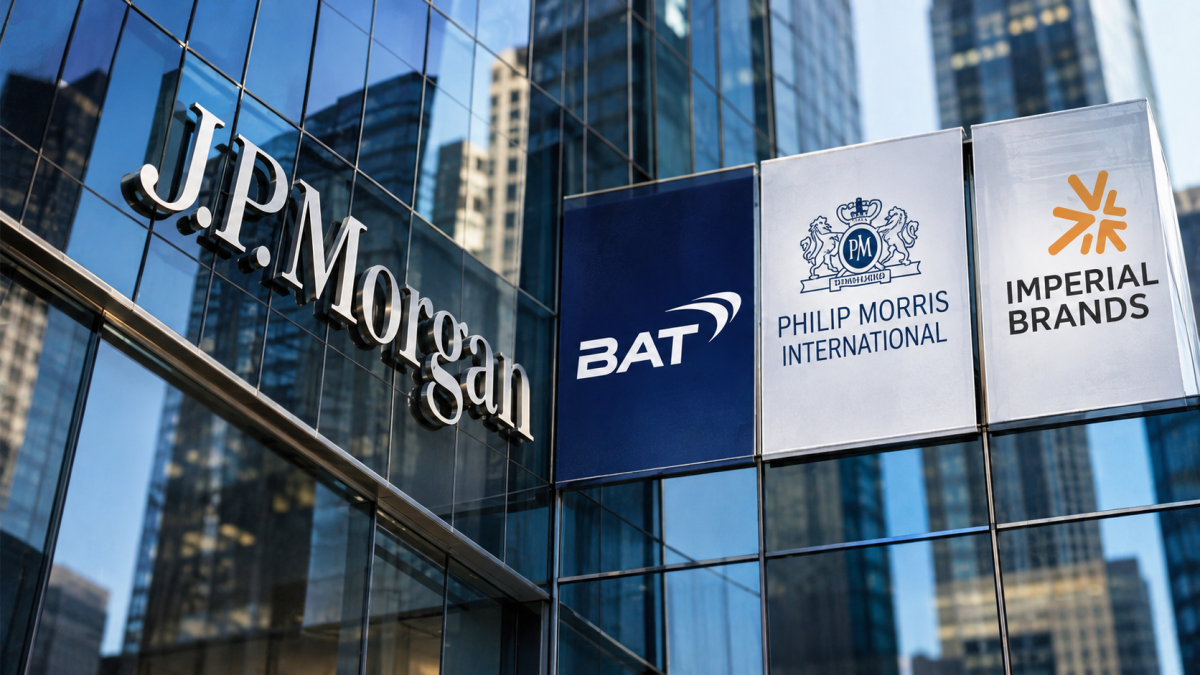
JPMorgan resumed equity research coverage of British American Tobacco (BAT), Philip Morris International (PMI) and Imperial Brands in November 2026, assigning BAT an Overweight rating and the other two companies Neutral ratings. The bank forecasts like-for-like sales growth of 3.9% for BAT and 6.2% for PMI in 2027, but estimates the two companies will trade at approximately 11 times and 21 times 2027 earnings, respectively. JPMorgan cited BAT's improving position in US nicotine pouches and vaping products as a driver of its investment outlook. BAT reported a 220% constant-currency increase in US modern oral nicotine revenue in the first half of 2026, while PMI's ZYN US shipments returned to growth in the third quarter. Imperial expects NGPs to represent 4% to 5% of sales and has expanded its oral portfolio through acquisitions.
Capital Markets
Nov.12
How Investors Are Repricing the Global Tobacco Industry as Nicotine Markets Shift
How are investors reassessing the global tobacco industry as nicotine markets evolve? In an interview with 2Firsts, Charlie Chen, Head of Research at CCB International Securities, forecasts annual growth of 30–50% for nicotine pouches, outpacing vaping and heated tobacco. He examines how regulatory enforcement, shifting market shares and new business models are influencing company valuations. The report also explores differences between multinational tobacco groups and Chinese companies, drawing on insights from the New Approaches Summit on profitability, investment strategies and industry consolidation.
Nov.11
Pennsylvania Vape Directory Enforcement Starts Oct. 19, Barring Retail Sales of Unlisted Products
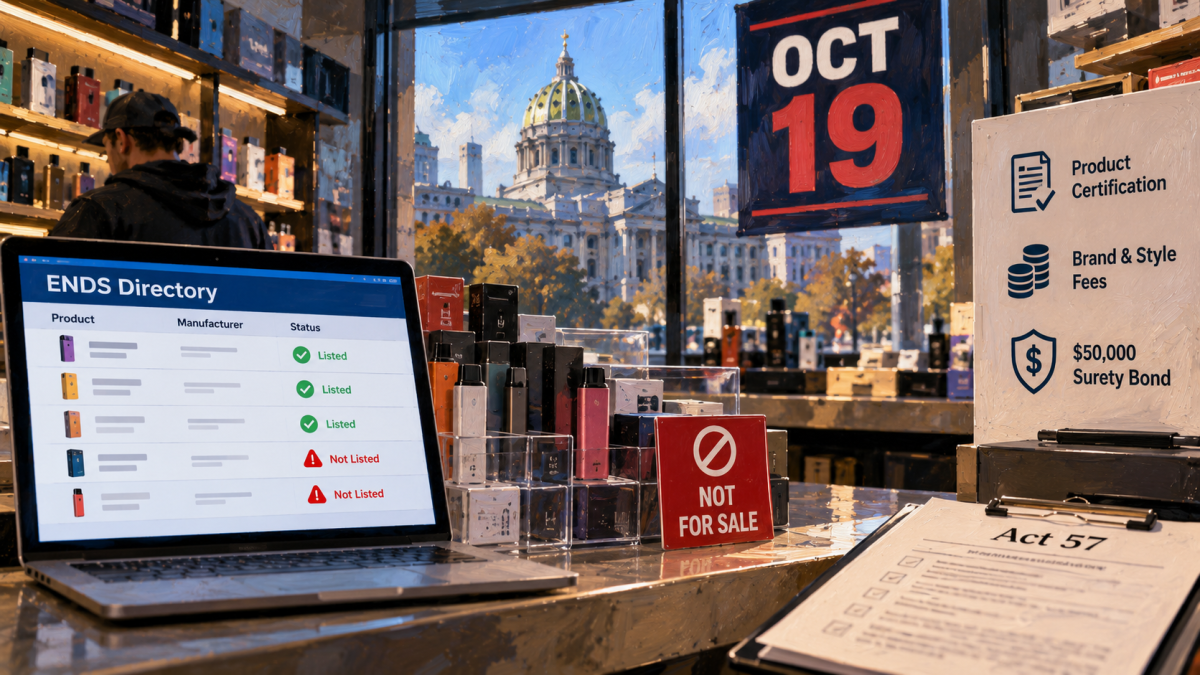
Pennsylvania's Act 57 vape directory regime will reach the end of its 120-day inventory transition period on Oct. 19. Nicotine-containing e-cigarettes intended for retail sale in the state that are not listed on the Attorney General's ENDS directory will then be barred from retail sale and treated as contraband subject to seizure, forfeiture and destruction. Manufacturers face annual product certification, brand- and style-based fees and a minimum $50,000 surety bond, while retailers and wholesalers must source through licensed channels and monitor the directory.
Regulations
Oct.08
Indonesia's Influential Islamic Body MUI Urges Vape Permit Freeze, Raising Uncertainty for 200 Manufacturers
Indonesia's Ulema Council (MUI) published Fatwa No. 131/2026 on November 9, declaring electronic cigarette use, production and trade haram under Islamic religious rules. The council urged the Industry Ministry to prohibit the issuance of vape industry permits and review licensing policies, while calling on the president and parliament to enact a comprehensive ban. On November 10, the Constitutional Court heard a challenge to provisions of the 2023 Health Law seeking a prohibition on vape production, importation, distribution and use. The Health Ministry said on November 11 it was studying stronger restrictions, including a possible ban on circulation, while industry association APVI called for tighter oversight rather than a total ban. Indonesia's Industry Ministry previously estimated the sector comprises about 200 companies, Rp31 trillion ($1.7 billion) in cumulative investment and approximately 100,000 supply-chain jobs. No nationwide statutory ban has been enacted.
Regulations
Nov.12
DATA|UK Retail Research Group IGD Says Convenience Tobacco and Vape Sales Fell 10.6%, With 15.4% Market Share Versus Alcohol's 15.1%; Top Rank at Risk in 2027
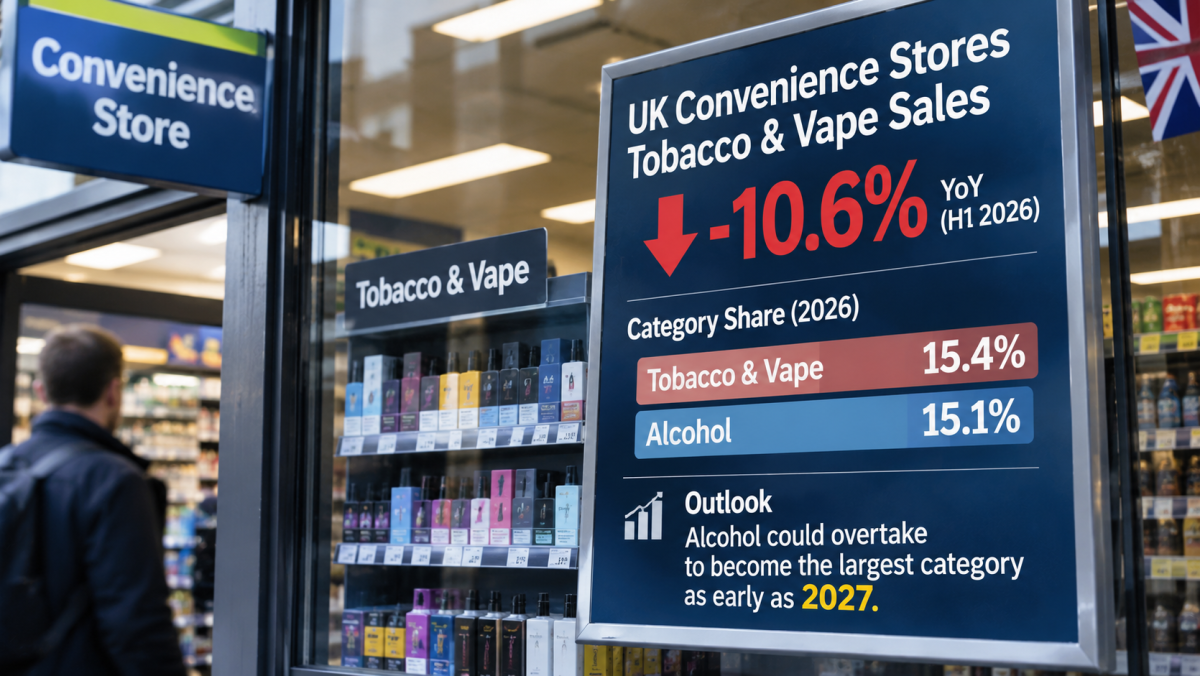
Combined tobacco and vaping sales in UK convenience stores fell 10.6% year over year in the first half of 2026, making the category a major drag on channel performance, according to retail research organization IGD. Total convenience sales declined 1.2%, while sales excluding tobacco and vaping increased 0.7%. IGD's 2026 category-share figures show tobacco and vaping accounting for 15.4% of convenience sales, compared with 15.1% for alcohol. The organization forecasts alcohol could overtake tobacco and vaping as the largest category by sales value as early as 2027 if current trends continue. IGD expects the convenience market to increase from £48.6 billion in 2026 to £54.9 billion in 2031, a 2.5% compound annual growth rate, or 3.4% excluding tobacco and vaping.
DATA
Nov.11
Russia's State Duma Passes Tobacco and Nicotine Ingredient Disclosure Bill, Targeting 2027 End to Trade-Secret Protection for Certain Harmful Ingredient Data
Russia's State Duma passed a government-sponsored amendment on November 11, 2026, by 414 votes to none, seeking to prevent businesses from classifying information on the presence and number of types of certain harmful ingredients in tobacco and nicotine-containing products as trade secrets. The measure covers ingredients capable of increasing nicotine dependence or exhibiting toxic, carcinogenic, mutagenic or reproductive toxicity, including substances that acquire such properties during heating or smoldering. Bill No. 1286415-8 would amend Article 5 of Federal Law No. 98-FZ on Commercial Secrets and is scheduled to take effect on January 1, 2027. The bill has cleared all three readings in the State Duma but has not completed the remaining legislative procedures.
Regulations
Nov.12 by 2Firsts Perspectives