PMI AI White Paper Warns of “Cognitive Atrophy” and Attention Erosion, Calls for Focus on Human Cognition’s Evolution

Jan.21
PMI AI White Paper Warns of “Cognitive Atrophy” and Attention Erosion, Calls for Focus on Human Cognition’s Evolution
Philip Morris International (PMI) has released a white paper calling for cross-sector dialogue on how AI may affect human cognitive abilities. The paper flags risks including “cognitive atrophy” and attention erosion, and warns of a widening cognitive divide and rising pressures on information verification and trust.

Key Takeaways


  • PMI has released a white paper calling for cross-sector dialogue on how human cognition will evolve—and how it should be governed—in the age of AI.
  • It argues that as AI moves deeper into knowledge work, “human advantage” capabilities such as critical thinking, creativity and adaptability will become more important.
  • The paper identifies two main risks: “cognitive atrophy,” as generative AI substitutes for thinking processes, and “attention erosion,” driven by information feeds and synthetic content.
  • It warns that a “cognitive divide” could widen and that deepfakes and other synthetic media will intensify pressures on trust and verification.


2Firsts, January 21, 2026


According to Business Wire, Philip Morris International (PMI) released a white paper on Jan. 20 in Stamford, Connecticut, titled Human Cognition: The Next Frontier? (Chinese: Human Cognition: The Next Frontier?), calling for cross-sector discussion on “how human cognitive abilities will evolve” as artificial intelligence continues to reshape the way work, society and economies function.


The white paper argues that as AI increasingly automates routine tasks and expands into knowledge-work processes, capabilities such as critical thinking, creativity and adaptability will become more important. It says organizations need to reassess how to develop and protect human cognitive abilities.


The document also outlines what it describes as “accelerating cognitive risks.” It defines “cognitive atrophy” as the substitution effect of generative AI in ideation, drafting and analysis, which could reduce deep thinking and independent judgment built through sustained mental effort. It describes “attention erosion” as the impact of always-on environments—notifications, information feeds, dashboards and synthetic content—that can fragment attention and weaken sustained focus and complex reasoning.


In addition, the paper raises the prospect of an “emerging cognitive divide,” arguing that disparities in access to time, focus and advanced learning resources may widen and become entrenched as a new form of inequality in the AI era. It also warns that the growth of synthetic media and deepfakes will create “trust and verification challenges,” requiring new habits of information verification and stronger digital skepticism.


Cover image source: Business Wire


We welcome news tips, article submissions, interview requests, or comments on this piece.

Please contact us at info@2firsts.com, or reach out to Alan Zhao, CEO of 2Firsts, on LinkedIn


Notice

1.  This article is intended solely for professional research purposes related to industry, technology, and policy. Any references to brands or products are made purely for objective description and do not constitute any form of endorsement, recommendation, or promotion by 2Firsts.

2.  The use of nicotine-containing products — including, but not limited to, cigarettes, e-cigarettes, nicotine pouchand heated tobacco products — carries significant health risks. Users are responsible for complying with all applicable laws and regulations in their respective jurisdictions.

3.  This article is not intended to serve as the basis for any investment decisions or financial advice. 2Firsts assumes no direct or indirect liability for any inaccuracies or errors in the content.

4.  Access to this article is strictly prohibited for individuals below the legal age in their jurisdiction.


Copyright


This article is either an original work created by 2Firsts or a reproduction from third-party sources with proper attribution. All copyrights and usage rights belong to 2Firsts or the original content provider. Unauthorized reproduction, distribution, or any other form of unauthorized use by any individual or organization is strictly prohibited. Violators will be held legally accountable.

For copyright-related inquiries, please contact: info@2firsts.com


AI Assistance Disclaimer


This article may have been enhanced using AI tools to improve translation and editorial efficiency. However, due to technical limitations, inaccuracies may occur. Readers are encouraged to refer to the cited sources for the most accurate information.

We welcome any corrections or feedback. Please contact us at: info@2firsts.com

NACS Urges USTR to Address Illegal E-Cigarette Exports in China Trade Engagements
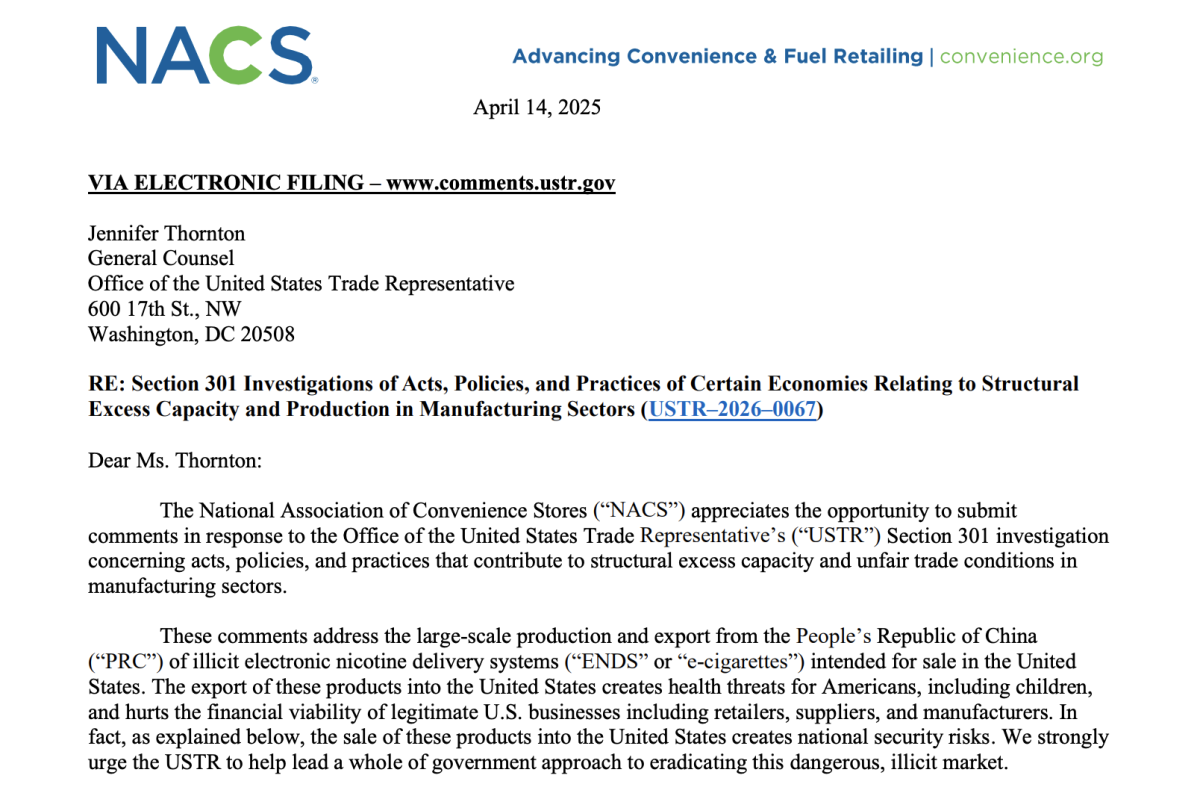
NACS submitted a comment letter to USTR in a proceeding examining unfair trade practices worldwide. The letter focuses on illicit nicotine products made in China and shipped to the United States in violation of U.S. law. NACS said the U.S. electronic nicotine delivery systems market has become dominated by illicit products, mainly disposable e-cigarettes manufactured in China and sold without the marketing authorization required by the U.S. Food and Drug Administration.
Apr.16 by 2FIRSTS.ai
Disposable Vape Ban Shifts Purchasing Formats as UK Vape Volume Falls 10.3%
Data from convenience insight agency Talysis shows that the value of tobacco, vapes and smoking alternatives in the independent convenience sector fell by 4.4% in the first quarter of 2026, while volume fell by 7.8%. The vaping subcategory declined by 3.9% in value and 10.3% in volume over the same period. Talysis said the impact of the disposable vape ban continues to pressure turnover and footfall.
May.08 by 2FIRSTS.ai
Swedish Government Minister Visits Nicotine Pouch Factory, Calls Sector Important Export Industry
Sweden’s Minister for Foreign Trade and Development Cooperation, Benjamin Dousa, visited nicotine pouch producer Another Snus Factory on Monday, calling the sector an important export industry as several European countries tighten regulation of the products.The company produces about 30 million cans of white snus annually and holds roughly 12% of Sweden’s domestic market.
Apr.16
Product | Labeled “Built in the USA” Up to 60,000 Puffs: DOJO PUREX 60K Launches on U.S. Sales Channels
DOJO unveiled the PUREX 60K e-cigarette at TPE 2026 held in Las Vegas, United States. The product is labeled “Built in the USA,” supports up to 60,000 puffs, and features 16ml e-liquid capacity, a 1000mAh battery, and ECO and SMART output modes. It has gone live on DOJO’s official website and select U.S. online sales channels at a price of $18.99.
Apr.07 by 2FIRSTS.ai
Russian Lawmaker Says Vape Circulation Licensing Will Be Regulated by Law in the Coming Months
Alexander Tolmachev, deputy chairman of the Russian State Duma Committee on Youth Policy, said the issue of licensing vape circulation will be resolved at the legislative level in the coming months. He said a significant share of such products currently on the market are counterfeit, that their real nicotine concentration may be several times higher than stated, and that the composition of the liquid is unknown.
Mar.18 by 2FIRSTS.ai
Reuters Exclusive: FDA’s Fast-Track Review of Nicotine Pouches Slows Over Youth and New-User Concerns
Reuters reported on April 1 that several popular nicotine pouch products still have not been cleared for sale in the United States despite a fast-track review pilot run by the U.S. Food and Drug Administration. Three sources said FDA reviewers have taken a cautious approach because of potential risks to youth and other non-tobacco users, including the possibility of driving nicotine addiction among adults who do not already smoke.
Apr.02 by 2FIRSTS.ai