Singapore Man Fined for Selling Imitation Tobacco Products

Regulations by 2FIRSTS.ai
Dec.11.2023
Singapore Man Fined for Selling Imitation Tobacco Products
Lim Zhi Wei, a Singaporean man, was fined $8,500 for falsely reporting stolen IT equipment when it was actually e-cigarettes.

According to a report by Mothership on December 8, a man in Singapore has been fined $8500 for filing a complaint about theft in his warehouse. He claimed that the stolen items were information technology (IT) equipment, but the investigation revealed that the warehouse actually stored e-cigarettes and accessories.


A Singaporean man named Lim Zhi Wei, aged 38, has confessed to four charges related to selling or advertising imitation tobacco products under the Tobacco Advertising and Sales Control Act.


In addition, six other charges were also taken into consideration in the verdict. If Lin is unable to pay the fine, he will be required to serve a 17-day sentence.


The court heard Lin's report on the theft of a warehouse, which stated that the stolen items were IT equipment. However, during the investigation, the police discovered that the stolen goods were actually e-cigarette devices and related components, rather than IT equipment.


Afterward, the Health Sciences Authority (HSA) was notified and proceeded to arrest Lin on May 13, 2022. The authorities seized a total of 60,050 pods, 172 boxes of e-cigarettes with pods, 1,601 sets of e-cigarette kits without pods, 296 individual e-cigarettes without pods, 22 disposable e-cigarettes, and 27 bags containing various e-cigarettes and pods.


During the investigation of the Lin family, the Health and Safety Agency (HSA) also discovered a larger quantity of e-cigarettes and their components. Additionally, prohibited items were found within his rental vehicle.


Lin has admitted to packaging, selling, and delivering e-cigarettes and their accessories in Singapore. He promoted these banned items through chat conversations, claiming to be conducting these activities on behalf of a Malaysian named Jason. Lin further alleged that another person he knows, William, was also involved in these operations.


Lin said he received a payment of 10 Singapore dollars for each package he delivered, and 1 Singapore dollar for each package he packed. He stated that over the course of two months working in packaging and delivery of e-cigarettes and related components, he received a total payment of approximately 2000 to 3000 Singapore dollars.


According to a recent investigation, in April 2022, Lin conducted a sale on WhatsApp, offering 50 boxes of various flavored pods to an individual at a price of SGD 9 per box.


Previously, in February 2022, he promoted a "root beer flavor" pod to another potential buyer on WhatsApp, and provided a photo for consideration. In addition, Lin sold 13 boxes containing 39 grape-flavored pods to an individual on WhatsApp, for a total of $300. This transaction involved Lin collecting the payment through DBS PayLah! and delivering the pods to the buyer's maid at a vacant lot in Bukit Panjang.


For the sale or provision of counterfeit tobacco products, first-time offenders can face a maximum sentence of six months in prison, a fine of up to ten thousand Singapore dollars, or both. Repeat offenders may face a maximum imprisonment and fine that are twice the previous penalties.


We welcome news tips, article submissions, interview requests, or comments on this piece.

Please contact us at info@2firsts.com, or reach out to Alan Zhao, CEO of 2Firsts, on LinkedIn


Notice

1.  This article is intended solely for professional research purposes related to industry, technology, and policy. Any references to brands or products are made purely for objective description and do not constitute any form of endorsement, recommendation, or promotion by 2Firsts.

2.  The use of nicotine-containing products — including, but not limited to, cigarettes, e-cigarettes, nicotine pouchand heated tobacco products — carries significant health risks. Users are responsible for complying with all applicable laws and regulations in their respective jurisdictions.

3.  This article is not intended to serve as the basis for any investment decisions or financial advice. 2Firsts assumes no direct or indirect liability for any inaccuracies or errors in the content.

4.  Access to this article is strictly prohibited for individuals below the legal age in their jurisdiction.


Copyright


This article is either an original work created by 2Firsts or a reproduction from third-party sources with proper attribution. All copyrights and usage rights belong to 2Firsts or the original content provider. Unauthorized reproduction, distribution, or any other form of unauthorized use by any individual or organization is strictly prohibited. Violators will be held legally accountable.

For copyright-related inquiries, please contact: info@2firsts.com


AI Assistance Disclaimer


This article may have been enhanced using AI tools to improve translation and editorial efficiency. However, due to technical limitations, inaccuracies may occur. Readers are encouraged to refer to the cited sources for the most accurate information.

We welcome any corrections or feedback. Please contact us at: info@2firsts.com

South Korea Constitutional Court Upholds Volume-Based E-Liquid Tax, With Challenged Rates at KRW 370 and KRW 628 per Milliliter
South Korea's Constitutional Court has upheld fixed taxes on nicotine-containing e-cigarette liquids based on solution volume, ruling that challenged provisions imposing KRW 370 per milliliter in individual consumption tax and KRW 628 per milliliter in tobacco consumption tax do not violate the Constitution. The cases stemmed from historical disputes involving importers that reported nicotine as being extracted from tobacco stems rather than leaves. South Korea has since broadened its tobacco definition to include synthetic nicotine, while current tax laws provide reduced rates for certain products not derived from tobacco.
Sep.18
Smoke-Free Business Hits 42% of Q2 Net Revenue as PMI’s First TNFD Report Covers Single-Use Electronics, Critical Raw Materials and IQOS Repairs
Philip Morris International has published its first report aligned with the Taskforce on Nature-related Financial Disclosures, bringing its electronics supply chain and the use and end-of-life stages of smoke-free devices and consumables into its nature-related assessment. PMI said its smoke-free business accounted for about 42% of total net revenues in the second quarter of 2026. The report says non-circular electronic products, particularly single-use items, can increase consumption of limited natural resources and also details an IQOS repair pilot. A 2040 circularity scenario tests assumptions including a 50% reduction in product waste-related costs, 10% raw-material savings and a 25% substitution rate for refurbished products versus new products.
Sep.23
Germany's Four-Year Tobacco Tax Plan Heads to Parliament as BAT, JTI and PMI Push for Changes
Germany's parliament is scheduled to hold a first reading of amendments to the Tobacco Tax Act on September 24. The government plans annual tax increases from 2027 through 2030 covering cigarettes, heated tobacco, vaping liquids and other categories. It expects the reform to generate €756 million in additional revenue in 2027, rising to €3.589 billion in additional annual revenue by 2030. Ahead of the parliamentary debate, the German Association of the Tobacco Industry and Novel Products, or BVTE, launched the "Tabaksteuer mit Augenmaß" campaign backed by BAT, JTI, Philip Morris, Reemtsma and wholesale and retail groups.
Sep.23
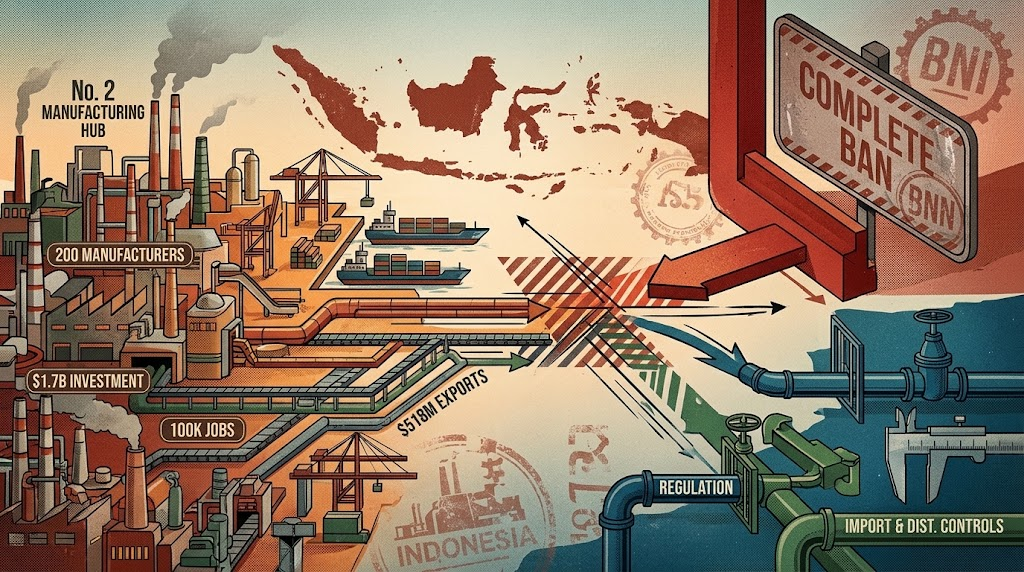
Special report|Indonesia's Vape Industry Has 200 Manufacturers and $1.7 Billion in Investment. Could a Regulatory Divide Derail Its Rise as the World's No. 2 Manufacturing Hub After Shenzhen?
Indonesia's Ministry of Industry said at a November 3, 2026, policy forum that the country has about 200 electronic cigarette companies, Rp31 trillion (approximately $1.71 billion) in cumulative industry investment and around 100,000 jobs across the supply chain. The National Narcotics Agency is seeking a comprehensive ban on vape use and circulation, while the industry ministry favors tighter import, product-standard and distribution controls. Indonesia exported approximately $518 million in vaping products in 2025, and Chinese manufacturers including Smoore, GEEKVAPE and Jinjia Group have established local operations. An international logistics specialist interviewed by 2Firsts said more Chinese vape companies began production in Indonesia from the second half of 2025, accompanied by increased shipments of manufacturing equipment and investment in logistics facilities. The regulatory debate comes as Indonesia expands its role in international vaping manufacturing.
Special Report
Nov.05
Russia Expands Temporary Administration of JTI Assets in Second Round: From Four to All Seven Russian Entities, With Approximately $9.5 Billion in Related Assets
Japan Tobacco Inc. (JT) confirmed on November 9, 2026, that all seven of its Russian entities had been placed under temporary administration after a second presidential decree added three companies to the four designated a day earlier. The additional entities are associated with importing, management, holdings and the former supply of Ploom heated-tobacco devices. JT disclosed approximately ¥1.5 trillion in Russian business-related assets as of September 30, including ¥360 billion in cash and deposits, and approximately ¥200 billion in liabilities. Under its revised FY2026 forecast, Russia accounts for about 25% of adjusted operating profit. JT said operations in Russia were continuing, while the financial impact remained under assessment.
company
Nov.09
NATO Executive Director David Spross Sees U.S. Vape Regulation Improving, Calls for More PMTA Authorizations and Warns of 2027 State Tax Pressure
The National Association of Tobacco Outlets is calling for more FDA marketing authorizations, greater transparency in the PMTA process and continued enforcement against unauthorized e-cigarettes, even as its executive director, David Spross, points to recent regulatory developments as signs of progress. At the state level, excise taxes, flavor restrictions and vapor product directories remain major issues for tobacco retailers. By August 2026, 17 states had enacted laws establishing state-managed e-cigarette directories or similar systems.
Innovation
Sep.29 by 2Firsts Perspectives