Smoking Rates Drop 20% in Cambodia, New Study Shows

Feb.27.2023
Smoking Rates Drop 20% in Cambodia, New Study Shows
Smoking rates in Cambodia fell by one fifth between 2014-2021, with attitudes towards tobacco also changing.

New research findings reveal that the smoking rate in Cambodia decreased by one-fifth between 2014 and 2021.


Results from the 2021 National Adult Tobacco Survey in Cambodia indicate a decrease in overall smoking prevalence from 16.6% in 2014 to 13.04% in 2021. Male smoking prevalence experienced a decline of 6.93% from 32.3% in 2014 to 25.37% in 2021, while female smoking prevalence decreased from 2.4% in 2014 to 2.05% in 2021.


The attitude of Cambodians is also changing, as evidenced by a survey that found 95% of respondents support a hike in cigarette taxes and 95.75% support an increase in tobacco product prices.


The number of people exposed to tobacco has seen a significant decline from 2014 to 2021. The percentage of individuals exposed to tobacco smoke in their homes has reduced from 66% in 2014 to 27% in 2021. Similarly, the number of individuals exposed to tobacco smoke in their workplace has seen a 50% decrease, from 48% in 2014 to 24% in 2021.


However, concerning is the fact that despite the presence of anti-smoking laws, the exposure to tobacco smoke in public transportation has increased from 33% in 2014 to 62% in 2021.


Every year in Cambodia, over 16,000 people die from smoking, with one-third of those being the poorest individuals. If a smoking ban had been implemented earlier, every one of these preventable deaths could have been avoided. However, the tobacco industry remains active and deceitful in expanding its market, leading to an epidemic of tobacco-related illnesses.


Tobacco not only causes disease and death, but also has an impact on the economy: globally, the tobacco industry causes a loss of over $1.4 trillion USD (about 9.7 trillion RMB) each year. In Cambodia, the economic cost is over $227 million USD (about 1.58 billion RMB) per year due to healthcare expenses and lost productivity alone. Overall, Cambodia suffers an economic loss of $27 billion Cambodian riel (about 4.622 billion RMB) each year due to tobacco, equivalent to 3% of its gross domestic product.


References:


The prevalence of smoking has decreased in Cambodia.


Disclaimer

This article is provided solely for professional research, industry discussion, and informational purposes. Any references to brands, companies, products, technologies, or policies are made for factual reporting and analytical purposes only, and do not constitute endorsement, recommendation, promotion, or advertising by 2Firsts.

Nicotine-containing products, including but not limited to cigarettes, e-cigarettes, heated tobacco products, and nicotine pouches, carry significant health risks. Readers are responsible for complying with all applicable laws and regulations in their respective jurisdictions, including age restrictions and access limitations.

The information contained in this article should not be regarded as investment, legal, medical, regulatory, or commercial advice. While 2Firsts strives to ensure the accuracy and reliability of its content, it does not assume liability for any direct or indirect loss arising from errors, omissions, inaccuracies, or reliance on the information contained herein.

This article is not intended for individuals below the legal age for accessing tobacco or nicotine-related information in their jurisdiction.


Copyright Notice

This article is either original content produced by 2Firsts or content reproduced, translated, summarized, or adapted from third-party sources with attribution where applicable. The intellectual property rights of the original content remain with 2Firsts or the respective original rights holders.

No individual or organization may copy, reproduce, distribute, republish, modify, translate, or otherwise use this content without prior authorization. Any unauthorized use may result in legal action.

For copyright-related inquiries, corrections, or removal requests, please contact: info@2firsts.com.


AI-Assisted Translation and Editing Notice

Portions of this article may have been translated, edited, or reviewed with the assistance of artificial intelligence tools to improve efficiency and readability. Due to the limitations of AI-assisted translation and editing, discrepancies, omissions, or inaccuracies may exist when compared with the original source.

Where applicable, readers are advised to refer to the original source for the most complete and accurate information. If you identify any errors or believe that any content infringes upon your rights, please contact us at info@2firsts.com, and we will review and address the matter promptly.

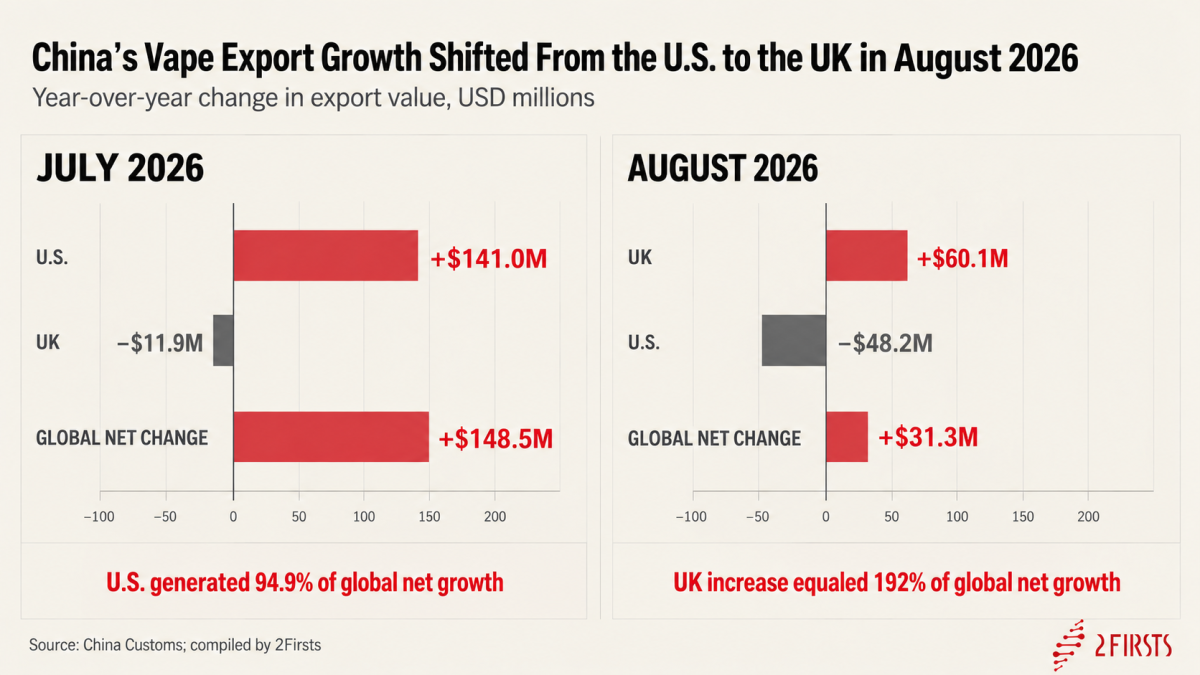
2Firsts Data|China’s Vape-Related Exports Rose 3.3% in August 2026 as UK Shipments Jumped 51.4% and U.S. Exports Fell 12.4%
China exported $979 million of vape-related products in August 2026, up 3.3% from a year earlier but down 6.4% from July. The UK replaced the U.S. as the main source of growth: UK-bound shipments jumped 51.4% to a 2026 high of $177 million, while exports to the U.S. fell 12.4% to $339 million. Shipments to markets outside the U.S. increased 14.2%, broadening growth beyond the market that had driven July’s rebound.
News
Sep.23 by 2Firsts Perspectives
Special Report | Russia Places Four JTI Businesses Under Temporary Management, a First for Tobacco Majors
Russia has placed shares in four Japan Tobacco International businesses under temporary management, the first such move involving a major global tobacco manufacturer, according to Interfax. JTI held 35.8% of Russia's tobacco market by volume in the first nine months of 2026. While British American Tobacco and Imperial Brands have exited Russia, Philip Morris International continues operating there. As the market changes and diplomatic efforts continue, could international tobacco companies that left Russia eventually return?
Nov.06
2Firsts First Look|China to End VAT Export Rebates on Vape Devices and Nicotine in April 2027, Following Earlier Removal for HTP Devices and Nicotine Vapes
China's Ministry of Finance and State Taxation Administration announced on October 12, 2026, that value-added tax (VAT) export rebates for vape devices, nicotine and its salts, and certain non-combustible inhalation products will be eliminated from April 1, 2027. The measure adds four tobacco- and nicotine-related customs codes, including 8543400010, which covers vape devices and qualifying empty pods. China previously eliminated rebates for nicotine-containing vaping products and devices under code 8543400090 in April 2026. According to industry classification information held by 2Firsts, the latter currently corresponds to heated tobacco devices. Export excise tax refund and exemption arrangements will remain unchanged.
Special Report
Oct.12
U.S. Military Could Test Nicotine Pouches and Vapes for Smoking Cessation as Washington Examiner Cites ZYN and Potential $4 Billion Reduction in Related Defense Costs
The House-passed FY2027 National Defense Authorization Act includes a provision authorizing the defense secretary to conduct a one-year smoking-cessation pilot for active-duty service members. Section 707 lists counseling, nicotine gum and patches alongside what the bill calls "electric nicotine delivery systems," nicotine pouches and heat-not-burn products. A recent Washington Examiner op-ed cited ZYN as an example in arguing for the provision, but the legislation does not name any commercial brand or supplier. ZYN is made by PMI-owned Swedish Match USA, with specified products holding FDA marketing authorizations and modified risk orders.
Sep.20
Philippines Mandates Safety Certification for Nicotine Pouches, Gives Industry 12 Months to Comply
The Philippines Department of Trade and Industry has placed nicotine pouches under mandatory product certification through Department Administrative Order No. 26-07, Series of 2026. Nicotine pouches must obtain a Philippine Standard, or PS, license before they can be manufactured, imported, packed, distributed or sold in the country. The regime requires testing for nicotine content, pH and water activity, while packaging must disclose nicotine strength, ingredients, allergens, batch information, the PS certification mark and prescribed health warnings. Existing market participants have a 12-month transition period to comply.
Regulations
Oct.12
NAS 2026 | Former FDA Tobacco Chief Mitch Zeller Calls for Shift From “End Game” to “End State”
At the 2026 New Approaches Summit in New York, former FDA Center for Tobacco Products Director Mitch Zeller called for the tobacco harm reduction debate to shift from the traditional “end game” toward defining a desired “end state.” He also highlighted unresolved concerns around dual use, argued that biomarkers of exposure may be more meaningful than cigarettes-per-day in assessing risk reduction, and said nicotine misperceptions remain a major barrier to public health progress.
Sep.25