South Korean Lawmakers Propose Warning Labels and Graphics on Vape Devices

Nov.25.2024
South Korean Lawmakers Propose Warning Labels and Graphics on Vape Devices
The South Korean National Assembly and the Ministry of Health and Welfare are considering a bill that would require warning labels or graphics on vape devices. The proposal also seeks to ban the use of imagery appealing to minors in tobacco advertisements.

According to N.News on November 25th, the South Korean National Assembly and the Ministry of Health and Welfare are closely monitoring a proposed bill to add smoking warning labels or images to e-cigarette devices.


National Assembly member Jeon Jin-sook has submitted a bill to amend the National Health Promotion Act in order to strengthen e-cigarette regulation.


Currently, there are regulatory loopholes in the law regarding new tobacco products such as e-cigarettes. The existing law only requires warning labels on tobacco packaging. However, according to a new bill amendment, warning labels and images will also be required on tobacco products specified by executive order, including e-cigarettes, and their associated devices. Additionally, the amendment plans to include these devices in the restrictions on tobacco advertising.


In order to prevent teenagers from developing an interest in smoking, a proposed law aims to prohibit the use of animal photos, cartoon characters, or movie characters in tobacco advertisements. The South Korean Ministry of Health and Welfare has expressed strong support for this measure, believing that it is necessary to raise awareness of the dangers of smoking and provide support for relevant legal amendments.


Currently, South Korea's tobacco control laws mainly consist of the National Health Promotion Act and the Tobacco Business Act. The former focuses on national health, while the latter aims to develop the tobacco industry.


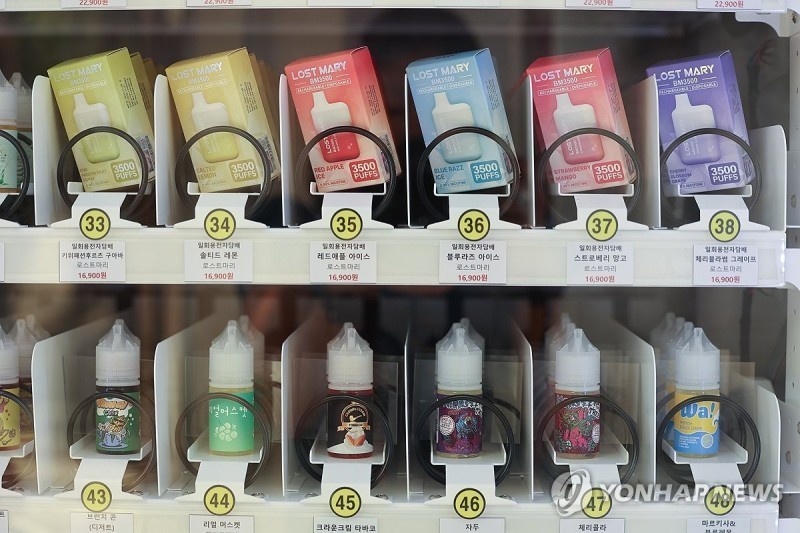
The Tobacco Business Law does not include products that use minimal amounts or synthetic nicotine in its definition of tobacco. Therefore, liquid e-cigarettes are not considered traditional tobacco products, allowing for more freedom in their online and offline sales without warning labels. Additionally, these products are not subject to tobacco consumption taxes, making it easier for teenagers to access and try liquid e-cigarettes.


A survey in South Korea shows that the percentage of teenagers using e-cigarettes is on the rise. Data released by the Disease Control and Prevention Department in March 2023 reveals that the rate of high school students using e-cigarettes has increased from 2.7% in 2018 to 3.1% in 2023.


We welcome news tips, article submissions, interview requests, or comments on this piece.

Please contact us at info@2firsts.com, or reach out to Alan Zhao, CEO of 2Firsts, on LinkedIn


Notice

1.  This article is intended solely for professional research purposes related to industry, technology, and policy. Any references to brands or products are made purely for objective description and do not constitute any form of endorsement, recommendation, or promotion by 2Firsts.

2.  The use of nicotine-containing products — including, but not limited to, cigarettes, e-cigarettes, nicotine pouchand heated tobacco products — carries significant health risks. Users are responsible for complying with all applicable laws and regulations in their respective jurisdictions.

3.  This article is not intended to serve as the basis for any investment decisions or financial advice. 2Firsts assumes no direct or indirect liability for any inaccuracies or errors in the content.

4.  Access to this article is strictly prohibited for individuals below the legal age in their jurisdiction.


Copyright


This article is either an original work created by 2Firsts or a reproduction from third-party sources with proper attribution. All copyrights and usage rights belong to 2Firsts or the original content provider. Unauthorized reproduction, distribution, or any other form of unauthorized use by any individual or organization is strictly prohibited. Violators will be held legally accountable.

For copyright-related inquiries, please contact: info@2firsts.com


AI Assistance Disclaimer


This article may have been enhanced using AI tools to improve translation and editorial efficiency. However, due to technical limitations, inaccuracies may occur. Readers are encouraged to refer to the cited sources for the most accurate information.

We welcome any corrections or feedback. Please contact us at: info@2firsts.com

North Carolina Tightens Vape Product Directory Enforcement, Expands State and Local Powers as Violators Face Fines, Product Seizures and License Suspension or Revocation
North Carolina has expanded enforcement of its vapor product directory rules, authorizing more state and local law enforcement participation and establishing a task force led by the State Bureau of Investigation. The legislation requires at least one unannounced compliance inspection annually for retailers, distributors and wholesalers handling covered products. Penalties effective October 1, 2026, include civil fines of $500–$750 for a first violation and $1,000–$1,500 for repeated violations within 12 months, along with potential license suspension or revocation. Manufacturers may face penalties of $10,000 per unlisted product. The measures strengthen the product directory system established in 2024.
Regulations
Oct.28
Vape Manufacturer Ispire Expands Malaysia Operations, Negotiates Southeast Asia OEM Deal as Nicotine Pouch and US Age-Gating Businesses Develop
US-listed vaping technology and manufacturing company Ispire Technology reported fiscal first-quarter 2027 revenue of $27.5 million on November 9, 2026, down 9.3% year over year but up 3.2% sequentially. Gross margin recovered to 16.2%, while its net loss widened to $6.4 million from $3.3 million a year earlier. Management attributed the sales decline primarily to tighter European vaping regulation and reduced distributor orders. Ispire is expanding manufacturing in Malaysia and negotiating an OEM/ODM agreement with a Southeast Asian vaping brand, with an announcement anticipated in January 2027. The company estimates that Malaysian manufacturing offers an approximately 25% US tariff advantage over China-based production. However, it continues to purchase products from Shenzhen Yi Jia Technology Co., Ltd., a manufacturer controlled by its chairman, and reported $52 million in non-current related-party payables at September 30.
company
Nov.11 by 2Firsts Perspectives
Special Report|CrossBar's High-Puff Vapes Draw Attention on Pennsylvania's 163-Product Directory as Link Between Earlier 1.3mL PMTA Filings and New 13mL Products Remains Unclear
Pennsylvania began enforcing its electronic nicotine delivery system directory restrictions on October 19, 2026. Among 163 product listings recorded before enforcement, four CrossBar 20K disposables stood out with 13mL capacity, advertised puff counts of up to 20,000 and a flattened design distinct from conventional pod systems and compact disposables. Historical records identify earlier 1.3mL CrossBar products associated with Romo LLC, while newer 13mL products appeared in several state directories beginning in 2025 under entities including Blue Nine LLC. PMTA compliance expert Mr. K identified amendments and application ownership transfers as possible regulatory mechanisms, although neither has been confirmed in this case. Separately, Reynolds' $7.5 million acquisition of 16 PACHA products and related assets illustrates the commercial value of products linked to historic PMTA submissions.
Special Report
Oct.22
JTI Liggett Puts U.S. Value Cigarette Brands in Spotlight at 2026 NACS Show
At the 2026 NACS Show in Las Vegas, JTI Liggett highlighted its value-priced cigarette portfolio, including LD and Montego, following JT Group's acquisition of Vector Group. The company's U.S. business reported market share gains, with LD sales volume rising 32.6% in the first half of 2026. Meanwhile, Ploom was displayed separately at Altria's booth under an existing partnership. JTI Liggett booth staff told 2Firsts that the company had not yet launched nicotine pouch products in the United States.
EXPO
Oct.09
Philippines BIR Steps Up Illicit Vape Enforcement Ahead of Christmas Shopping
The Philippines’ Bureau of Internal Revenue is intensifying enforcement against illicit vape and tobacco products ahead of the Christmas shopping season, directing regional and enforcement offices to strengthen monitoring of production sites, warehouses, distribution channels and retail outlets. The BIR destroyed 240,550 illicit vape products in August with an estimated tax liability of about PHP1.53 billion. A nationwide tax-compliance operation in July also inspected 3,590 businesses involved in tobacco and vapor products.
Regulations
Sep.17 by 2Firsts Perspectives
South Korea Constitutional Court Upholds Volume-Based E-Liquid Tax, With Challenged Rates at KRW 370 and KRW 628 per Milliliter
South Korea's Constitutional Court has upheld fixed taxes on nicotine-containing e-cigarette liquids based on solution volume, ruling that challenged provisions imposing KRW 370 per milliliter in individual consumption tax and KRW 628 per milliliter in tobacco consumption tax do not violate the Constitution. The cases stemmed from historical disputes involving importers that reported nicotine as being extracted from tobacco stems rather than leaves. South Korea has since broadened its tobacco definition to include synthetic nicotine, while current tax laws provide reduced rates for certain products not derived from tobacco.
Sep.18