Key Points
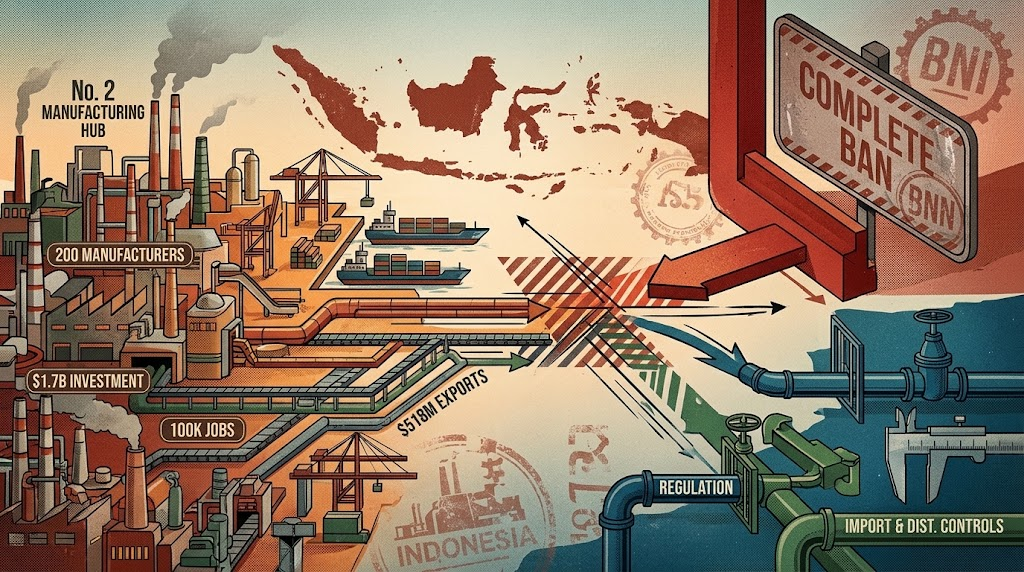
Indonesia's Ministry of Industry cited approximately 200 electronic cigarette companies, Rp31 trillion ($1.71 billion) in cumulative investment and around 100,000 jobs across the supply chain.
Indonesia's electronic cigarette exports reached approximately $518 million in 2025, with excise revenue of Rp2.84 trillion, or about $157 million. China exported approximately $10.598 billion in vaping and related products during the same year.
Chinese manufacturers including Smoore, GEEKVAPE and Jinjia Group have established Indonesian operations. A logistics specialist interviewed by 2Firsts reported increased equipment shipments and production activity from late 2025 into 2026.
The National Narcotics Agency is advocating a comprehensive ban on vape use and circulation, while the industry ministry favors tighter manufacturing, import and distribution controls. No final nationwide ban has been adopted.
2Firsts
November 5, 2026
Indonesia's Ministry of Industry said the country's electronic cigarette sector has attracted Rp31 trillion (approximately $1.71 billion) in cumulative investment and comprises about 200 companies, as government agencies debated whether vaping should be prohibited nationwide.
Nugraha Prasetia Yogie, an industry ministry official responsible for sectors including tobacco products, told a November 3 policy forum that the industry supports approximately 100,000 jobs across its supply chain.
He favored tighter controls on manufacturing, raw-material imports and distribution instead of a comprehensive prohibition.
The position differs from that of Indonesia's National Narcotics Agency (BNN), which is advocating a ban on vape use and circulation after identifying controlled drugs and other psychoactive substances in some e-liquid samples submitted for laboratory testing.
The forum was organized in Jakarta by the Indonesian Ulema Council (MUI), bringing together representatives from the industry ministry, health ministry, narcotics agency, food and drug regulator, customs authorities, police and vaping businesses.
The dispute comes as Indonesia attracts more Chinese electronic cigarette manufacturing operations. Companies including Smoore, GEEKVAPE and Jinjia Group have established production facilities in the country. Indonesia exported approximately $518 million in vaping products in 2025.
Mr. M, an international logistics specialist serving the electronic cigarette industry, told 2Firsts that his company has transported manufacturing equipment for multiple Chinese vaping companies to Southeast Asia over the past year or more, with Indonesia among the main destinations. He observed more manufacturers beginning sustained production locally from the second half of 2025.
As Chinese vape producers expand their overseas operations, Indonesia's potential to become another major global manufacturing center beyond Shenzhen has become an industry question. The regulatory dispute has introduced further uncertainty into the country's investment environment.
Around 200 Companies, $1.7 Billion in Investment and More Than $500 Million in Exports
Yogie said Indonesia has approximately 200 electronic cigarette companies, covering open-system e-liquids, closed-system products and solid electronic cigarette categories.
He put cumulative investment at Rp31 trillion, or approximately $1.71 billion, with around 100,000 people employed across upstream and downstream operations and export earnings of approximately $518 million.
The official also cited annual excise revenue of about Rp2.8 trillion, equivalent to roughly $154 million.
Some of the economic figures had been reported earlier. Indonesia's state news agency ANTARA reported on April 14, 2026, that electronic cigarette exports reached $518.27 million in 2025, up from $164.95 million in 2022, an increase of approximately 214% over three years.
Electronic cigarette excise revenue rose from Rp98.87 billion in 2018 to Rp2.84 trillion in 2025, equivalent to approximately $157 million at early-November 2026 exchange rates.
The industry ministry's Rp31 trillion figure represents cumulative investment. The publicly reported statement did not specify the investment period.
The ministry cited approximately 200 industrial companies in November. In April, an Indonesian lawmaker had quoted an industry-association estimate of about 300 electronic cigarette manufacturers.
Indonesia has a population approaching 290 million and a large conventional tobacco market. Electronic cigarettes have also established specialist retail channels.
Budiman, chairman of the Indonesian Personal Vaporizer Association (APVI), told the November 3 forum that the country had approximately 7,000 specialist vape shops.
Indonesia's vaping industry serves both domestic consumers and international customers, with businesses operating across retail, e-liquid production, device manufacturing and exports.
From Factory Investments to Production: Chinese Vape Companies Ship More Equipment to Indonesia as Costs Remain Above Shenzhen
Shenzhen has long been a major center of global electronic cigarette manufacturing.
At a May 2025 briefing, China's State Tobacco Monopoly Administration said Shenzhen accounted for approximately 72% of the country's licensed electronic cigarette manufacturers and 66% of national vaping exports by value in 2024.
According to 2Firsts analysis of Chinese customs data, China exported approximately $10.598 billion in electronic cigarette and related products in 2025. Indonesia reported about $518 million in electronic cigarette exports over the same year.
Chinese vaping manufacturers have established operations in Indonesia over several years.
China-based atomization technology producer Smoore International established a manufacturing facility in Malang, East Java, in 2022.
Previous 2Firsts reporting identified an investment plan of approximately $80 million for the site, which covers around six hectares and was equipped with 16 production lines, including capacity for vape cartridge manufacturing.
Chinese vaping device manufacturer GEEKVAPE established an Indonesian factory in 2023. 2Firsts reported on the company's local manufacturing operations in 2024.
Shenzhen-listed Jinjia Group has also developed new tobacco product and packaging manufacturing operations in Indonesia. Its corporate disclosures refer to local production qualifications, automation improvements and related manufacturing activities.
More recently, some Chinese manufacturers that established Indonesian facilities in earlier years have expanded actual production.
Mr. M, an international logistics specialist who has served vaping companies for many years, told 2Firsts that his company has transported manufacturing equipment for multiple Chinese electronic cigarette businesses to Southeast Asia over the past year or more, with Indonesia among the main destinations.
Among Pearl River Delta manufacturers he serves, Mr. M said general manufacturing customers more often direct overseas equipment shipments to Vietnam, while vaping manufacturers tend to favor Indonesia.
He said many Shenzhen vaping companies had established Indonesian factories before 2025, but outside a number of larger manufacturers, several had not achieved consistent production.
Beginning in the second half of 2025, and particularly during 2026, he observed more companies beginning actual manufacturing operations in Indonesia.
His company also established a logistics warehouse in Indonesia during the past year to serve vaping customers.
Mr. M said some smaller manufacturers that had previously relied on nonstandard vaping business activities began seeking overseas opportunities as China strengthened enforcement against illicit electronic cigarette operations.
Other companies experiencing rapid order growth have considered additional overseas capacity because domestic production approvals limit how quickly they can expand manufacturing.
China has progressively tightened licensing and production capacity management for electronic cigarettes. In February 2026, the State Tobacco Monopoly Administration further clarified restrictions covering new projects, approved production capacity, annual output and contract manufacturing, including prohibitions on exceeding authorized production limits.
Chinese authorities have also stepped up enforcement against illicit vaping operations. The Guangdong Tobacco Monopoly Administration reported that 2.87 million illicit electronic cigarette products were seized during the first half of 2026.
China has separately introduced two rounds of changes to value-added tax export rebates for electronic cigarettes and related products.
Under Announcement No. 2 of 2026 issued by the Ministry of Finance and State Taxation Administration, VAT export rebates were withdrawn from April 1, 2026, for nicotine-containing vaping products and specified electronic aerosol devices, including disposable vapes, filled cartridges, e-liquids and certain equipment categories.
Announcement No. 29, issued in October 2026, provides for the withdrawal of VAT export rebates from April 1, 2027, on specified vape devices, nicotine and nicotine salts, and certain non-combustible inhalation products.
Together, the two measures will bring the main customs product categories for electronic cigarettes and related nicotine products within the scope of the rebate withdrawal. Export excise-tax refund and exemption arrangements remain unchanged.
Some Chinese vaping manufacturers began investing in Indonesia as early as 2022. International customer orders, production capacity, trade conditions, supply-chain arrangements and domestic regulatory requirements have since featured in companies' overseas manufacturing decisions.
Mr. M said Indonesian production costs have declined as more vaping manufacturers and supporting businesses establish operations in the country. However, based on the customers and operations he serves, overall manufacturing costs remain higher than in Shenzhen.
He expects costs in Indonesia may remain higher even after accounting for the Chinese export VAT rebate changes implemented in 2026 and those scheduled for 2027.
Narcotics Agency Pushes Ban as Industry Ministry Proposes Import and Product Controls
Indonesia's National Narcotics Agency has advocated tighter vaping restrictions following investigations involving electronic cigarettes and e-liquids used to distribute or consume controlled drugs.
On October 30, BNN said laboratory examinations had detected narcotics or dangerous psychoactive substances in 35 of 341 e-liquid samples tested.
Of those positive samples, 23 contained etomidate, 11 contained synthetic cannabinoids and one contained methamphetamine.
BNN separately reported on October 23 that approximately 98% of 1,789 e-liquid samples examined between January 2025 and September 2026 had tested positive for narcotics, psychotropic drugs or new psychoactive substances. It said 96.71% of the samples contained etomidate.
The two sets of results were released on different dates. BNN's published statements did not specify whether the sample groups overlapped or provide a full breakdown of their collection sources.
The agency has advocated a comprehensive ban on vape use and circulation and called for interagency examination of the economic, fiscal, public health and law-enforcement implications.
The industry ministry favors retaining lawful manufacturing and commercial activity while tightening controls on raw-material imports, product standards and distribution.
At the November 3 forum, Yogie said the ministry is considering restricting e-liquid raw-material imports to businesses holding valid excise-business identification numbers, known as NPPBKC.
The ministry also proposed making Indonesian National Standard SNI 9070:2022 mandatory and examining technical standards for vaping devices, including fingerprint-based measures intended to restrict use by people under 21.
SNI 9070:2022 currently applies to electronic cigarette liquids. Requirements for other product categories and implementation of mandatory standards remain subject to further regulatory decisions.
The ministry also discussed encouraging the use of locally sourced nicotine and expanding export opportunities through free trade agreements.
Djaka Kusmartata, an official at the Finance Ministry's Directorate General of Customs and Excise (DJBC), told the forum that the agency had not identified narcotic-containing vaping products bearing official excise stamps in the cases it had examined.
He called for tighter enforcement against distribution channels involving illicit substances.
Customs authorities also outlined plans to introduce an integrated excisable-goods monitoring system, known as SPTBKC, in 2027, including automated production-counting equipment at manufacturing facilities and tighter oversight of raw-material imports and product movements.
The industry ministry's position has centered on lawful manufacturing, investment, employment and exports, while BNN has emphasized the risk of vaping products being used in illicit drug distribution and consumption.
Domestic Sales and Export Manufacturing Face Interconnected Regulatory Questions
Indonesia's Government Regulation No. 28 of 2024 already restricts domestic electronic cigarette sales, including prohibiting sales to people under 21 and pregnant women and setting requirements covering sales locations, online transactions, packaging and advertising. Certain online transactions are permitted under qualifying age-verification arrangements.
Indonesia has not implemented a comprehensive nationwide ban on electronic cigarettes.
Whether BNN's proposed prohibition on use and circulation would extend to manufacturing solely for export, raw-material imports and related logistics operations remains unresolved.
The industry ministry has proposed tighter manufacturing, raw-material import and product-standard requirements, while customs authorities plan to introduce a monitoring system incorporating automated production-counting equipment in 2027.
For electronic cigarette manufacturers operating in Indonesia, those measures concern production licenses, raw-material sourcing, domestic sales and export arrangements.
MUI said it would continue reviewing the religious and legal status of vaping and has not announced a date for a final ruling.
As of November 5, the Indonesian government had not adopted a final nationwide ban arising from the latest discussions.
With Chinese vaping manufacturers increasing production activity in Indonesia, the competing regulatory approaches could influence the next phase of manufacturing investment in the country.
Follow 2Firsts for timely updates on global tobacco and nicotine regulation, cross-border manufacturing, corporate investment and market developments.
Cover Image generated by AI
References:
- MUI — Industry Ministry's Vape Regulation Position, November 4, 2026
- BNN — October 30, 2026, Laboratory Findings
- BNN — October 23, 2026, Laboratory Findings
- BNN — Proposal for Comprehensive Vape Restrictions
- MUI — Customs Authority's Statements on Vape Distribution
- MUI — APVI Industry and Retail Network Statements
- ANTARA — Indonesian Electronic Cigarette Industry Data, April 14, 2026
- BSN — Electronic Cigarette Liquid Standard SNI 9070:2022
- Indonesian Ministry of Health — Government Regulation No. 28 of 2024
- China State Tobacco Monopoly Administration — Shenzhen Industry Data
- 2Firsts — China's 2025 Electronic Cigarette Exports
- China — February 2026 Electronic Cigarette Capacity Management Policy
- Southern Daily — Guangdong's 2026 Illicit Vape Seizures
- China — 2026 Export VAT Rebate Changes
- China — 2027 Export VAT Rebate Changes
- 2Firsts — Two-Stage Export VAT Rebate Analysis
- 2Firsts — Chinese Vape Manufacturing in Indonesia
- 2Firsts — GEEKVAPE's Indonesian Manufacturing Operations
Disclaimer
This article is provided solely for professional research, industry discussion, and informational purposes. Any references to brands, companies, products, technologies, or policies are made for factual reporting and analytical purposes only, and do not constitute endorsement, recommendation, promotion, or advertising by 2Firsts.
Nicotine-containing products, including but not limited to cigarettes, e-cigarettes, heated tobacco products, and nicotine pouches, carry significant health risks. Readers are responsible for complying with all applicable laws and regulations in their respective jurisdictions, including age restrictions and access limitations.
The information contained in this article should not be regarded as investment, legal, medical, regulatory, or commercial advice. While 2Firsts strives to ensure the accuracy and reliability of its content, it does not assume liability for any direct or indirect loss arising from errors, omissions, inaccuracies, or reliance on the information contained herein.
This article is not intended for individuals below the legal age for accessing tobacco or nicotine-related information in their jurisdiction.
Copyright Notice
This article is either original content produced by 2Firsts or content reproduced, translated, summarized, or adapted from third-party sources with attribution where applicable. The intellectual property rights of the original content remain with 2Firsts or the respective original rights holders.
No individual or organization may copy, reproduce, distribute, republish, modify, translate, or otherwise use this content without prior authorization. Any unauthorized use may result in legal action.
For copyright-related inquiries, corrections, or removal requests, please contact: info@2firsts.com.
AI-Assisted Translation and Editing Notice
Portions of this article may have been translated, edited, or reviewed with the assistance of artificial intelligence tools to improve efficiency and readability. Due to the limitations of AI-assisted translation and editing, discrepancies, omissions, or inaccuracies may exist when compared with the original source.
Where applicable, readers are advised to refer to the original source for the most complete and accurate information. If you identify any errors or believe that any content infringes upon your rights, please contact us at info@2firsts.com, and we will review and address the matter promptly.