Key Points
- Supreme vaping revenue rose 15% to £148.1 million.
- Group revenue increased 17% to a record £270.2 million.
- The company said it helped retailers shift from disposables to pod systems.
- Supreme is reducing single-category regulatory exposure through drinks and wellness acquisitions.
- The Vaping Products Duty in October is the next regulatory milestone.
2Firsts
July 3, 2026
UK media reported that consumer goods group Supreme posted record revenue for the year to March 31, 2026, while its vaping business continued to grow after the UK disposable vape ban took effect.
Supreme, headquartered in Manchester, is a fast-moving consumer goods manufacturer, distributor and brand owner with categories including vaping, batteries, lighting, drinks, health and wellness. In recent years, the company has used acquisitions to expand its non-vape businesses and reduce reliance on a single regulatory-sensitive category.
Vaping Revenue Rose 15%
Supreme said group revenue rose 17% to a record £270.2 million in the year to March 31, 2026. Vaping revenue increased 15% to £148.1 million, rising by almost £20 million from the prior year.
The UK disposable vape ban took effect on June 1, 2025. Supreme Chief Executive Sandy Chadha said the ban was one of the most significant regulatory events in the industry’s recent history, but the company’s vaping category outperformed expectations.
Chadha said Supreme retained all major retail customers and helped them transition from disposable vapes to pod systems. The company said this underlined its channel position and execution capability in the UK vaping market.
However, group profit was affected by investment and acquisition costs. Reports showed that underlying earnings remained at £40.6 million, while pre-tax profit fell 14% to £26.7 million, mainly due to factory investment and costs related to the acquisitions of Typhoo and SlimFast.
Disposable Ban Drives Product Mix Shift
The UK disposable vape ban covers all single-use vaping products and prohibits businesses from selling or supplying them. The government said the ban was intended to reduce youth vaping and environmental waste.
For the UK vaping market, the ban has not removed demand, but has changed the product mix. Some consumers and retailers have moved toward pod systems, reusable devices and other compliant products.
Supreme’s results reflect that shift. The company did not describe the disposable vape ban only as a negative shock, but as a period of product and channel transition. By retaining major retail customers and supporting replacement products, Supreme still delivered growth in vaping revenue after the ban.
The result suggests that, under tighter regulation, competition in vaping is moving away from single high-volume disposable products and toward product replacement capability, retail account management, inventory transition and compliance execution.
VPD Becomes the Next Regulatory Milestone
Supreme said the UK Vaping Products Duty will be the industry’s next major regulatory milestone. The duty is expected to take effect in October and will include packaging tax-stamp requirements.
Chadha said the company spent much of the second half of fiscal 2025-26 preparing for the duty, including adapting manufacturing processes for digital tax stamps, reviewing packaging requirements, applying for duty suspension arrangements and reconfiguring parts of its warehousing operations.
The company said VPD may reduce sales volumes, but could also reduce illicit trade and shift the market toward established and trusted distributors. Supreme said smaller competitors may face a considerable compliance burden, while it expects to navigate the change effectively and gain market share.
For the UK vaping industry, VPD may have a different impact from the disposable vape ban. The disposable ban changed which products could be sold, while VPD will directly affect cost, pricing, packaging, warehousing and supply-chain management.
Diversified Acquisitions Reduce Single-Category Regulatory Risk
Beyond vaping, Supreme operates in batteries, lighting, drinks, health and wellness. In recent years, the company has expanded its non-vape portfolio through acquisitions to reduce single-category exposure to regulatory changes in vaping.
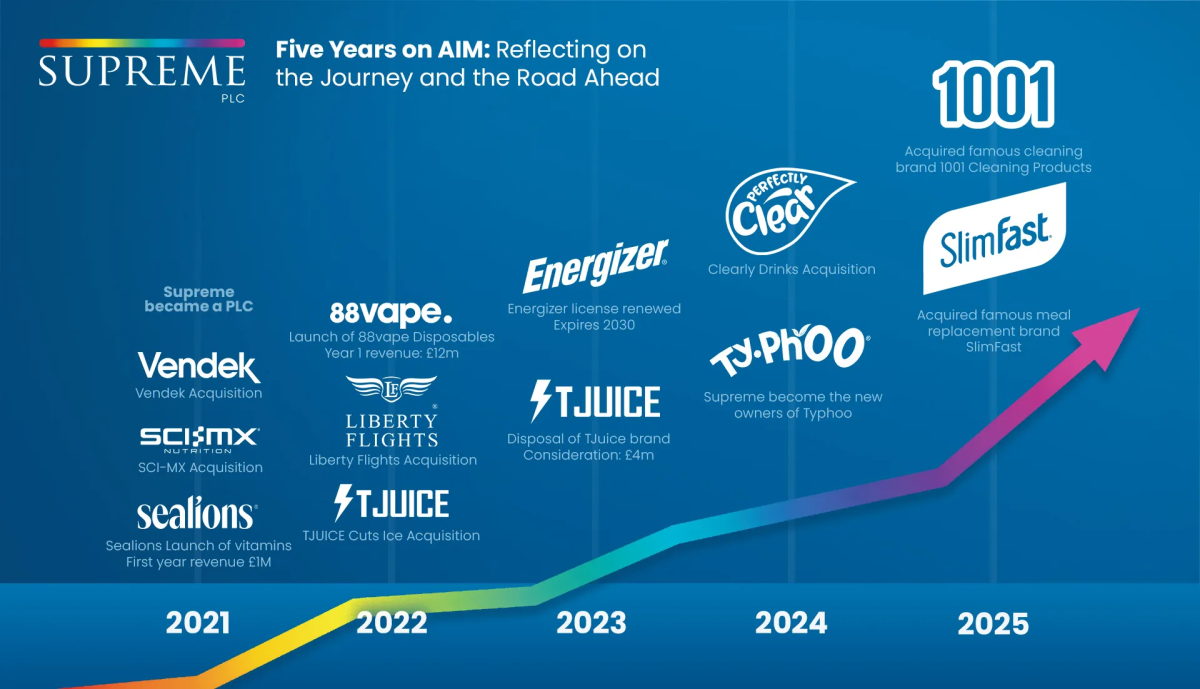
Supreme previously acquired Clearly Drinks, expanding its soft drinks and bottled beverages business. It later acquired traditional British tea brand Typhoo, moving further into mainstream beverages. In October 2025, Supreme announced the acquisition of SlimFast’s UK and European business from Glanbia for £20.1 million, further expanding its Drinks & Wellness category.
Reports showed that Supreme’s drinks and wellness portfolio grew 60% to £69.3 million, with SlimFast contributing after only five months within the group.
This diversification strategy is significant as vaping regulation continues to change. Vaping remains an important revenue source for Supreme, but growth in non-vape businesses helps offset risk from the disposable ban, VPD, tax stamps and possible future regulatory changes.
From an industry perspective, Supreme’s case shows that the UK vaping market has not simply contracted after the disposable ban. It is entering a phase of channel restructuring and compliance-led competition. Companies with product-switching capability, retail networks, financial strength and tax-compliance systems may gain an advantage in the new regulatory environment.
Industry Impact and Next Steps
Supreme’s results send three signals.
First, the UK disposable vape ban is reshaping the market rather than ending demand. Consumers and retailers are shifting toward pod systems, reusable devices and other compliant products.
Second, distributor compliance capability will become more important. VPD, tax stamps, packaging and warehousing requirements will raise operating thresholds and push the market toward companies with scale and systems.
Third, diversification may become an important strategy for vape-related companies facing UK regulatory risk. As vaping taxes and product rules continue to evolve, businesses dependent on a single category may face greater volatility.
Key issues to watch include how VPD affects UK vape prices, sales volumes and illicit trade, and whether Supreme can expand market share under higher compliance requirements as it expects.
Overall, Supreme’s full-year results show that the UK disposable vape ban did not stop its vaping revenue growth, but the competitive logic of the industry has changed. Product compliance, tax management, retail-channel control and business diversification are set to become important factors in the UK vaping market.
Follow 2Firsts for the latest updates on global tobacco harm reduction, nicotine products and regulatory developments.
Image source: Supreme PLC