The Warning Against Misleading Promotion of E-cigarettes to Adolescents

Jul.29.2024
The Warning Against Misleading Promotion of E-cigarettes to Adolescents
Indian experts warn against misleading promotion of e-cigarettes as a healthier alternative to tobacco, targeting teenagers strategically.

According to a report by newspatrolling on July 28, Indian health and child rights experts have issued a warning that e-cigarettes are increasingly being portrayed as a healthier alternative to traditional tobacco products. This misleading claim is believed to be a strategic move by the e-cigarette industry to target teenagers aged 10 to 19.


Priyank Kanoong, the Chairman of the National Commission for Protection of Child Rights (NCPCR) in India, has issued a warning that these products are being promoted by anti-national forces to trap our youths. He has urged all states to take immediate and strict measures to address this threat.


E-cigarettes are just as dangerous as tobacco and drugs in our country. Once children become addicted to these products, they are easily attracted to using other forms of tobacco.


These (e-cigarette) products are being used as a gateway to lifelong addiction, posing a threat to the health and future of our young people. State governments must implement strict measures to address this threat and protect our children from the harm caused by these harmful substances. We must steadfastly commit to ensuring the well-being of our nation's youth.


The 2019 "Ban on E-Cigarettes (Production, Manufacture, Import, Export, Transport, Sale, Distribution, Storage, and Advertising) Act" prohibits all e-cigarette products. The implementation of this law is due to India being the second largest market for tobacco, attracting many foreign companies seeking to enter the Indian e-cigarette market.


Dr. Naveen Thacker, distinguished chairman of the International Pediatric Association (IPA), has expressed concerns about the strategies of the tobacco industry.


The industry targets young people using social media and e-commerce platforms, using influencers and even experts to attract them. Their intentions towards young people are obvious, with flavors like bubblegum and candy, illegal sales of 600 enticing varieties. Misconceptions that they are safer than traditional tobacco must be dispelled.


Dr. Pragya Shukla, Head of the Clinical Oncology Department at the Delhi National Cancer Institute and a prominent public health expert, emphasized the importance of countering industry strategies that portray e-cigarettes as healthy products and market them to children.


All our health experts and international health organizations, including the World Health Organization, fully support India's ban on e-cigarettes.


Before implementing the ban, the Indian Council of Medical Research (ICMR) released a detailed report highlighting the negative impacts of e-cigarette use, pointing out that they may lead to cardiovascular and respiratory diseases.


We welcome news tips, article submissions, interview requests, or comments on this piece.

Please contact us at info@2firsts.com, or reach out to Alan Zhao, CEO of 2Firsts, on LinkedIn


Notice

1.  This article is intended solely for professional research purposes related to industry, technology, and policy. Any references to brands or products are made purely for objective description and do not constitute any form of endorsement, recommendation, or promotion by 2Firsts.

2.  The use of nicotine-containing products — including, but not limited to, cigarettes, e-cigarettes, nicotine pouchand heated tobacco products — carries significant health risks. Users are responsible for complying with all applicable laws and regulations in their respective jurisdictions.

3.  This article is not intended to serve as the basis for any investment decisions or financial advice. 2Firsts assumes no direct or indirect liability for any inaccuracies or errors in the content.

4.  Access to this article is strictly prohibited for individuals below the legal age in their jurisdiction.


Copyright


This article is either an original work created by 2Firsts or a reproduction from third-party sources with proper attribution. All copyrights and usage rights belong to 2Firsts or the original content provider. Unauthorized reproduction, distribution, or any other form of unauthorized use by any individual or organization is strictly prohibited. Violators will be held legally accountable.

For copyright-related inquiries, please contact: info@2firsts.com


AI Assistance Disclaimer


This article may have been enhanced using AI tools to improve translation and editorial efficiency. However, due to technical limitations, inaccuracies may occur. Readers are encouraged to refer to the cited sources for the most accurate information.

We welcome any corrections or feedback. Please contact us at: info@2firsts.com

Kumulus Vape2026 H1 Revenue Falls 8.3% but Profit Rises 24% as B2B Weakens and Consumer Channels Grow
French vaping company Kumulus Vape reported first-half 2026 revenue of €25.5 million, down 8.3% year over year, as its core B2B distribution business fell 11% to €21.6 million. B2C and store-network revenue rose 5.6% and 17.8%, respectively. Commercial margin increased to 26.3% from 21.7%, while net profit rose 24.1% to €0.8 million. The company attributed the profitability improvement to catalog optimization, logistics restructuring and the ramp-up of Labster, its in-house production unit for proprietary brands.
Market
Sep.17 by 2Firsts Perspectives
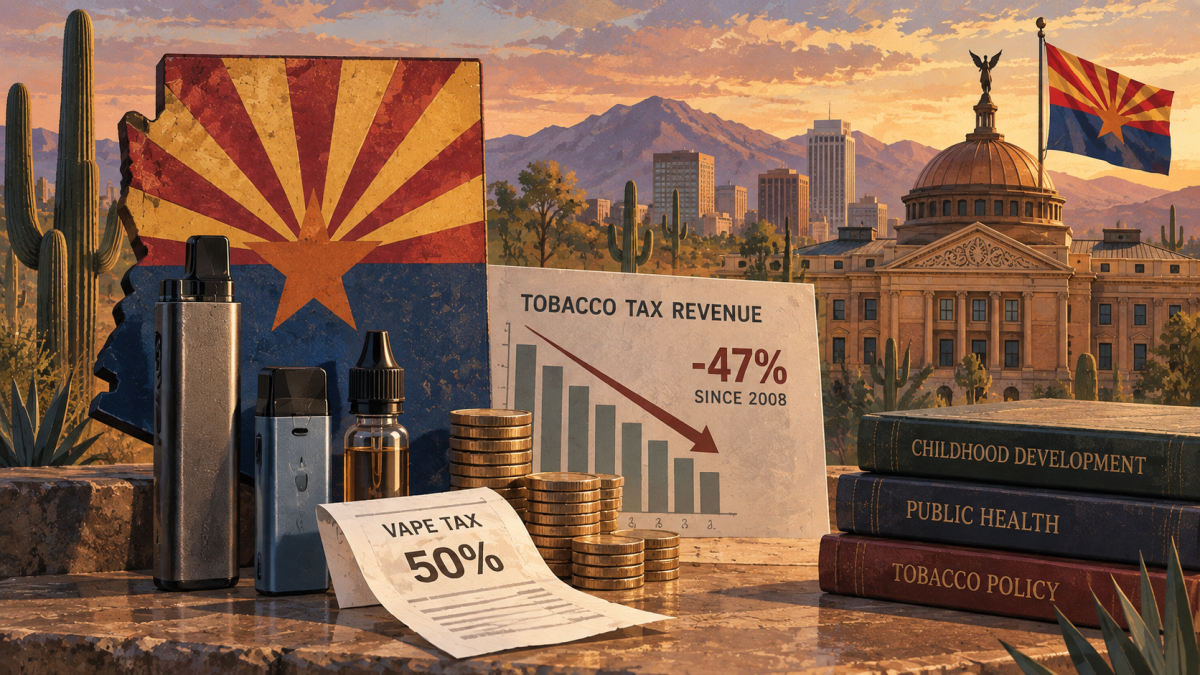
Arizona Turns to a 50% Retail Vape Tax as Tobacco Tax Revenue Falls 47% From 2008
Arizona's First Things First is pushing for an excise tax equal to 50% of the retail price of vaping products, estimating that the measure could generate about $100 million annually. The agency says its tobacco-tax revenue has fallen 47% from 2008 levels. Arizona has attempted to broaden its nicotine tax base in each of the past two years: a 2025 bill proposed a 50% wholesale-price tax, while a 2026 measure shifted to a 50% retail-price tax covering alternative nicotine products and vapor products. Separately, the state enacted HB 4001 this year to establish a new licensing and sales framework for alternative nicotine products.
Sep.21
Sweden Threatens EU Tobacco Tax Deal as Nicotine Pouch Duty Dispute Looms Over November 9 Meeting
Sweden is expected to oppose a European Union proposal to raise minimum tobacco excise duties, Law360 reported on October 26, 2026, citing an EU official. A provisional Council agenda dated October 23 confirms that the tobacco taxation package is scheduled for discussion at the November 9 finance ministers' meeting, where member states will seek a general approach. The proposed reforms would raise minimum taxes on conventional tobacco products and establish EU-wide excise rules for vaping liquids, heated tobacco and nicotine pouches. Sweden supports harmonising tobacco taxation rules but objects to requiring nicotine pouches to bear the same minimum tax burden as certain smoking tobacco products. As EU indirect tax legislation requires unanimous Council approval, Swedish opposition could block the proposal in its current form.
Regulations
Oct.29
South Korea Extends Vape Rules to Unmanned Stores After Bringing Synthetic Nicotine Under Tobacco Law
South Korea's Ministry of Gender Equality and Family said on September 14 that it plans to designate unmanned e-cigarette stores as businesses where minors are prohibited from entering or working. Operators would be required to verify customers' ages and display notices restricting access by minors. The proposal is open for public comment through October 6. The move follows an April expansion of South Korea's statutory tobacco definition that brought products made with natural or synthetic nicotine under the Tobacco Business Act. Nicotine-free liquids and products using nicotine analogues such as 6-methylnicotine, however, remain an emerging regulatory issue.
Sep.21
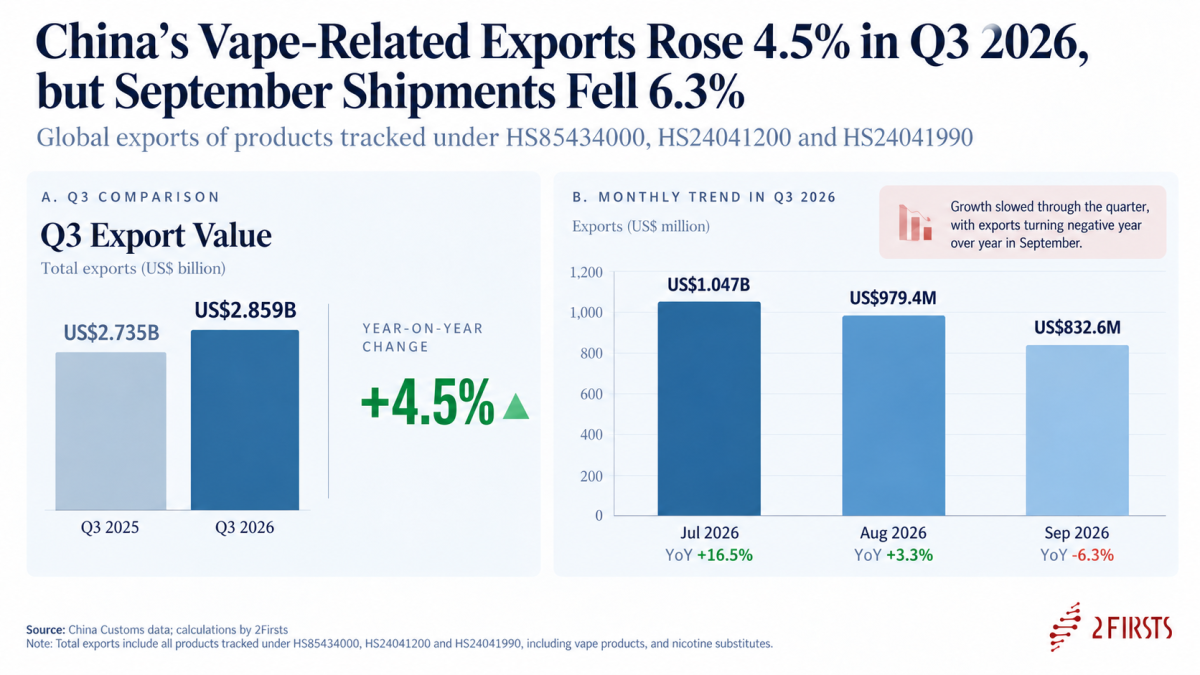
China’s Vape-Related Exports Rose 4.5% in Q3 2026 as 21.6% Growth in Shipments to the UK Offset a Decline in Shipments to the US
China's vape-related exports rose 4.5% year over year to $2.86 billion in the third quarter of 2026, led by stronger shipments to the United Kingdom as exports to the United States declined. UK-bound shipments increased 21.6%, adding $81.9 million, while US exports fell 5.2%, or $53.6 million. Growth weakened through the quarter, with September exports down 6.3% globally and 37.8% to the US. Nicotine-containing vape products accounted for more than 82% of the quarterly net increase, while device exports were nearly flat. Nine-month exports totaled $7.82 billion, up 4.0%.
DATA
Oct.26
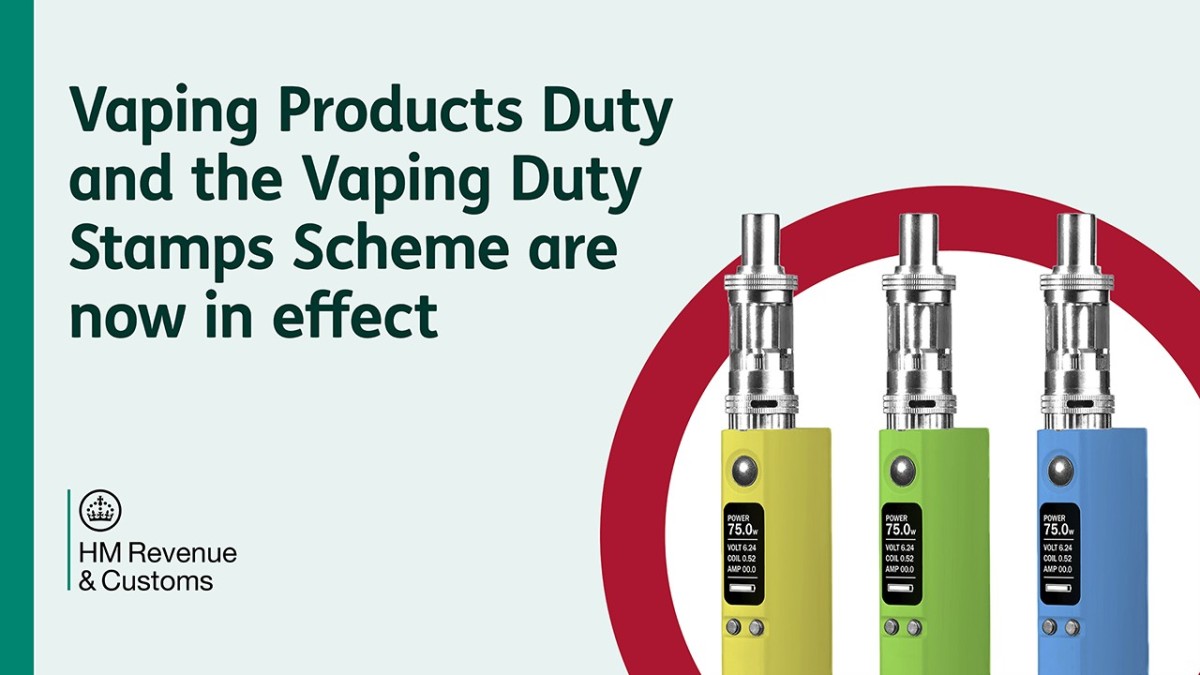
UK HMRC Launches Vape Duty Stamps on October 1, Ushering in Supply-Chain Traceability as Chinese Exporters Face New Compliance Hurdles
HM Revenue & Customs put the UK's Vaping Products Duty and Vaping Duty Stamps Scheme into effect on October 1. All vaping liquids manufactured in or imported into the UK are now subject to duty at £2.20 per 10ml, regardless of nicotine content. The stamp regime will introduce digital functionality designed to provide traceability throughout the supply chain, with approved manufacturers, importers and warehousekeepers required to report product movements and retailers and consumers eventually able to scan stamps to verify authenticity. China exported $177 million of vape-related products to the UK in August, up 51.4% year over year, increasing the significance of the new compliance regime for China's Shenzhen-centered vape supply chain.
Regulations
Oct.04