Key Points
- Nicotine pouches lead growth;
- Cigarette volume fell 4%;
- Vape sales declined 5.8%;
- Chewing tobacco fell 13.3%;
- Retailers expand pouch space.
2Firsts
June 12, 2026
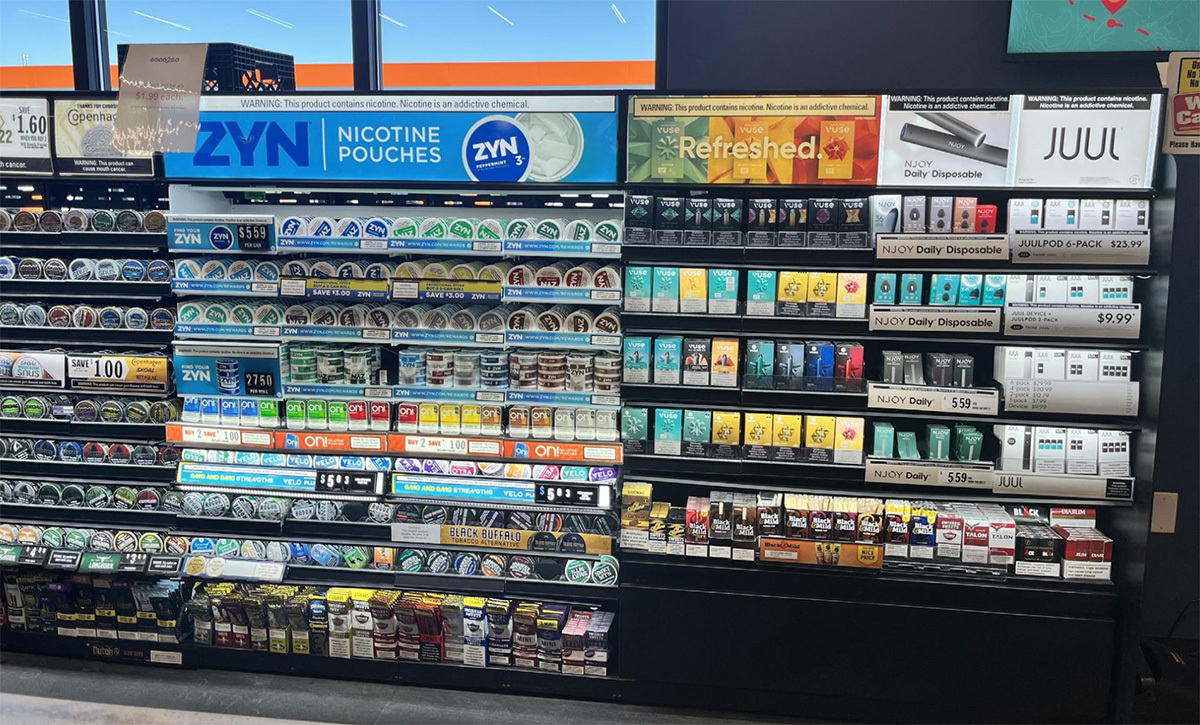
U.S. convenience-store operators are increasingly reconfiguring backbar layouts, reducing space allocated to traditional cigarettes while expanding displays for nicotine pouches and other modern nicotine alternatives.
According to reports by CSP Daily and CStore Decisions, retailers say consumers are gradually shifting away from combustible cigarettes toward alternative nicotine products, prompting significant changes in category management strategies.
Casey’s Chief Financial Officer Stephen Bramlage said during the company’s latest earnings call that nicotine and nicotine-alternative products have become important contributors to margin growth.
Casey’s reported a 5.1% increase in same-store grocery and general merchandise sales during fiscal fourth-quarter 2026, while average margins rose to 35.7%, an increase of 90 basis points from the previous year.
Bramlage said margin expansion was driven by cost management and product-mix improvements, with nicotine alternatives playing a significant role.
“Nicotine is probably the single biggest contributor,” he said. “As combustible cigarettes continue to decline as a portion of the mix and are replaced by nicotine alternatives, that is a very accretive margin switch.”
He added that Casey’s early decision to allocate more shelf space to nicotine alternatives and reduce cigarette space has created a structural advantage.
Meanwhile, Fort Worth-based convenience-store operator Yesway identified nicotine as one of its three strongest-performing categories during the first quarter of 2026, alongside packaged beverages and snacks.
Chief Financial Officer Ericka Ayles said vendor-supported promotions helped consumers trade up from lower-tier cigarette products.
Industry-wide data indicate that structural changes are taking place across the tobacco category.
According to Circana, U.S. convenience-store cigarette sales increased 1.6% year over year to US$11.1 billion during the 12 weeks ending March 22, 2026.
However, cigarette unit sales declined 4% during the same period, while average prices rose 5.9%, indicating that revenue growth was driven primarily by price increases.
Tina Badger, category manager at CrossAmerica Partners, said cigarettes remain the largest tobacco category from a revenue perspective but are becoming increasingly segmented.
She noted that price-sensitive consumers are moving toward fourth-tier value brands while premium brands continue to retain loyal customers.
The cigar category showed a similar pattern.
Dollar sales increased 1.7%, while unit sales fell 4.1% and average prices rose 6%.
Vaping products, meanwhile, continued to face headwinds.
Circana data show that vape sales declined 5.8% and unit sales fell 14% during the 12-week period ending March 22.
Badger said the category has stabilized following years of disruption, with growth now driven by compliant product assortments rather than rapid SKU expansion.
She added that products with regulatory authorization are delivering more consistent performance.
Kalen Frese, director of merchandising and warehouse for Warrenton Oil Co., said FDA enforcement has slowed growth in the disposable vape segment.
However, he noted that the FDA’s authorization of four flavored Glas vape pods in May indicates that the regulatory environment remains dynamic.
Among all tobacco and nicotine categories, nicotine pouches continue to demonstrate the strongest growth momentum.
Frese described the category as continuing to “grow and be on fire.”
He said promotional programs offered by major tobacco companies have helped accelerate sales growth.
CrossAmerica has observed a similar trend.
Badger said strong trial rates, repeat purchases and migration from cigarettes and traditional smokeless tobacco products are fueling category expansion.
She noted that nicotine pouches appeal to adult consumers because of their discreet, smoke-free format and expanding range of flavors and nicotine strengths.
Traditional smokeless tobacco, by contrast, remains under pressure.
Badger said an aging consumer base and shrinking usage occasions are limiting growth.
Circana reported that chewing tobacco sales declined 13.3% during the three months ending March 22, with a 15% decline recorded during the final month of that period alone.
Industry participants are also seeing increasing levels of multi-product nicotine use.
Badger said factors such as pricing, usage occasions and regulatory access are becoming more important than brand loyalty in shaping consumer choices.
She believes these shifts are reshaping assortment planning, merchandising strategies and space allocation decisions at the backbar.
As cigarette volumes continue to decline, nicotine pouches expand rapidly and vaping enters a more mature phase, U.S. convenience-store tobacco displays are undergoing one of their most significant structural transformations in recent years.
Cover image:CStore Decisions
Disclaimer
This article is provided solely for professional research, industry discussion, and informational purposes. Any references to brands, companies, products, technologies, or policies are made for factual reporting and analytical purposes only, and do not constitute endorsement, recommendation, promotion, or advertising by 2Firsts.
Nicotine-containing products, including but not limited to cigarettes, e-cigarettes, heated tobacco products, and nicotine pouches, carry significant health risks. Readers are responsible for complying with all applicable laws and regulations in their respective jurisdictions, including age restrictions and access limitations.
The information contained in this article should not be regarded as investment, legal, medical, regulatory, or commercial advice. While 2Firsts strives to ensure the accuracy and reliability of its content, it does not assume liability for any direct or indirect loss arising from errors, omissions, inaccuracies, or reliance on the information contained herein.
This article is not intended for individuals below the legal age for accessing tobacco or nicotine-related information in their jurisdiction.
Copyright Notice
This article is either original content produced by 2Firsts or content reproduced, translated, summarized, or adapted from third-party sources with attribution where applicable. The intellectual property rights of the original content remain with 2Firsts or the respective original rights holders.
No individual or organization may copy, reproduce, distribute, republish, modify, translate, or otherwise use this content without prior authorization. Any unauthorized use may result in legal action.
For copyright-related inquiries, corrections, or removal requests, please contact: info@2firsts.com.
AI-Assisted Translation and Editing Notice
Portions of this article may have been translated, edited, or reviewed with the assistance of artificial intelligence tools to improve efficiency and readability. Due to the limitations of AI-assisted translation and editing, discrepancies, omissions, or inaccuracies may exist when compared with the original source.
Where applicable, readers are advised to refer to the original source for the most complete and accurate information. If you identify any errors or believe that any content infringes upon your rights, please contact us at info@2firsts.com, and we will review and address the matter promptly.