Key Points
- The Fifth Circuit vacated FDA’s MDO covering NicQuid’s vape PMTA.
- The court held that FDA’s comparative-efficacy standard had become a substantive rule and therefore required APA notice-and-comment procedures.
- The court pointed to FDA’s use of the framework across more than one million MDOs involving non-tobacco-flavored ENDS as evidence of its binding and generally applicable nature.
- The decision does not hold that comparative-efficacy analysis itself is arbitrary or unlawful, nor does it prevent FDA from weighing youth risks against adult switching benefits.
- FDA may reconsider the framework, adopt it through notice-and-comment rulemaking, or undertake other proceedings consistent with the court’s opinion.
- The ruling differs sharply from the Ninth Circuit’s recent conclusion in MH Global LLC v. FDA that FDA could apply its comparative-efficacy framework through adjudication without first conducting notice-and-comment rulemaking.
2Firsts
August 28, 2026
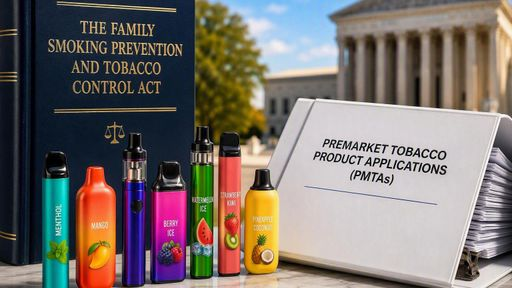
According to VitalLaw on August 27, 2026, the U.S. Court of Appeals for the Fifth Circuit ruled that the Food and Drug Administration’s comparative-efficacy standard for reviewing electronic cigarette premarket tobacco product applications (PMTAs) constituted a substantive rule that should have gone through notice-and-comment rulemaking under the Administrative Procedure Act (APA). The court vacated FDA’s marketing denial order (MDO) against NicQuid LLC and remanded the matter to the agency.
The case, NicQuid, L.L.C. v. FDA, No. 25-60369, was brought by ENDS manufacturer NicQuid and vapor-product retailer Wood Creek Vapory challenging FDA’s denial of NicQuid’s PMTA.
Case Focuses on Procedure, Not FDA’s Authority to Assess Vape Risks
Under the Tobacco Control Act (TCA), new tobacco products cannot be legally marketed without FDA authorization. Applicants must demonstrate that marketing a product would be “appropriate for the protection of the public health” (APPH).
FDA denied NicQuid’s PMTA in 2024 under its comparative-efficacy framework.
The agency determined that NicQuid had not provided sufficient evidence showing that potential cessation or complete-switching benefits for adults outweighed the risks to youth.
FDA specifically cited the absence of randomized controlled trials, longitudinal cohort studies or other comparably robust evidence of adult switching behavior.
Although NicQuid submitted cross-sectional surveys, FDA found that they were not specific to the company’s products and did not evaluate outcomes by flavor type in a way that allowed comparisons between tobacco and other flavors.
The Fifth Circuit did not rule that such comparative public health analysis was itself unlawful.
Instead, the central question was whether FDA could turn that analysis into a generally binding requirement without first using formal rulemaking procedures.
Fifth Circuit Finds Framework Had Become a Substantive Rule
The Fifth Circuit concluded that FDA’s comparative-efficacy framework had moved beyond product-specific adjudication.
The court focused on several factors.
First, the framework affected a broad class of market participants.
The opinion noted that FDA had issued MDOs covering more than one million non-tobacco-flavored ENDS applications, while the agency had received applications covering more than six million ENDS products overall.
FDA, by contrast, had authorized only 45 ENDS products of any kind.
The court said the scale of the framework’s use, and its direct impact on applicants’ commercial and property interests, supported treating it as a substantive rule.
Second, the court found that the comparative-efficacy requirement appeared binding on FDA staff.
Internal agency memoranda showed the framework being applied as a consistent requirement across large numbers of flavored ENDS reviews, according to the opinion.
Third, the Fifth Circuit found that the policy had been developed prospectively through internal memoranda rather than emerging incrementally from the facts of individual adjudications.
The court said the nominal use of adjudication could not shield what was effectively the development of a prospective regulatory policy.
Court Says FDA Cannot Use Informal Adjudications to Create Binding Rule
FDA argued that agencies generally have discretion to develop policy through either rulemaking or adjudication.
The Fifth Circuit acknowledged that principle but said it did not allow an agency to use informal adjudication to establish a rigid, across-the-board requirement with the force and effect of law.
The court characterized FDA’s comparative-efficacy framework as having become a “hard and fast” requirement rather than a flexible standard developing through case-specific decisions.
When an agency intends to impose a broadly binding legal requirement, the court said, it must generally use notice-and-comment rulemaking or another legally sufficient process rather than a series of informal product-specific decisions.
NicQuid MDO Vacated, but Comparative-Efficacy Analysis Not Eliminated
The Fifth Circuit vacated NicQuid’s MDO and remanded the case to FDA.
The ruling does not prevent FDA from using comparative analysis in future PMTA reviews.
The court said FDA could reconsider the policy, re-adopt it through APA-compliant notice-and-comment rulemaking, or undertake other appropriate proceedings consistent with the opinion.
The court also declined to reach whether FDA acted arbitrarily and capriciously when applying the framework specifically to NicQuid’s menthol, tobacco-flavored or zero-nicotine products.
The immediate significance of the ruling therefore concerns how FDA establishes and implements PMTA review standards, rather than a wholesale rejection of the agency’s substantive assessment of flavored ENDS.
Fifth and Ninth Circuits Take Different Approaches
The ruling also creates a notable contrast with the Ninth Circuit’s recent decision involving the same FDA framework.
In MH Global LLC v. FDA, the Ninth Circuit upheld FDA’s denial of flavored ENDS applications and concluded that the agency did not need to adopt its comparative-efficacy framework through notice-and-comment rulemaking before applying it in PMTA adjudications.
The Fifth Circuit has now reached a different procedural conclusion.
It held that once the framework was applied uniformly across more than one million MDOs and effectively bound FDA reviewers, it became a substantive rule subject to APA rulemaking requirements.
The two decisions therefore leave an important regulatory question unresolved across federal appellate jurisdictions:
Can FDA establish and broadly enforce its comparative-efficacy requirement through individual PMTA adjudications, or must the agency first adopt the standard through formal notice-and-comment rulemaking?
For vape manufacturers pursuing U.S. market authorization, the disagreement adds another layer of uncertainty around the evidentiary framework FDA may use for flavored ENDS applications.
The decision, however, does not eliminate the PMTA requirement or remove applicants’ obligation to provide scientific evidence capable of supporting an APPH determination.
About NicQuid
Founded in 2012 and headquartered in Ohio, NicQuid LLC is an independent U.S. e-liquid manufacturer that produces nicotine salt and other e-liquid products for open-system electronic nicotine delivery systems (ENDS). The company has participated in U.S. vape regulatory discussions for years and has submitted comments and related petitions concerning FDA tobacco regulation.
Follow 2Firsts for timely updates on U.S. FDA tobacco regulation, PMTA litigation and global vape compliance developments.
Cover Image: VitalLawSources
Disclaimer
This article is provided solely for professional research, industry discussion, and informational purposes. Any references to brands, companies, products, technologies, or policies are made for factual reporting and analytical purposes only, and do not constitute endorsement, recommendation, promotion, or advertising by 2Firsts.
Nicotine-containing products, including but not limited to cigarettes, e-cigarettes, heated tobacco products, and nicotine pouches, carry significant health risks. Readers are responsible for complying with all applicable laws and regulations in their respective jurisdictions, including age restrictions and access limitations.
The information contained in this article should not be regarded as investment, legal, medical, regulatory, or commercial advice. While 2Firsts strives to ensure the accuracy and reliability of its content, it does not assume liability for any direct or indirect loss arising from errors, omissions, inaccuracies, or reliance on the information contained herein.
This article is not intended for individuals below the legal age for accessing tobacco or nicotine-related information in their jurisdiction.
Copyright Notice
This article is either original content produced by 2Firsts or content reproduced, translated, summarized, or adapted from third-party sources with attribution where applicable. The intellectual property rights of the original content remain with 2Firsts or the respective original rights holders.
No individual or organization may copy, reproduce, distribute, republish, modify, translate, or otherwise use this content without prior authorization. Any unauthorized use may result in legal action.
For copyright-related inquiries, corrections, or removal requests, please contact: info@2firsts.com.
AI-Assisted Translation and Editing Notice
Portions of this article may have been translated, edited, or reviewed with the assistance of artificial intelligence tools to improve efficiency and readability. Due to the limitations of AI-assisted translation and editing, discrepancies, omissions, or inaccuracies may exist when compared with the original source.
Where applicable, readers are advised to refer to the original source for the most complete and accurate information. If you identify any errors or believe that any content infringes upon your rights, please contact us at info@2firsts.com, and we will review and address the matter promptly.