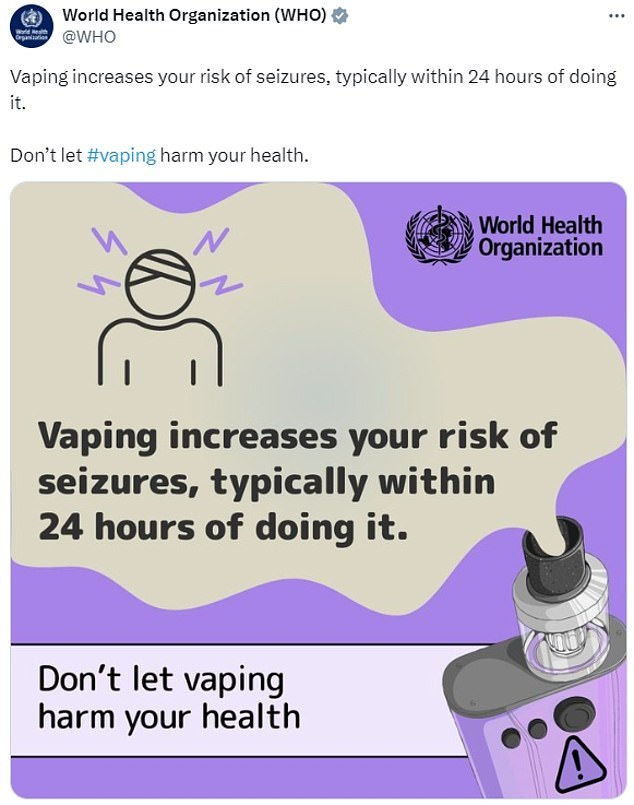
According to a report by the Daily Mail, the World Health Organization recently made a statement on the social platform "X", claiming that e-cigarettes can cause seizures within a few hours, which has sparked criticism from various parties. The global health organization's statement on "X" was fact-checked by internet users, and the social platform later released a community statement.
The announcement stated: "The basis of this post is research that has not been peer-reviewed and the evidence is uncertain. The basis of this statement is approximately 120 uncertain events that have occurred since 2019."
Dr. Charles Gardner, a developmental neurobiologist in Brooklyn, tweeted, "Please provide peer-reviewed evidence to support the claim that e-cigarettes 'typically' trigger seizures within 24 hours. If you cannot do this, please delete your tweet. Note: I have reviewed the literature and have not found any studies showing that e-cigarettes increase the risk of seizures.
In addition, some users have referred to the World Health Organization as clowns and liars, claiming that they are spreading propaganda. Steve Rolles, senior policy analyst at the Transform Drug Policy Foundation, also said, "I am convinced this is nonsense. Why is the World Health Organization's stance on e-cigarettes so peculiarly out of line?"
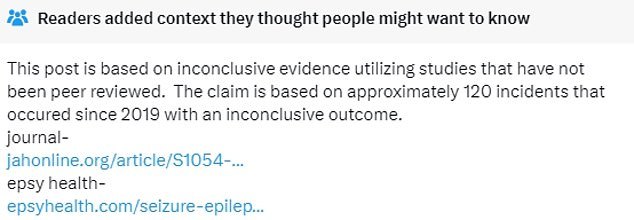
In a community announcement on "X," a link to an editorial on e-cigarettes and epilepsy was included. The editorial, published in the Journal of Adolescent Health, discusses a 2019 study analyzing 122 cases of seizure and other neurological symptoms in individuals who reported using e-cigarettes in the past 24 hours. Due to its potential to trigger seizures, researchers suggest that participants may be at risk for nicotine-induced epilepsy and symptoms.
However, the editorial pointed out that the details of the study "raise questions about causality, which must be considered when assessing the actual health risks of nicotine e-cigarettes for adolescents." It also noted, "A major question is why inhaling nicotine from e-cigarettes can trigger seizures, while inhaling nicotine from traditional tobacco does not.
The authors point out that a person would need to inhale a large dose of nicotine to trigger a seizure, but e-cigarette devices contain much lower levels of nicotine compared to traditional cigarettes. Additionally, the toxic effects of high doses of nicotine are expected to appear within minutes of inhalation and dissipate within a few hours. The authors state, "Seizures do not seem likely to occur if there are no other systemic toxic effects present.
In the United States, the use of e-cigarettes has reached record levels, with over 17 million adults and 2 million children addicted to these devices. An editorial pointed out a flaw in a 2019 study, stating that the analysis of reported seizures was based on self-reporting and not always clear. Descriptions varied, with some individuals reporting severe seizures while others detailed tremors or seizure-like activity. In most cases, these events were not evaluated by medical professionals. The editorial's author noted that nicotine could potentially cause anxiety attacks and unconscious muscle contractions, leading some individuals to misinterpret these symptoms as seizures, even though they are not.
Despite traditional cigarette smoking rates decreasing each year, the number of people using e-cigarettes is continuously increasing, especially among middle and high school students. An analysis from the Centers for Disease Control and Prevention (CDC) in 2023 found that 2.1 million children, or nearly 8% of the student population, are using these devices, with 47% of children who have tried e-cigarettes still currently using them.
E-cigarettes typically come in attractive flavors such as cotton candy and caramel custard, and their packaging designs appeal to younger users. Data shows that approximately 90% of young people report having used products with fruit or candy flavors.
We welcome news tips, article submissions, interview requests, or comments on this piece.
Please contact us at info@2firsts.com, or reach out to Alan Zhao, CEO of 2Firsts, on LinkedIn
Notice
1. This article is intended solely for professional research purposes related to industry, technology, and policy. Any references to brands or products are made purely for objective description and do not constitute any form of endorsement, recommendation, or promotion by 2Firsts.
2. The use of nicotine-containing products — including, but not limited to, cigarettes, e-cigarettes, nicotine pouchand heated tobacco products — carries significant health risks. Users are responsible for complying with all applicable laws and regulations in their respective jurisdictions.
3. This article is not intended to serve as the basis for any investment decisions or financial advice. 2Firsts assumes no direct or indirect liability for any inaccuracies or errors in the content.
4. Access to this article is strictly prohibited for individuals below the legal age in their jurisdiction.
Copyright
This article is either an original work created by 2Firsts or a reproduction from third-party sources with proper attribution. All copyrights and usage rights belong to 2Firsts or the original content provider. Unauthorized reproduction, distribution, or any other form of unauthorized use by any individual or organization is strictly prohibited. Violators will be held legally accountable.
For copyright-related inquiries, please contact: info@2firsts.com
AI Assistance Disclaimer
This article may have been enhanced using AI tools to improve translation and editorial efficiency. However, due to technical limitations, inaccuracies may occur. Readers are encouraged to refer to the cited sources for the most accurate information.
We welcome any corrections or feedback. Please contact us at: info@2firsts.com